NEW YORK (AP) — Scientists at the Centers for Disease Control and Prevention are turning to outside medical journals to publish urgent information, as personnel losses have slowed its own information sharing, the agency’s director said Tuesday.
The CDC has historically used health alerts and a publication called Morbidity and Mortality Weekly Report to quickly share information on pressing public health issues. But the director of the CDC Dr. Erica Schwartz told The Associated Press that the slow review process is why a warning about measles in newborns was published in a medical journal.
“We wanted to make sure that this information would be released very quickly. So we asked them to take it to an external journal so they could release this information quickly rather than going through” an internal CDC process for releasing information, Schwartz said.
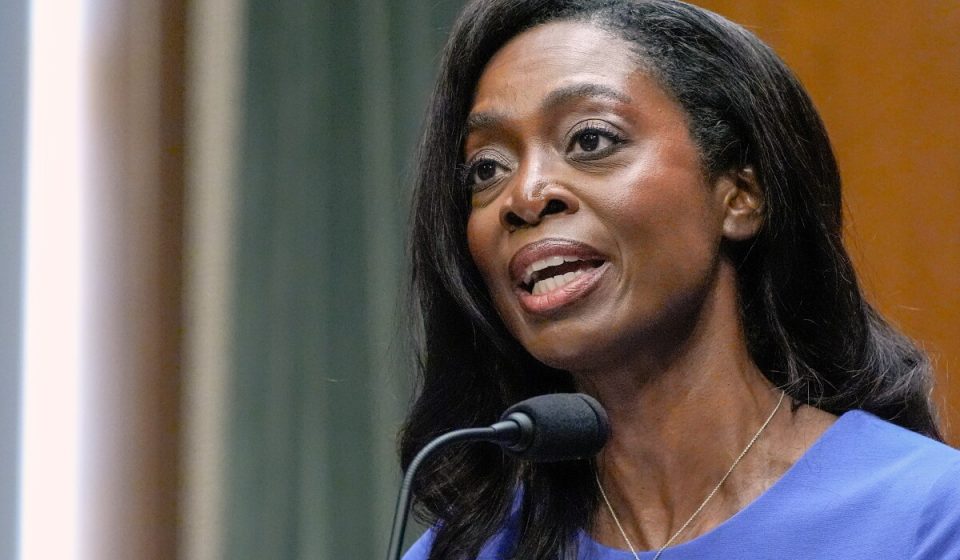
Schwartz spoke to the AP on Tuesday about the challenges she faced during her first three months leading the CDC and the criticism she faced inside and outside the agency.
Three months after his mandateshe is under investigation by House Democrats, faces calls to resign and draws anger from inside and outside the agency. And employees told the AP that staff morale remains low.
Here are some of the highlights of the interview:
Why the warning about measles in newborns was delayed
Public health officials were furious when reports emerged that — amid the worst measles outbreak in the United States in more than three decades — the CDC was slow to provide guidance to doctors on how to recognize and treat measles in unvaccinated women of childbearing age.
In September, CDC scientists submitted a proposed health alert to Schwartz’s office. They said CDC administrators did not respond for more than a month. The delay was first reported by the Washington Post. The AP confirmed this with a CDC scientist with direct knowledge of the situation who fears retaliation for publicly revealing what happened and spoke to the AP on condition of anonymity.
“The idea that CDC scientists (were) not able to give advice to American doctors? I mean, like steam coming out of my ears,” said Dr. Tom Frieden, who was CDC director during the Obama administration.
HHS officials had attributed the delay to the CDC’s scientific review and authorization process. Schwartz suggested Tuesday that it was quicker for CDC scientists to submit papers to external publications and go through their peer review processes, rather than letting the CDC publish them directly.
Since President Donald Trump took office early last year, the CDC has lost about 30% of its staff, largely through layoffs, retirements and resignations.
“We’re operating in a situation where we don’t have the same resources we had before I got here,” she said. The office that authorizes direct releases “doesn’t have the number of staff that it used to have,” she said.
The CDC scientist noted that other health alerts have been issued relatively quickly this year, such as the one regarding hantavirus.
Schwartz says change in reporting measles deaths was example of ‘radical transparency’
At Schwartz’s nomination hearing in July, she pledged to use “radical transparency” to restore public trust in the agency.
But the CDC has repeatedly been criticized for its lack of transparency.
These criticisms centered on a decision made in late August, shortly after Schwartz started, regarding the reporting of deaths associated with measles. Usually, the CDC shares state-reported deaths on its website. But after initially posting two deaths in Pennsylvania, the CDC removed them and said it was investigating further.
The action looked like interference by Health Secretary Robert F. Kennedy Jr., who initially said the deaths in Pennsylvania may have been ” fully manufactured.” Kennedy also questioned the number reported of COVID-19 deaths in the United States.
Schwartz told the AP that Kennedy played no role in the decision to remove Pennsylvania deaths from the CDC count.
She said “the CDC has not done a great job during COVID of defining what a COVID-19 death is” and wanted a uniform, nationwide definition of what should be considered a measles death. Because this system is still being developed, the agency is currently reviewing death certificates before updating its count.
Others see the move not as a sign of radical transparency, but rather as something else.
“As the (measles) crisis worsens, we are concerned that you will continue to direct your efforts toward the CDC to downplay the outbreak and artificially reduce the number of measles deaths that the CDC publicizes,” said three Democrats on the U.S. House of Representatives Committee on Energy and Commerce. recent letter to Schwartz.
Schwartz works on multiple goals, but doesn’t use his bully pulpit on vaccinations
Schwartz told the AP she came to the job with three priorities: restoring trust in the CDC, modernizing the agency and strengthening the CDC’s relationships with state and territorial partners.
She said she made a number of trips to meet with state leaders and tribal agencies and pushed for the development of an early warning system. Radar program against biothreats which she calls “the future of the CDC.”
What she hasn’t done, she acknowledged, is be a highly visible and vocal advocate for vaccines.
The measles epidemic particularly affected Simple Communities “conservative Amish and Mennonites – so named for their modest dress and limited use of technology. Vaccination rates vary widely, but overall they are less likely to be vaccinated than the general population.
Members of these close-knit religious communities “made decisions about their vaccination status 10, 20, 30, 40 years ago. So our approach is not to get on the bully pulpit and say, ‘Truly, you will get vaccinated,'” she said.
The CDC supports efforts to find trusted messengers to work on the ground in affected communities, rather than having a CDC official appear “on a weekend TV show when these people aren’t even watching that TV show,” she said.
Okay, but why not promote vaccination for flu, COVID-19, and other vaccines, as previous CDC directors have done?
She argues that she is constrained by a lawsuit filed by the American Academy of Pediatrics, the Infectious Diseases Society of America and other organizations.
Schwartz says that while the case is pending, “I’m kind of limited in what I can and what I can’t say.”
___
The Associated Press Health and Science Department receives support from the Howard Hughes Medical Institute’s Department of Science Education and the Robert Wood Johnson Foundation. The AP is solely responsible for all content.
Gn Health