
Tales of Eternia Remastered is only my second foray into the luminous Tales series. Originally released for PlayStation in Japan as Tales of Eternia and in North America as Tales of Destiny II, Tales of Eternia later received a limited PSP release, localized only in Europe, on which the remaster is based. Although my modest general knowledge of both Tales series and Tales of Eternia prevents me from being able to say whether this remastered port is worth a replay for those who have already been on the journey, I can certainly say that I thoroughly enjoyed my time with it.
I can also call safely Tales of Eternia Remastered the definitive version for newcomers, provided a few outdated game mechanics don’t bother them along the way.
Tales of Eternia Remastered begins when a mysterious girl speaking an unknown language literally falls from the sky in a strange metal contraption, stunning the two teenagers who witnessed the accident, villagers Reid and Farah. It doesn’t take long for the helpful Farah to recruit the more hesitant Reid to travel with her in hopes of better understanding the enigmatic girl called Meredy and learning why she’s there in the first place. Along with their academically-minded childhood friend Keele, the group travels through their world, uncovering revelations that ultimately lead them to help Meredy on a quest where the fate of two very different worlds hangs in the balance.
To say much more about Tales of Eternia RemasteredThe story would do a disservice, as plot developments and revelations unfold in surprising and memorable ways as the game progresses. However, at times I wished the game had explored certain narrative elements more, as they felt rushed at times. Still, it all comes together quite satisfactorily in the end. The found family dynamic between Reid, Farah, Meredy, and Keele is the heart and soul of the narrative, keeping players invested throughout. I even like the touches of romance that blossom throughout the story.
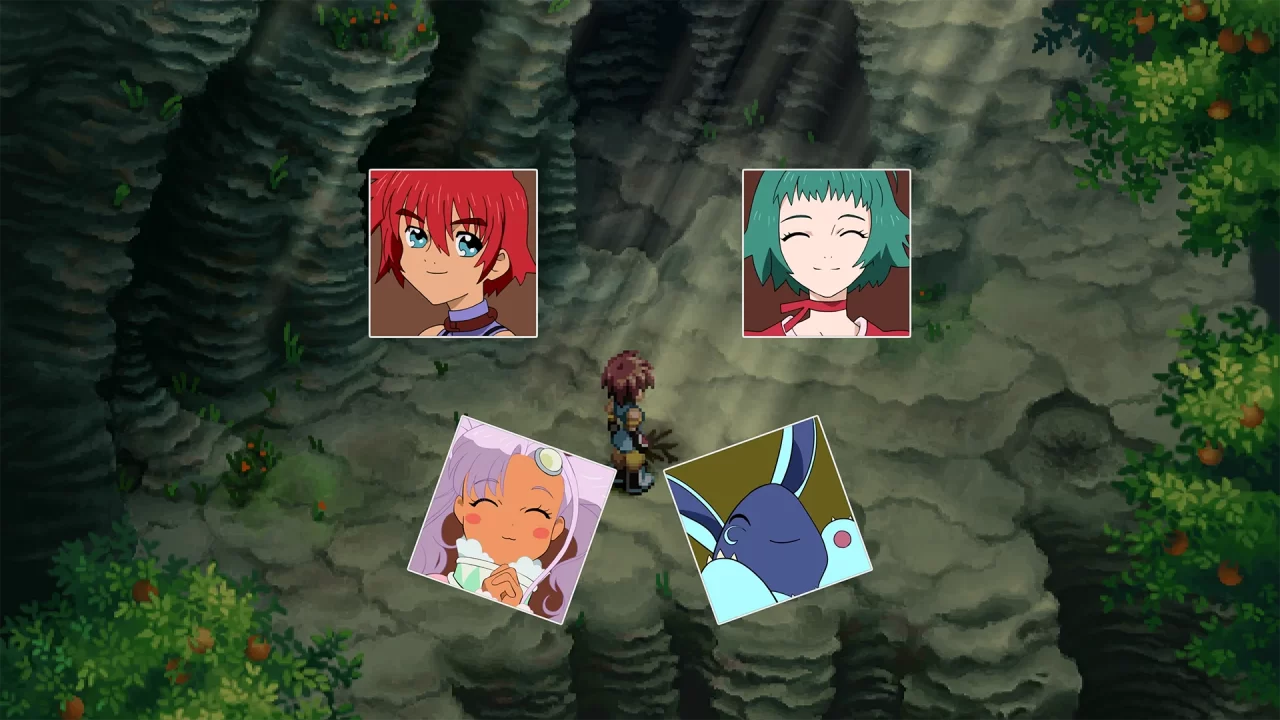
Our four heroes have great character arcs and believable emotional moments that are a joy to watch. I sometimes wish other characters in the cast would get the same treatment, as there are certainly some memorable and potential-laden characters throughout the game, some of whom can even join your party as an option at times. Unfortunately, they just haven’t gotten as much attention as the main members of our party, although they are likeable and interesting in their own right. But it’s a testament to the quality of the game’s writing, especially for the four main protagonists, that you become deeply invested in their journey.
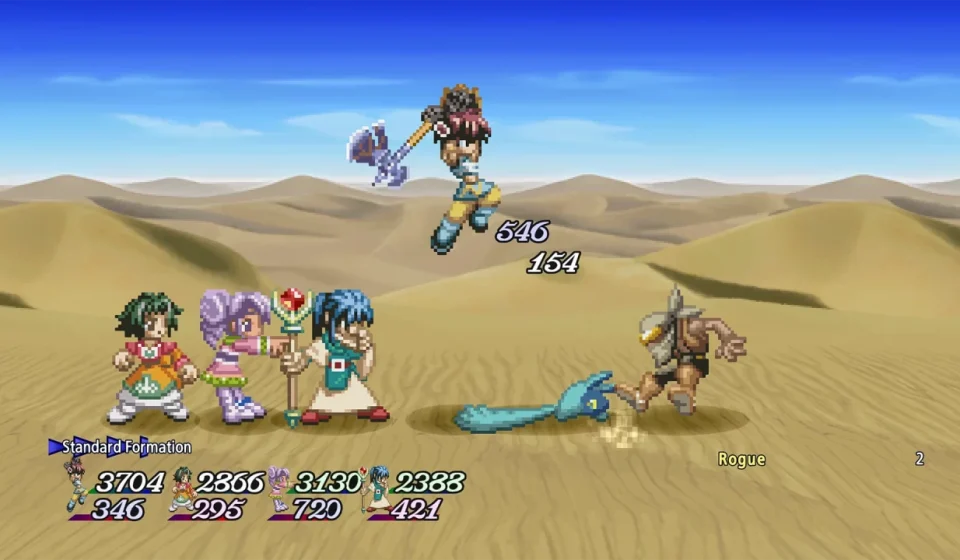
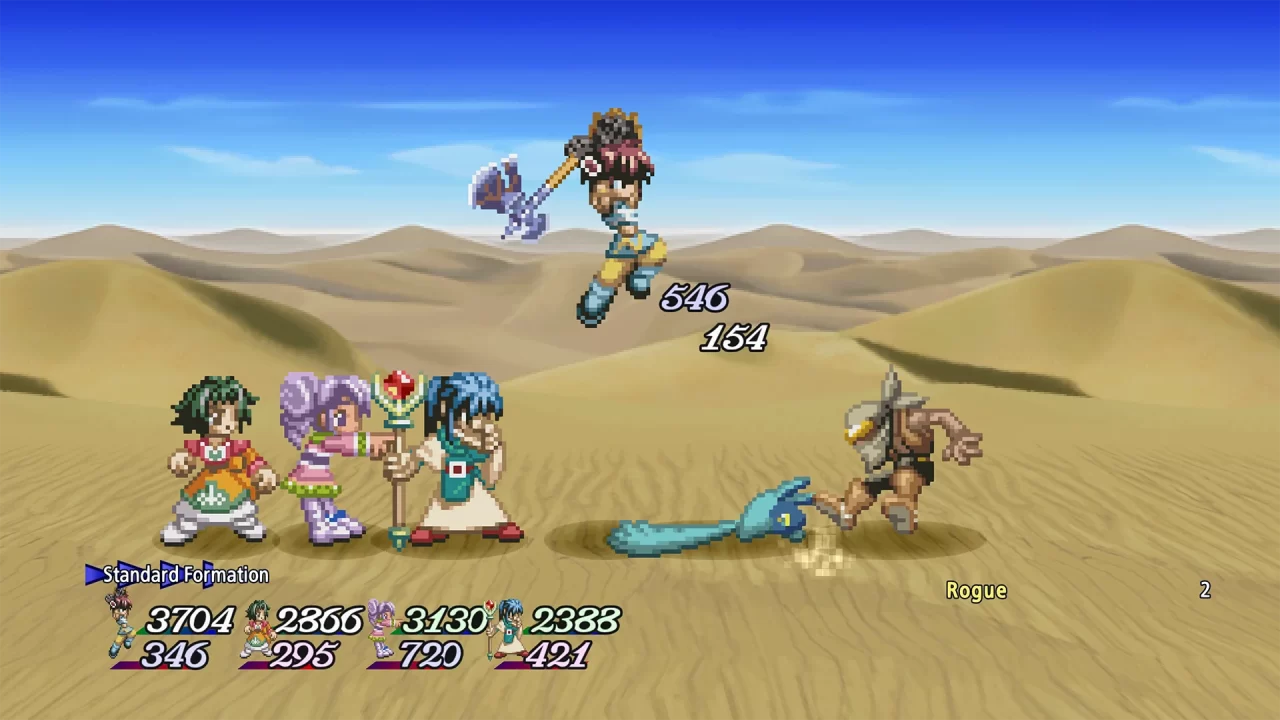
Of course, story and characters are just two key elements of an RPG. Gameplay is just as important, and Tales of Eternia Remastered often stands as the pinnacle of PS1-era game design, even if outdated mechanics sometimes hold it back. It is undoubtedly its combat system that stands out the most, with a much more action-oriented core. You can also choose between Auto, Semi-auto or Manual modes with the press of a button. I like my combat systems to be more intuitive and interactive, so I admit I’ve never really dabbled in Auto myself. However, I imagine it speeds up some random encounters.
Semi-auto was more my thing because I didn’t have to worry as much about positioning, as the character I was controlling would cross the screen and return at the start of a regular attack. You equip first then learn the button shortcuts for skills before a fight from a vast and ever-expanding collection. After that, you simply launch a regular attack, then enter the button combo for the skill you want to play in an on-screen 2D combat combo.
You can decide the usual behavior and tactics of your party members based on your attack style or a current fight, and you can even open a menu of items when needed for healing and more. Manual forgoes auto positioning, so it’s a bit more hands-on, which can be useful in some fights. I also switched to it on occasion when I needed more precise use of my skills, especially during an optional Reid solo fight later on.
There’s also Meredy and Keele’s Craymel Cages to consider, where you place an assortment of summoning spirits to access various spells and combinations thereof through a process called Fringing that can really open up strategic possibilities during fights. I really enjoyed Tales of Eternia RemasteredOnce I figured out the combat, I even sought out additional challenges, although it took some trial and error at first. Equipping yourself with the best stat gear suited to your playstyle and level is essential to survival, but honestly, I enjoyed the combat system so much that it didn’t really bother me.
Outside of combat, you can hold up to fifteen identical items in your inventory, meaning that item management can be crucial during dungeon runs and many difficult fights. Luckily, mid-game, you can earn enough money from battles to stay well stocked with healing items. You can also buy or acquire ingredients and then use them to prepare beneficial foods in a simple but useful cooking feature.
There are several mini-games spread throughout Tales of Eternia Remasteredranging from surprisingly fun to at least mildly tolerable. The WHIS card game is actually one of the most entertaining card games I’ve encountered in an RPG. Dungeon puzzles also appear frequently and vary in fun and complexity, but most are cleverly designed. I think the worst puzzle trick might have been “shoot a small magic orb at targets” after acquiring a certain ring, because how to position yourself to hit targets accurately was more difficult than expected. Likewise, it was sometimes strangely difficult to reposition objects in the right places when needed.
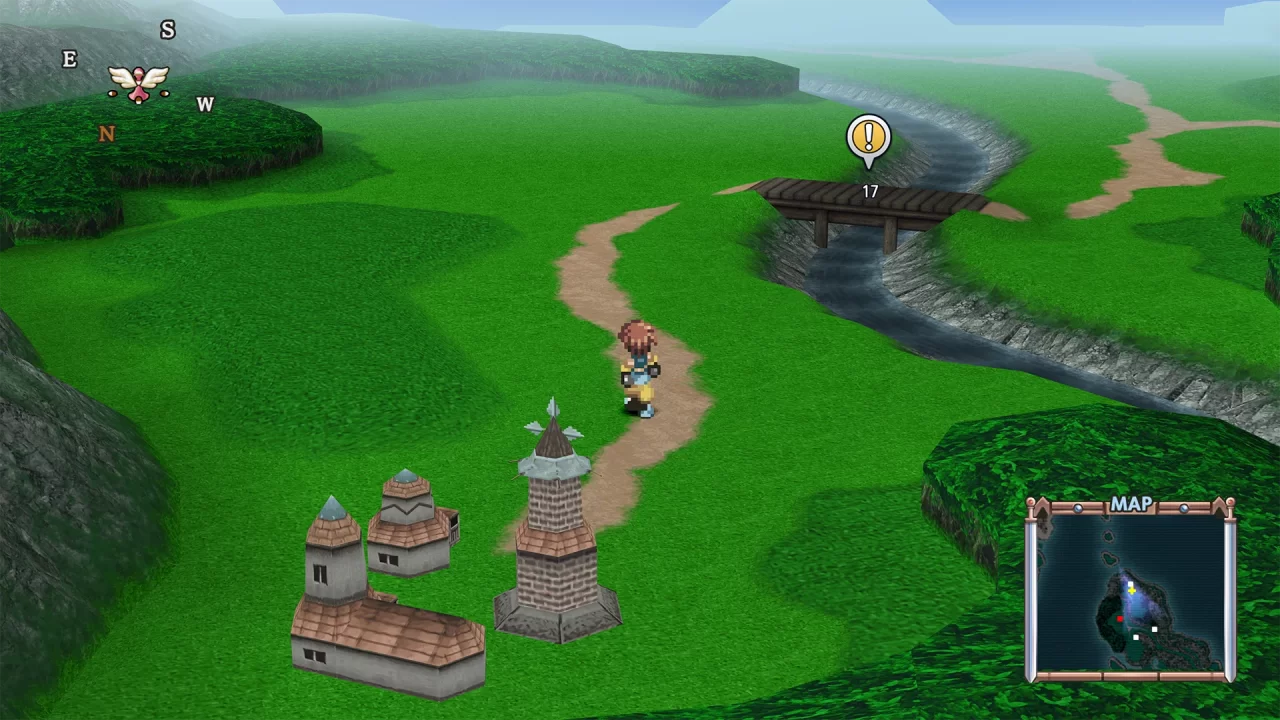
Aside from these somewhat minor annoyances, I think it was tedious to backtrack later between actually opening the world map and the optional airship upgrade. Unfortunately, this upgrade comes far too late in the game to make much of a difference. As you navigate the world map, you need to keep in mind exactly where certain cities are and how to reach them, even if that means having to once again circle large landmasses that will undoubtedly double your travel time. There is no fast travel or teleport option.
On the positive side, Tales of Eternia Remastered adds a map/objective marker so you know exactly where to go next to advance the story or tackle side quests, which is definitely a godsend! Skits are also nice little extra story scenes that you can also see on the world map or at campfires in dungeons. They’re not essential, but they help shed some light on how the characters interact with each other, and they’re overall fun and somewhat insightful.
Visually, the 2D sprites for Tales of Eternia are charming and expressive. The game is visually striking and very colorful, as evidenced by its anime-inspired cutscenes, designs, and character portraits. You can switch between the Remastered graphics and original graphics, and you can also choose between character sprites for menus or character portraits as you see fit.
From a scripting perspective, the localization is excellent, with virtually no grammatical or typographical errors. You can also choose between Japanese and English dubbing. Honestly, I was impressed with the English dub, especially for our four main characters, although I have no doubt that the Japanese dub would be just as good. The soundtrack is robust, with music that adapts brilliantly to the areas/events as it plays. I especially like the opening movie and the vocal theme song that plays at certain points.
I enjoyed my time with Tales of Eternia Remastered; it’s charming, with lots of heart and narrative depth. I think those who haven’t played a version of Tales of Eternia However, as well as those who also have patience for sometimes dated gameplay elements, should definitely give Tales of Eternia Remastered a test. This is an updated version of a game that could naturally be considered a PS1 classic. Plus, I have to admit, it makes me want to explore more. Tales serial releases now!
Gn tech