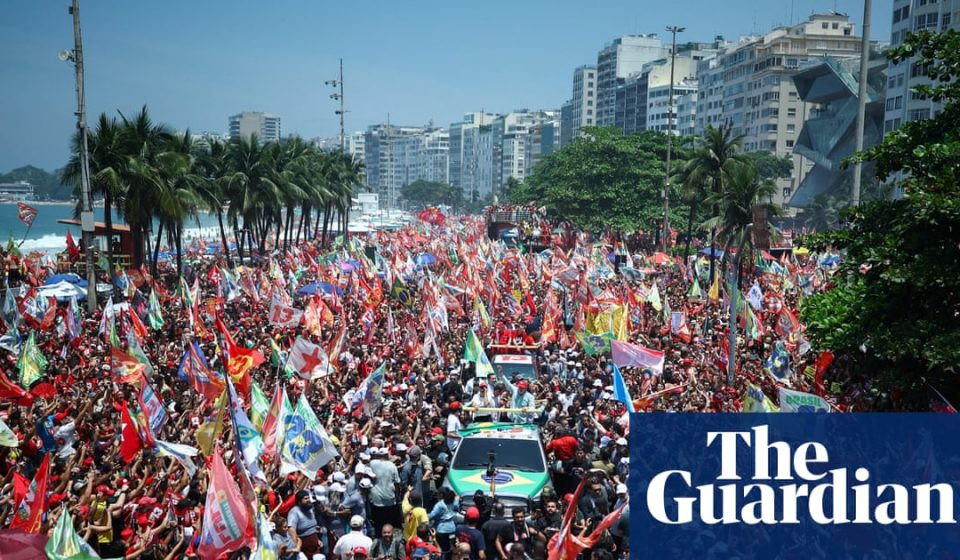
Tens of thousands of Lula supporters gather on the eve of the second round of Brazilian elections | Brazil

Tens of thousands of supporters of Brazil’s left-wing President Luiz Inácio Lula da Silva have gathered on Rio’s most famous beach for a giant protest they hope will propel him to a historic election fightback against his far-right rival, Flávio Bolsonaro.
Nearly 159 million Brazilians will vote in Sunday’s runoff election, with the two tied in polls after Bolsonaro won the first round on Oct. 4 by 47% to 45%.
On Saturday, under a blazing sun, crowds dressed in red gathered on the 4 km-long Copacabana beach to try to help Lula achieve a spectacular and unprecedented comeback. Never since the return of democracy to Brazil in the 1980s has the loser of the first round managed to bounce back.
Josias Silva, a 61-year-old truck driver, said he was confident his 80-year-old president would win a fourth non-consecutive term. He carried a homemade sign during the carnival procession reading: “Lula re-elected. Tomorrow will be a new day.”
“The people have woken up,” Silva said of the large pro-Lula street protests that have swept Brazil since the left-wing party’s first-round defeat, many of which were led by students.
“The young people know that we need this victory because otherwise we will have dictatorship again – and we do not want dictatorship. We do not want hatred. We do not want weapons. We want a country of love,” Silva added, celebrating the large number of people who came to attend one of the last presidential campaign rallies of Lula’s 50-year political career.
“There has never been a demonstration like this. It is the biggest protest in the history of Brazil. And we will win tomorrow with more than 60% of the votes,” Silva said.
Polls suggest a much narrower margin and most analysts see Bolsonaro, whose father, Jair Bolsonaro, served as president from 2019 to 2022, as the slight favorite, having sold himself to voters as someone who would tackle chronic levels of violent crime with an iron fist.
However, in recent days, Lula has appeared to regain the initiative and rise in the polls, amid a succession of scandals involving his right-wing foe. Last week, Brazilian magazine Piauí claimed that at the height of Brazil’s coronavirus outbreak in 2020, Flávio Bolsonaro attended a boat party attended by sex workers and vaccine lobbyists in hopes of striking a deal with his father’s government.
Some experts believe that a return of Lula could be possible. At the Copacabana rally, activists unfurled a huge yellow and green banner declaring: “WE WILL REVERSE THIS BACK!” »
“I’m super excited. Lula is going to win,” said Marta Moraes, a 59-year-old restaurateur, as she joined Saturday’s protest.
Moraes said the election was not a showdown between left and right. “We have nothing against the right… what we are against bolsonarismo,” she said, with tears in her eyes as she recalled how Flávio Bolsonaro’s father botched the Covid response during his chaotic administration from 2019 to 2022.
“I lost four members of my family because of Bolsonaro’s negligence,” Moraes said.
Jair Bolsonaro is serving a 27-year prison sentence for plotting a coup after losing the 2022 elections to Lula. Many Brazilian Democrats fear he will be released – and could even return to government – if his son wins. Reports in the Brazilian press suggest that several of Bolsonaro’s conspirators – who are currently in prison or hiding in exile – could be given high-level military and police positions within a Bolsonaro administration.
Cammy Marinho, a 49-year-old DJ and activist, said: “I am here to prevent the extinction of democracy – which is what the Bolsonaro family wants.”
Marinho said she had spent the last fortnight fighting to persuade people who voted for Bolsonaro, or who did not vote in the first round, to support Lula.
“It’s non-stop work: at the bakery, at the supermarket, in the metro – every time you feel there is an opportunity to talk to someone and show them the reality, everything that Lula did and is doing for the people and everything that this family (Bolsonaro) has done against the people,” she said.
Many protesters were part of the so-called “Lula Army,” a 10 million-member WhatsApp group created after the first round in hopes of overturning the election.
“Being a soldier in Lula’s army… means fighting for Brazilian democracy. This is not a normal election,” said Isabella Gaze, 64, a retired teacher and member of the group.
“They constantly claim that Lula is corrupt. But the truth is that they represent the most rotten and worst part of Brazilian politics. This is what we are fighting against now,” Gaze said of the Bolsonaros.
Many of the faces on Copacabana beach were teenagers, including 14-year-old Heitor Lopes da Silva. Silva had come from the town of Duque de Caxias in his wheelchair, with a sign that read: “Lula, I am a disabled person and I am here to support you.”
“All my life I believed that Lula was a good president. (Bolsonaro) represents the destruction of Brazil… he represents sadness and death,” he said of the Covid catastrophe during Bolsonaro’s time.
Large crowds of Bolsonaro supporters also took to the streets, notably in Belo Horizonte, the capital of Minas Gerais state, which has Brazil’s second-largest electorate after São Paulo and is a key indicator. No presidential candidate has ever won the presidency without winning Minas Gerais, where Bolsonaro led by just under 5% in the first round.
Thousands of Bolsonaristas gathered to see their candidate in a palm-lined square called Praça da Liberdade. To the booming sounds of AI-generated carioca funk tracks praising Bolsonaro, a sea of fans clad in Brazil’s yellow soccer jerseys waved Brazilian flags — and many American flags, too.
“The United States is a great nation. Who wouldn’t want to align themselves with them?” said Marcos Antonio, a 56-year-old cosmetics entrepreneur, holding a flag that merged the emblems of the two countries.
“I don’t want an alliance with Cuba or Venezuela. I want to move forward,” Antonio added. When reminded that Venezuela is currently aligned with the United States after Donald Trump’s invasion in January, he replied: “That’s true. But as of now, a fully right-wing government has not yet been installed. It is in transition.”
Antonio Carlos Costa Jr, 59, owner of a shooting club, complained: “Lula has done nothing for the country.”
Jair Bolsonaro relaxed laws on gun ownership and purchase – which security experts say ended up diverting many firearms to criminal gangs – while Lula once again tightened regulations. “Jair Bolsonaro simply gave citizens the right to defend themselves, and his son will do the same,” Costa Jr. said.
Lula’s supporters scoff at the idea that Bolsonaro, who has well-documented ties to members of Rio’s paramilitary “militias,” can rid Brazil of crime.
“If we vote militias into power, we will live in a dictatorship,” said Erika Cavalcante, 43, an architect who came to the march with a sign reading: “Don’t let the hoodlums win.”
Gn headline