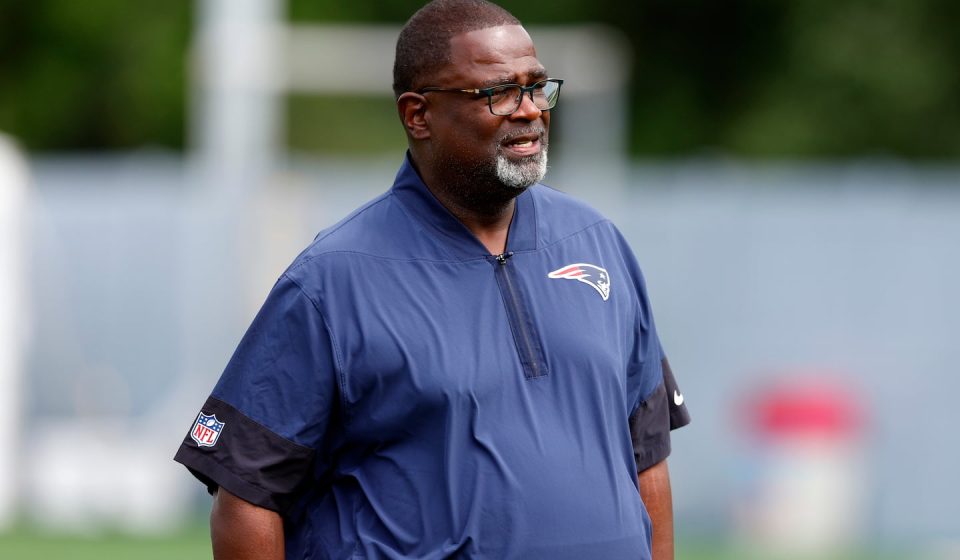

“Man, if my nail hurts, I’m almost ready to go to the doctor now,” said Williams, who has been in remission since January. “And it’s like we as men, not just coaches, but as men – and sometimes women too – we try to toughen things up. No, when something is bothering you from a health standpoint, especially as you get older, it’s important that you take a look at it.”
There is no official Comeback Coach of the Year award, but if there was one, Williams would be the favorite. He was diagnosed with prostate cancer shortly after coaching the 2025 season opener against the Raiders, forcing him to relinquish his defensive coordinator duties in favor of current coordinator Zak Kuhr.
Williams had missed time in the spring due to a health issue and felt exhausted during training camp, even passing out. Telltale signs in hindsight. But on that September night, he vomited. The bathroom kept calling. Sleep flew like a bee out of his reach. But he’s a football coach.
“I didn’t tell anyone because I wanted to coach during the game and not be a distraction or anything like that,” Williams recalled. “I remember sitting in my chair before the game started, before I went out for warmups, thinking if it wasn’t a regular season game, I wouldn’t be able to come out here and do that. But I did, and we lost the game.
“The next day, (Patriots coach Mike Vrabel) came into my office and said, ‘Hey, how are you feeling?’ And I told him, “Dude, not good,” and so I went to the hospital.
After initially thinking it was lymphoma, doctors discovered the prostate cancer had spread to his collarbone, hips, groin and legs. What followed was hormone treatment – prostate cancer feeds on testosterone – and chemotherapy. He underwent six rounds of chemotherapy, three weeks apart, at Massachusetts General Hospital. He had his personal team behind him, his wife Tifini and his son Tahj, as well as the Patriots team, who wore “T-Strong” gear.
Before that, prostate cancer wasn’t on his radar. It also wasn’t on this writer’s radar before being diagnosed.
“Not at all,” Williams, 52, said. “I wish I knew when I got it and could have tackled it sooner.”
This is why the PSA (prostate specific antigen) test is vital, especially for black men. According to True North, a global prostate cancer awareness program funded by men’s health charity Movember, one in eight men and one in six black men will develop prostate cancer.
True North recommends that men begin the screening conversation between the ages of 40 and 45 if they have a family history of prostate cancer or black ancestry, noting that “prostate cancer also tends to develop at a younger age and grow more quickly in black men than in any other group.”
Defensive tackle Milton Williams, whose mother is a breast cancer survivor, said Terrell Williams’ diagnosis was “a gut punch.” But he said he was back to being the “same old T”.
It’s a victory. At times last season, just serving as Fort Foxborough’s designated delivery boy for takeaway gifts presented to players who recorded turnovers was a herculean task.
“Sometimes I would take the Uber to Gillette, drop off the presents, come back home and go back to bed or sit on the couch and try to rest,” said Williams, who has been an NFL assistant coach since 2012, including six seasons on Vrabel’s Titans team.
Williams often considers how lucky he is to be in this medical mecca. He’s also grateful to be part of a caring team, led by Vrabel, where his colleagues, many of whom he worked with in Tennessee, are friends.
“I tell people all the time, I don’t know if I would have been able to get through it without the guys that I work with, without this staff in particular and the head coach in particular because he was so understanding and so supportive,” Williams said.
“Take away the football, we’re all really good friends… and so now in my role I’m just here to help these guys game plan and do whatever Vrabes needs me to do.”
Players feel its impact, regardless of their title.
“He continues to fill us in on certain things, scouting and everything else, certain players and preparation,” cornerback Marcus Jones said. “So he does the same thing (he previously did as defensive coordinator) at the end of the day.”
Williams’ PSA level, which was above 600 at the time of diagnosis, dropped to “something near zero.” Yet the illness remains on his mind.
“I feel good, like I feel normal. There are no limits,” Williams said. “I’m working, but always in the back of my mind I’m thinking: OK, is this thing going to come back?”
But what matters is that he is back and sharing his message to help others.
Christopher L. Gasper is a Globe columnist. He can be contacted at christopher.gasper@globe.com. Follow him @cgasper and on Instagram @cgaspersports.
Gn tech