
Tesla has started rolling out “Full Self-Driving” v15, and its list of improvements reads like a list of FSD’s biggest current weaknesses: sign detection, potholes, and speed management in school zones.
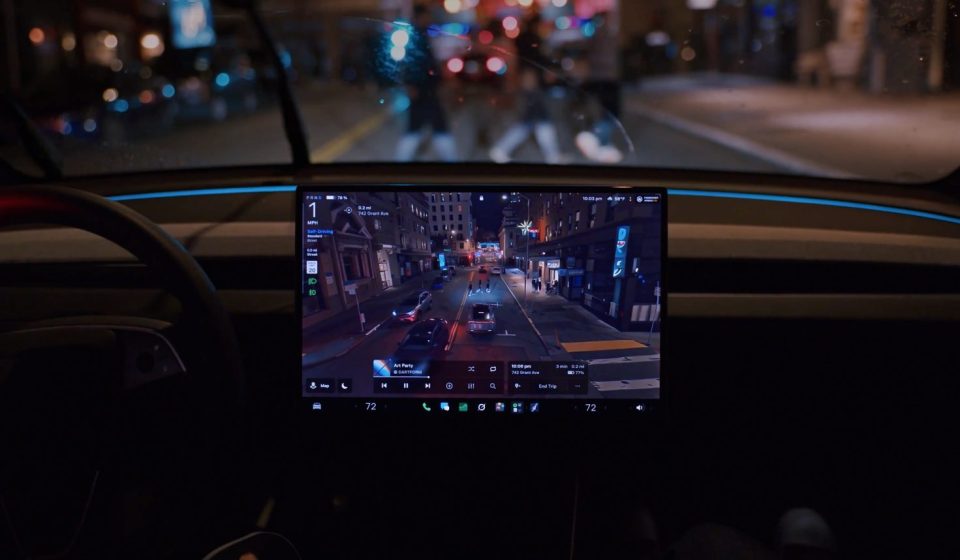
Tesla also claims “25x better handling of safety-critical cases” and adds a new live visualization that looks seriously impressive. If the driving improvements are as real as the visuals, this is a big update.
Tesla announced the rollout to X this afternoon, and its Tesla Super Intelligence account followed with the full release notes. The company hasn’t said which vehicles will get it first, but it has already told investors that its AI4 (HW4) computer is sufficient to run v15.
Here are Tesla’s release notes for FSD v15:
v15 upgrades every part of the driving network end-to-end. Understand :
- Enhanced vision encoder shared between FSD, Robotaxi and Optimus, which is trained on millions of internet videos for improved data generalization and efficiency, improving critical intervention rate by 25x.
- Introducing Tesla’s augmented reality, replacing all explicit model signals into a single end-to-end visualization using less total computation.
- Improved navigation through the use of an end-to-end learned model based on fleet route preference data.
- Improved parking location selection through the use of a personalized parking history, and the map will now display multiple parking options at your destination.
- Improved driver monitoring by increasing the availability of vision-based attention monitoring with hats and sunglasses and decreasing the stringency of driver profiles at higher speeds.
- Improved detection of road signs, small animals, road debris and chains.
- Improved detection of potholes, road details and avoidance of deep standing water.
- Improved speed management for each driver profile, school zones, speed limits and bad weather.
- Improved Autoshift functionality by unifying with FSD-based speed predictions.
Tesla’s main announcement also states that FSD can now slow down for speed cameras, and adds Bike Rack mode, which allows FSD to use a bike rack or similar hitch accessory. Learning to navigate currently only covers the beginning and end of journeys; Tesla says later versions of v15 will expand it to the entire route.
The new visualization is the flashiest part, and based on the video Tesla shared, it’s super impressive. The central screen shows a detailed, rendered version of the street around the car, far beyond the current FSD visualization.
Tesla calls it “Reality View” in its announcement and “Tesla Augmented Reality” in the release notes. The notes say it replaces all separate model signals with a single end-to-end visualization that uses less compute, and Tesla says it allows the driver to “see and control what FSD plans to do.” If it works as advertised, it could make monitoring the system much easier.
v15 addresses FSD’s biggest weaknesses
What stands out most is what Tesla is focusing on. Almost every improvement in the release notes targets an area where FSD is struggling today.
Signs are a big one. In a test published in September, the Brussels association Johanna.be found that FSD exceeded the limit in 55% of the 30 km/h zones crossed, with an average of 44 km/h. In most of these areas, the car’s screen showed a limit of 50 km/h. It didn’t read the sign.
Potholes are another. In August, Musk said pothole avoidance was “coming soon,” something he had previously promised in 2019. Today, FSD continues to drive through them.
School zones are also on the list. NHTSA is reviewing a petition claiming that Tesla’s Robotaxis passes through active school zones, in addition to an investigation opened in October 2025 into FSD traffic violations, such as running red lights. Slowing down speed cameras fits the same theme, although it also suggests that Tesla accepts that FSD exceeds the limit when there are no cameras nearby.
So if v15 really fixes these issues, it’s a very good update. The question is to what extent.
A change is going in the other direction. Tesla says it is “decreasing the rigor” of driver monitoring in high-speed driver profiles, at a time when drivers asleep on FSD continue to make headlines and Tesla is increasing monitoring in Europe at the request of regulators.
“25x” is the critical intervention rate
The release notes clarify what the “25x” refers to: Tesla says the new vision encoder improves the critical intervention rate by 25x. This is the right indicator to measure progress towards unsupervised driving. But Tesla still doesn’t share the actual figure, only the multiplier.
Mathematics quickly becomes interesting. Our data from earlier this year suggests that FSD v14 could travel a few thousand miles between critical interventions. An improvement of 25 times that figure would put the v15 at about 50,000 miles between critical service, well beyond the roughly 10,000 miles we said Tesla needed for limited unsupervised service. If this were true for the entire fleet, we could see Tesla make its biggest push toward autonomy in a long time.
And v15 is already generating a lot of hype. In April, Elon Musk wrote that v15 “will far exceed human safety levels, even in complex and completely unsupervised situations.” We pointed out at the time that he said similar things about v12 and v14. In August, Tesla told JPMorgan that v15 was a “step change” based on seven “core technologies,” about 40 percent of which are already in use in its Robotaxi fleet in Austin.
Two steps forward, one step back
FSD never got better in a straight line. Each major release has brought real gains as well as new issues, and point releases regularly slide backwards.
When v14 arrived in October 2025, it came with hallucinations, slamming, and speeding, and early data collected from the public showed about 732 miles between critical disengagements, lower than we expected. It then improved a lot. Then the v14.2 updates backed off before Musk sold v14.3 as the version where “the last big piece of the puzzle finally lands.”
Seven months and a long series of point releases later, owners are still overseeing, and Tesla now needs v15 to deliver what v14.3 was supposed to do.
The visuals are super impressive. We can already judge this from the video, and Reality View could make FSD easier to understand and supervise.
The driving side is more difficult to judge. Tesla is directly attacking the weaknesses that owners and regulators complain about most: misinterpreted speed limits, potholes, school zones, debris. If v15 brings real progress on all these points, it is a very good update.
But “improved detection” doesn’t tell us how much better it is, and a 25x multiplier without the underlying number is difficult to verify. FSD has taken two steps forward, one step back throughout its history, with point releases regularly breaking things that the previous version handled well. And Tesla still won’t release the opt-out data that would help fix the problem.
If you buy an electric vehicle, powering it with home solar energy can reduce your fuel costs to almost zero. With electricity rates up nearly 10% in the last year and expected to continue to rise, turning to solar power is one of the best ways to protect against rising costs. And with leasing and PPA options, you can do it without any upfront costs and start saving immediately. If you want to find the best deal, check out EnergySage. It’s a free service with hundreds of pre-screened installers competing for your business, so you save 20-30% compared to a stand-alone solution. No sales calls until you choose an installer. Get your free quotes here.

FTC: We use automatic, revenue-generating affiliate links. More.
Gn bussni