
On Election Day, former Land Commissioner Jerry Patterson warned his fellow Texas Republicans that a “spanking” was coming.
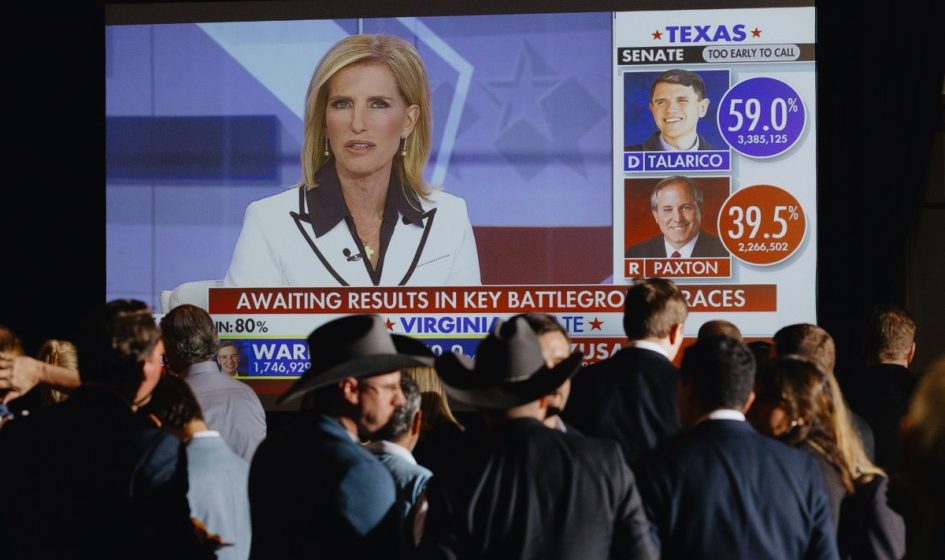
It happened: Democrats won every major statewide office in the runoff and flipped the Texas House. And it didn’t take long for Republicans to start arguing over who was to blame.
“I blame our leaders. That’s just the case,” Comptroller Don Huffines, who lost his bid for a full term after three months on the job, said on his election night. “I blame Greg Abbott. I blame Dan Patrick. I blame all these doughy middlemen who want to think, oh, they’re in the middle, we want to make everyone happy. Well, you sure did a good job in this mess!”
The next morning, U.S. Sen. John Cornyn, who lost a May primary runoff to Attorney General Ken Paxton, offered his own diagnosis. In a Wall Street Journal opinion piece, he attributed the devastation to self-inflicted wounds, including the nomination of candidates like Paxton who forced voters “to choose between politics and personal character” — a “suicidal” proposition for the Republican Party.
“Here in Texas, mainstream conservatives and independents have been asked to swallow an almost comical list of personal scandals and improprieties,” Cornyn wrote, also citing Paxton as a candidate who “shrinked the tent, obsessed with ‘RINOs’ and political theater.”
On social media, others went straight to the feud.
“(Ken) Paxton was a terrible candidate, and I’ve had (Republicans who voted in the last four GOP primaries) at the door telling me they couldn’t vote for him,” wrote Derrick Wilson, president of the Texas Federation of Young Republicans. “He is not the only one involved, but he slowed down the vote.”
“Please be quiet,” Republican staffer Decker Reno responded. “Your political analysis has ruined the (Young Republicans).”
After more than 30 years of total dominance, many Texas Republicans entered Tuesday’s election having known November as a formality for their entire political lives. They ended the evening in the political wilderness trying to figure out what went wrong.
The erasure hit a party that, as ugly as its primaries were, had always found a way to overcome the infighting that has divided its base since the Tea Party era, winning in November. Tuesday took this cushion away, leaving behind only the internal wreckage.
Some Texas Republicans argued that decades of easy victories had let the party’s muscles atrophy in general elections, leaving an entire generation of candidates and operatives trained almost exclusively on the politics of winning primaries. That helps explain the messaging problems that have dogged the party this year, this idea holds — problems the GOP will need to resolve if it wants to reassert itself.
“Our party has focused on an increasingly narrow slice of the electorate, believing that the only election it could lose is a primary,” said GOP operative Matt Mackowiak, who was a senior adviser to Cornyn’s campaign.
The tenor of Paxton’s campaign hasn’t changed much from what won him the primary, except for an economic campaign focused on tax breaks and proposals on data centers. As recently as his last rally, the day before the election, his supporters rejoiced in his disruption of the Republican establishment and his dismantling of the “Bush cartel,” as one surrogate put it.
Both charges – bridging a chasm within the party and rebuilding its general election platform – pose difficult problems. But some who have wanted to purge the influence of the MAGA movement believe that spending a lifetime in the minority could be the medicine that corrects the GOP’s structural flaws.
“Remember the spanking you received as a child – the one you were told was ‘for your own good’?,” Patterson wrote on Facebook before the election. “For Republicans, tomorrow’s spanking is that kind of spanking.”
One obvious consequence of this “spanking” was that Republicans seemed more willing than ever to fight the influence of their party’s standard-bearer. That meant asking whether their candidates, many of whom owe their careers at one point or another to supporting Donald Trump, should have been more willing to publicly break with the president.
With fingers pointed in several directions, Trump was at the top of many Texas Republicans’ list of complaints behind the idea that everything else is downstream from the president’s low popularity.
“We can talk about the world war, about trade strategy, about taking stakes in private companies, about siding with Putin,” said Chad Wilbanks, former executive director of the Republican Party of Texas. “The blame lies with President Trump for the failures of the Republicans who won last night.”
The fact that Republicans failed across the country – losing Senate elections in red states like Iowa, Kansas and South Carolina in addition to Kansas – demonstrates how toxic the Republicans’ federal image, essentially inextricable from Trump’s, has become.
Deeply underwater across the country, the president launched an unpopular war in Iran that drove up gas prices and sparked a mass deportation campaign that played a role in erasing the Republican Party’s hard-won gains with Hispanic voters. And he was dogged by corruption headlines, elevating it as a problem in the eyes of voters because he paid too little attention, his critics argued, to the issue at the top of his list, the one on which he came to power in 2024: the economy.
“In key areas, Mr. Trump repeated Mr. Biden’s mistake and misinterpreted his mandate,” Cornyn wrote in the Journal op-ed. “Voters wanted to revamp our trade relations, but they got arbitrary ‘Liberation Day’ tariffs that raised prices without creating incentives for long-term relocation. Voters wanted secure borders and peaceful streets, but got hyper-aggressive immigration measures. The Iran conflict happened without any attempt to persuade the public.”
Of course, Trump had his own interpretation. If he had been on the ballot, he said, Republicans would have won overwhelmingly – although he explicitly asked Republicans across the country to pretend that he was indeed the candidate. And he reserved particular criticism for Abbott – the only losing Republican to whom he dedicated his own post on Truth Social.
“If Greg Abbott, the governor of Texas, had not become a RINO during the last six months of his political life, he would not have lost,” Trump wrote. “He went back to his original formula, and it wasn’t pretty!
It’s a far cry from Trump’s pre-election remarks just hours earlier, when he wrote that Abbott was an “outstanding governor and man” alongside a list of accomplishments – an irony that frustrated Republicans were quick to note.
Those who won tough races tended to have a distinct brand. Republican operative Ross Hunt identified state Reps. Morgan Meyer of Dallas and Mano DeAyala of Houston as examples of Republicans who campaigned explicitly as moderates and sought out ticket splitters. Both held their own in their wealthy, highly educated Texas House districts that Talarico carried.
But would that have been enough for statewide candidates?
“Probably not,” Hunt said. “But if our attorney general nominee, or our land commissioner, agriculture commissioner nominees or others explicitly distanced themselves from Trump, we would probably see at least 48%, 49% results.”
Texas Republicans brought a lot of their own baggage to the election.
Even beyond this cycle, Republicans pointed to several sliding door moments that contributed to their defeat: Trump elevating Paxton, Cornyn running in first place, the Texas Senate acquitting Paxton in his impeachment trial, and the major battles spawned by this episode.
The party’s shift to the right over several cycles — and intense focus on purging the party of so-called Republicans In Name Only, or RINOs — set the stage for statewide losses, some argued, reserving blame especially for extremist donors whose money fueled RINO-hunting escapades each primary season.
“It took years,” Mackowiak said. “(West Texas ultraconservative megadonor) Tim Dunn should congratulate himself. He’s purged the ranks of Republican elected officials in our state to the point where we had the biggest blowout (in decades) in Texas. That’s a historic accomplishment, and he certainly paid for it with hundreds of millions of dollars.”
And then there’s the ethical baggage Paxton carried — a years-long criminal case, his indictment, a massive, unexplained increase in his net worth and his alleged infidelity that his wife, state Sen. Angela Paxton, cited in filing for divorce.
“Nominate a flawed candidate who was impeached and indicted, spend $500 million instead of spending it on another election, then what do you think will happen? ” said U.S. Rep. Chip Roy, R-Austin, who worked for Cornyn and Paxton. “You can’t make people want to believe in someone they don’t believe in. It’s not enough to be ideologically sympathetic. You actually have to believe in someone’s leadership. Of course, that has had a negative impact across the board.”
Of course, Republicans across the state of Texas were swept across the board, as were Republican candidates in other competitive U.S. Senate races. The scale of the rout seemed at least to absolve Paxton from taking sole responsibility.
Gregg Keller, a spokesman for the pro-Paxton Lone Star Liberty PAC, said his takeaway from the evening was that non-interventionism remains a powerful motivator in American politics, and particularly among the Republican base. Economic frustrations, plus the war in Iran, proved to be a powerful combination that overshadowed the effects of a candidate’s personal brand or policy preferences, he argued.
One of the original sins of the cycle, according to Keller, was Cornyn’s decision to run for office.
“What we learned last night was that everything (Cornyn’s camp) was saying was incorrect,” Keller said. “They were saying that John Cornyn would have been a better candidate in the general election than Paxton, and what we learned was that it was a blue tsunami year. Even Greg Abbott, so far one of the most popular governors in America, didn’t make it through. I think that’s unfair and slightly pathetic.”
Gn usa