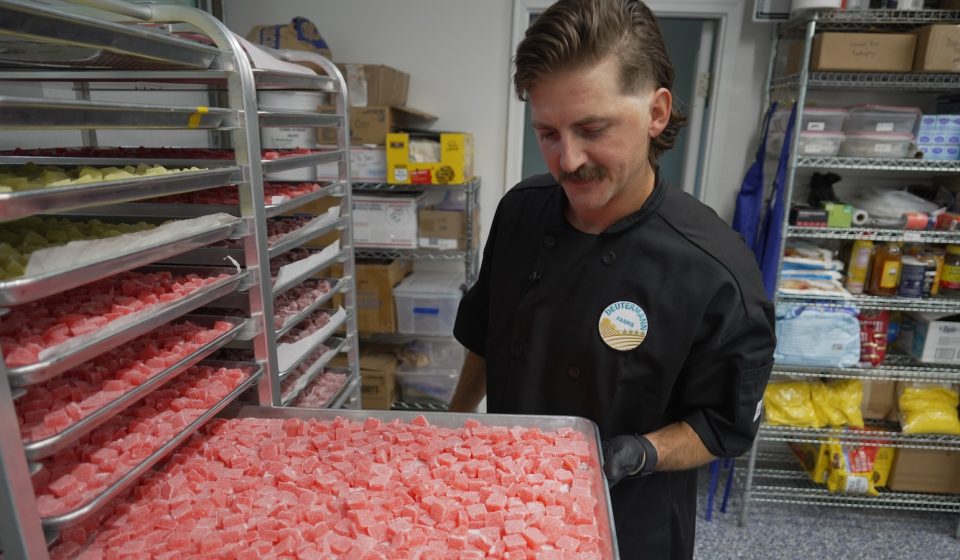

In a commercial kitchen outside Raleigh, North Carolina, Nicholas Hohns spreads a blue-green paste into a wire mesh pan, creating one of his company’s signature products: potent THC gummies, containing the main intoxicating compound found in marijuana.
It’s an activity he may soon have to give up. The multibillion-dollar U.S. market for hemp products — from THC-laced seltzers sold in some Target stores to smokable cannabis flowers — is at risk of being eliminated after Congress voted to close a loophole in federal law that allowed it to thrive.
The industry’s advocates, as well as some lawmakers, are fighting to save it. The short-term government funding bill signed by President Donald Trump last month delayed the effective date of the “THC hemp ban” from Nov. 12 to Dec. 11, giving Congress more time to consider regulating the products rather than banning them.
“It’s a really strange place,” Hohns said. “You worked 100 hours a week for the last four years and, yes, you made money. But now you may have nothing left to show.”
Marijuana and hemp are the same plant: cannabis. Marijuana is grown for the high levels of THC in its flowers. Low-THC hemp has historically been grown for its robust fiber, edibles, or wellness products. “Rope, not drugs” has long been the motto of farmers in favor of hemp legalization.
To give farmers a new cash crop, Kentucky Republican Senator Mitch McConnell successfully pushed for the legalization of industrial hemp in the 2018 farm bill.
But the way that law defines hemp — as containing less than 0.3 percent of a specific type of THC, called delta-9, by weight — opened a huge loophole. Drinks or snacks can meet this threshold and still contain enough THC to get people high.
Vape oil, gummies, chips, sodas and other unregulated and untested products loaded with hemp-derived THC became widespread across the country, including at gas stations or convenience stores, where they were available even to teenagers. Some companies have begun selling marijuana on the theory that the THC in raw marijuana is in a form called THC-A, which only converts to the impairing delta-9 when heated or burned.
The products have skirted state bans on recreational weed or undercut heavily taxed and regulated cannabis where it is legal.
Dozens of states have responded by regulating or banning hemp products.
McConnell finally closed that loophole late last year by banning THC hemp in a move that ended the longest government shutdown in history.
The ban, which limits the amount of THC in hemp products to 0.4 milligrams per container, would not take effect for another year.
The ban “threatens to reduce retail revenue by $28.3 billion, eliminating 225,000 jobs and reducing the state’s sales tax potential by $2.1 billion,” according to a report released last month by Whitney Economics, which studies the market.
The industry hopes to save itself by limiting impairing products to people 21 and older, limiting the amount of THC that can be contained in a package and banning imported cannabis compounds.
Kentucky Cornbread Hemp owners Eric Zipperle and Jim Higdon are willing to cap their products at, say, 5 milligrams if that’s what it takes to win support from lawmakers. But the 0.4 milligram limit would destroy their business, they said.
“If this happens in December, this place is toast — it’s gone,” Zipperle said.
They have 105 employees, sell hemp drinks in 18 states and hope to bring in $65 million this year.
The 0.4 milligram cap is so low that it would even ban some non-impairing CBD products, such as topical lotions, said Jonathan Miller, general counsel for industry group US Hemp Roundtable.
Hohns, who runs Deutermann Farms in Clayton, North Carolina, entered the hemp industry after losing his job as a personal trainer during the COVID-19 pandemic. North Carolina has not legalized either medical or recreational marijuana, but most of the edibles produced by Hohns are more potent than those available in states that have done so.
“When I started seeing THC edibles being sold…I figured I had anywhere from 18 months to two years to make money in this industry,” Hohns said. “There is no way the government is going to sit here and let us do this when it was supposed to be about fiber, plastic, building materials and rope.”
It was more than four years ago. Hohns kept his capital investments to a minimum, fearing closure. He considered making other products, such as creatine gummies, if he were to get out of the hemp and THC business.
Things have been more stressful for others. Drinkin’ Buds, a cannabis beverage company in Sheboygan, Wisconsin, has put production on hold. Co-founder Matt Swanson stepped off the payroll Thursday.
“There’s so much uncertainty,” Swanson said. “I am actively looking for a job. »
Among those who have defended the hemp industry are alcohol retailers, including Total Wine. & More. Sales of cannabis seltzers helped offset declining alcohol sales.
Opponents include people who say the products are dangerous.
“I have sympathy for the people who are losing their jobs, but I also have sympathy for the many other people whose lives are affected by this,” said Kevin Sabet, CEO of Smart Approaches to Marijuana.
The regulated legal marijuana industry, which views hemp THC as unfair competition, also supports the ban. Cory Harris, a lobbyist for legal cannabis operators at the state level, suggested that dire predictions about its effects on the intoxicating hemp industry are overstated.
Although the ban would end interstate sales of products such as THC-laced seltzers and candies, some could find their way into legal state markets, he said. It is possible that THC drinks will be sold in stores in the states where they were produced. States like North Carolina could adopt legal hemp programs.
“If you go from virtually no rules to suddenly having a very large number of rules, it’s a buzzkill,” Harris said. “Welcome to our world. But if you base your entire business in a legally questionable loophole, that’s kind of the risk you’re taking.”
___
Associated Press journalists Allen G. Breed in Clayton, North Carolina, and Dylan Lovan in Louisville, Kentucky, contributed.
Gn bussni