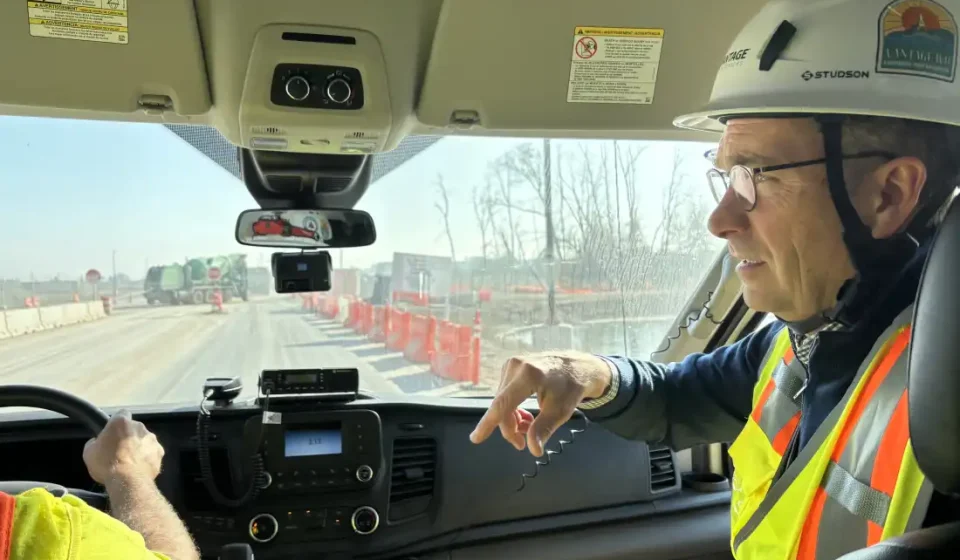

Ted Neitzke, mayor of the town of Port Washington, Wisconsin, believes the data center project will help his community by reducing taxes and generating new revenue.
Sacha Pfeiffer/NPR
hide caption
Sacha Pfeiffer/NPR
Most Americans don’t like data centers.
They made this clear during the midterm elections, when local communities overwhelmingly approved moratoriums and restrictions on data center construction. Yet Congress is currently debating a bill that would make their construction easier — and this bill passed by the Senate last week.
The arguments against these installations are well established. Less common are ardent voices of support.
Ted Neitzke is one of those rare supporters. He is mayor of Port Washington, an old industrial town in Wisconsin, north of Milwaukee and next to Lake Michigan.
“Every revolution has brought an evolution, and that’s what I think is happening,” Neitzke told NPR last month. “We’re living in the early 20th century, just reshaped. We have Zuckerberg. They had JP Morgan. We have Elon Musk. They had Rockefeller.”
As mayor, Nietzke supports a controversial data center the size of 500 football fields being built on former farmland in Port Washington. Opponents of the project say it will harm the community. But Mayor Neitzke thinks he’s found a way to reap the benefits and minimize the downsides.
“I don’t understand why a community like ours, which grew up in an industrial base, would struggle with the fact that we would need this again,” he said.
Even after the midterm elections produced a decisive rebuke of data center plans, Mayor Neitzke says his city’s data center deal could serve as a national model, one that would address many of Americans’ concerns about them.
“There is no industrial development that has better value per square foot than a data center,” he added, “and a lot of people will be very upset when I say that.”
Listen to the full story by clicking the blue play button above.
Gn headline