The night Erik and Lyle Menendez killed their parents, they came up with an elaborate, twisted, and ultimately unbelievable explanation for those crucial hours in 1989.
They said they screened Tim Burton’s “Batman” at a movie theater in Century City, went to Santa Monica for a food festival, then stopped at home for a second before planning a dinner with friends at an ultra-trendy Beverly Hills restaurant. But once they returned home, they said they found their parents shot multiple times.
The destination of this aborted dinner? The cheesecake factory.
The restaurant, famous for its gaudy interiors, huge portions and even bigger calorie counts, was propelled into the 2026 midterm elections. It all started when Barack Obama joked that President Trump renovated the White House to look like “Saddam Hussein opened a cheesecake factory.”
Trump and his allies fired back, accusing Obama of elitism and taking great offense to the comparison. “When you say it’s a Cheesecake Factory, it just shows why you’ve been a bad president,” Trump said.
The Cheesecake Factory is many things. But above all it is a very Californian invention.
The restaurant opened auspiciously in 1978, a modest and surprisingly small space in the golden triangle of Beverly Hills’ elite.
It was known for its large quantity of food (and many varieties of cheesecakes) at reasonable prices in a Rodeo Drive setting – affordable opulence. The operators took inspiration from the chic places around them, notably Wolfgang Puck’s Spago. But the mission was to provide the average person with a luxury experience.
By the time the Menendez brothers used him as an alibi, the restaurant was hot.
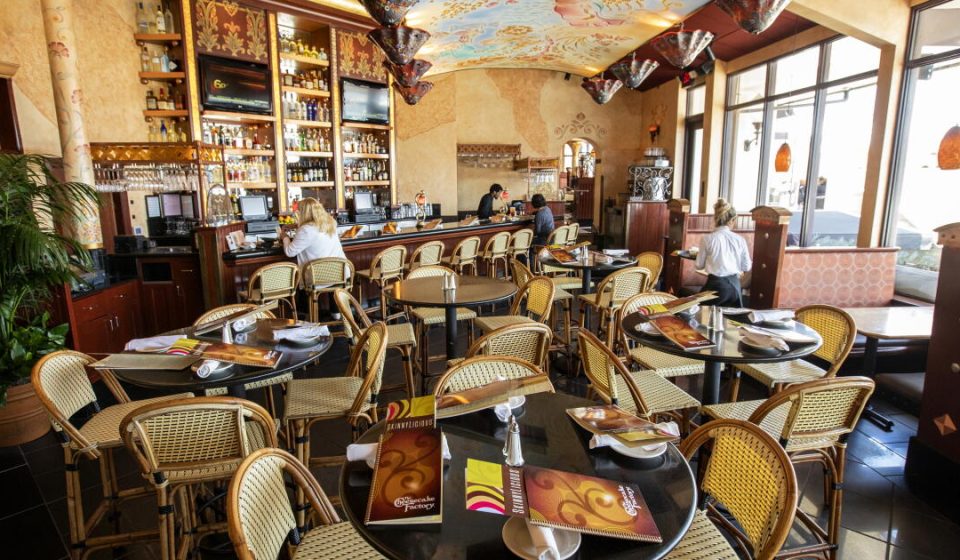
The Cheesecake Factory we know today underwent a major expansion in the 1990s. That’s when we were treated to eclectic interiors of marble, polished wood, Roman columns transforming into palm trees in a look blending architectural styles from Egypt, England, Italy, France and many other places. Sure, you were now eating in a mall and not at the booth next to Sylvester Stallone, but the experience still had to be glitzy.
Rick McCormack, the architect behind the look, credited founder David Overton with inspiration, saying he wanted to evoke funky 1970s San Francisco restaurants located in grand Victorian homes.
“We have these French limestone floors, and then we add Egyptian columns and Victorian wood paneling – a really eclectic mix – that most people wouldn’t have the courage to try,” McCormAck told Eater in an excellent 2017 story from the Cheesecake Factory.
As for Overton, he revealed to the Associated Press in 1998 that he sometimes consults an astrologer to choose the right opening date for new locations.
“I think Cheesecake Factory is a lot like Southern California because there is a very eclectic group of people who live in California and come from all parts of the country,” David Gordon, president of the company, told Vice in a 2016 oral history.
There are now Cheesecake Factories everywhere. And somewhere along the way, it became cool to be sarcastic about them. Oversized menus. Excessive portions. Legendary caloric values. A look that seems so out of place in a culture of clean, modern lines.
Writer Christina Catherine Martinez wrote an essay for Image magazine citing the Cheesecake Factory as an early example of a “Euro-blend” architectural style that has swept through Los Angeles shopping centers and apartments over the past two decades. This “has a lot to do with the fact that real estate’s descendants imagine themselves to be the purveyors of a new Renaissance, but the buildings themselves are inspired less by Renaissance principles than by vague attempts at worldliness.”
But is the Cheesecake Factory trying to be tasteful – or something else?
Asked about the collision of styles that marked his restaurant’s interiors, Overton once explained it this way: “I wanted something timeless. »
He succeeded. Because in the graveyard of trendy Los Angeles restaurants, the Cheesecake Factory is still going strong.
Times Librarian Cary Schneider contributed to this report.
Gn bussni