
The Euro-Japanese BepiColombo mission becomes the second to arrive in orbit around Mercury

Follow us
Add us as a favorite source on Google
Updated as of 2 p.m. ET on November 22: On Sunday afternoon (November 22), the BepiColombo team announced that although the spacecraft successfully arrived in orbit around Mercury on Saturday (November 21), things didn’t go quite as planned. “During the maneuver, the thruster burn was shorter than expected due to a software issue,” the mission team said. said via. “The spacecraft is safe and ESOC teams are working to understand what happened. Updates provided Monday.”
For only the second time, Mercury receives a robotic visitor from Earth.
Before BepiColombo, only one spacecraft had circled the innermost planet in the solar system: NASA’s. MESSENGERwhich happened from March 2011 to April 2015.
BepiColombo consists of two main spacecraft: ESA’s Mercury Planetary Orbiter (MPO) and JAXA’s Mercury Magnetospheric Orbiter (MMO), also known as Mio.
The duo was launched – with a power and propulsion element called the Mercury Transfer Module (MTM) – aboard an Ariane 5 rocket from French Guiana. in October 2018beginning a long looping journey through the inner solar system.
Mercury is a difficult planet to reach because it is so close to the sun. Spacecraft approaching the planet are accelerated to high speeds by the immense gravitational pull of our star and therefore must lose a large amount of kinetic energy to be captured by Mercury’s much weaker tug.
The BepiColombo team therefore designed a trajectory including an overview of Earthtwo of Venus and six of Mercury over a period of approximately seven years. This flight time was increased by one yearHowever, after the mission, a problem with its solar panels occurred, which reduced the power available to the MTM’s electric thrusters.
Saturday’s orbital insertion took place after a 37-minute engine burn, which began at 1:24 p.m. EST (1824 GMT). There was, however, a bit of drama, as confirmation of the success of the maneuver did not come until several hours later.
“We received a response from Bepi: the spacecraft is now in contact with the ground and teams at ESOC (the European Space Operations Center) are busy evaluating the telemetry. Flight Dynamics has already confirmed that it has successfully captured the orbit around Mercury! Early next week we will share the next update with upcoming milestones,” the mission team said. said via on Saturday evening.
We received a response from Bepi: the spacecraft is now in contact with the ground and ESOC teams are busy evaluating the telemetry. Flight Dynamics has already confirmed that it has achieved an orbital capture around Mercury! Early next week we will share the next update with upcoming steps.November 22, 2026
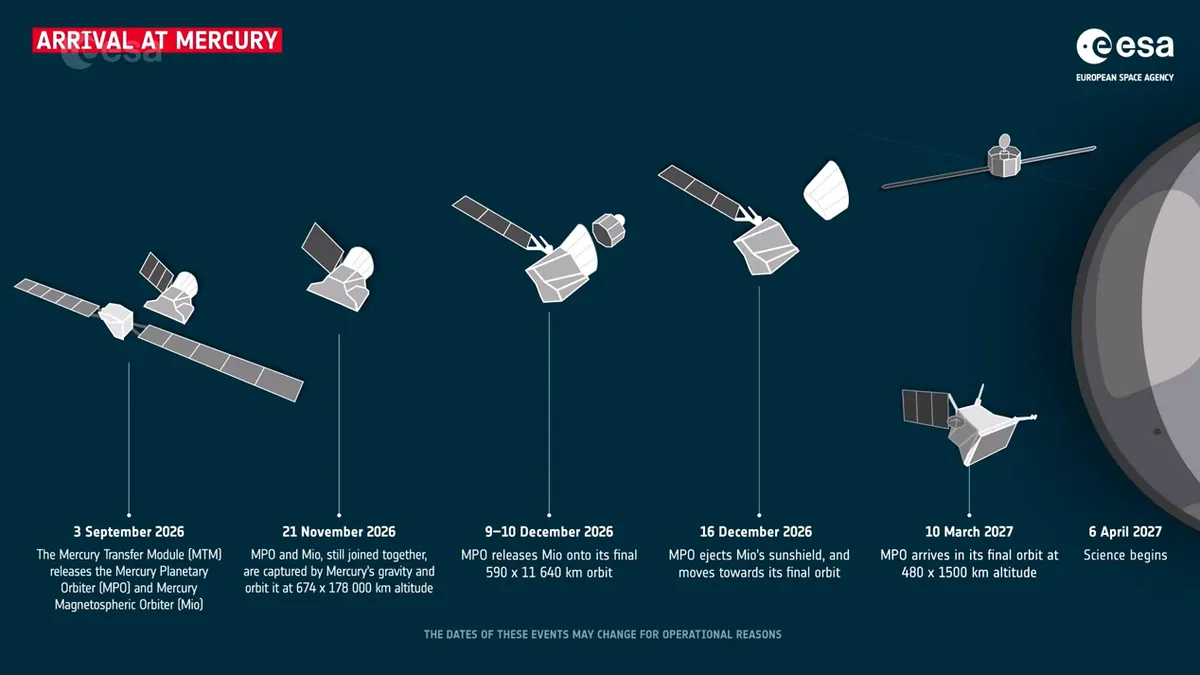
The orbital insertion is the final stage of BepiColombo’s Mercury arrival phase, which is expected to last about six months in total.
The arrival began on September 3, when the MTM released MPO and Mio. The two orbiters remain connected today; they won’t break up until around December 9th.
Shortly thereafter, Mio will settle into its final orbit, a highly elliptical trajectory that will take it above Mercury’s poles. MPO is also intended for a polar orbit, although much less elliptical than that of Mio; The ESA probe will perform a series of engine burns before finally arriving there on March 10, 2027.
BepiColombo – named after the late Italian scientist and mathematician Giuseppe “Bepi” Colombo – will not begin its scientific work until April 6, 2027. The two probes will gather complementary data from their different points of view, shedding much light on a mysterious world.
“The mission will study all aspects of Mercury, from the structure and dynamics of its magnetosphere and how it interacts with the solar wind“its internal structure with its large iron core and the origin of the planet’s magnetic field,” ESA officials wrote in a statement. Description of the BepiColombo mission.
“The data will allow scientists to better understand the origin and evolution of a planet located near its parent star, as well as a better understanding of the overall evolution of our solar system,” they added.
Editor’s note: This story was updated at 11:15 a.m. ET on November 22 with news of a successful orbital arrival.
Gn headline