
After 67 blows, deliverance. On August 8, 1974, Kaïssa inflicted checkmate on his opponent and offered the Soviet Union the very first title of world computer chess champion.
It’s a bit of a revenge from the Eastern bloc, a year after the triumph of the American genius, Bobby Fischer, who defeated the reigning world champion, the Russian Boris Spassky.
But this time it’s not a human who imposes himself. It is a calculating machine, an artificial intelligence “Made in Russia”, which pulverizes “capitalist” computers.
AI, a “bourgeois science”?
Certainly, the Russians have a long chess tradition, but from there to beating American computers, designed in the best universities in the United States, those where the official history of artificial intelligence is written?
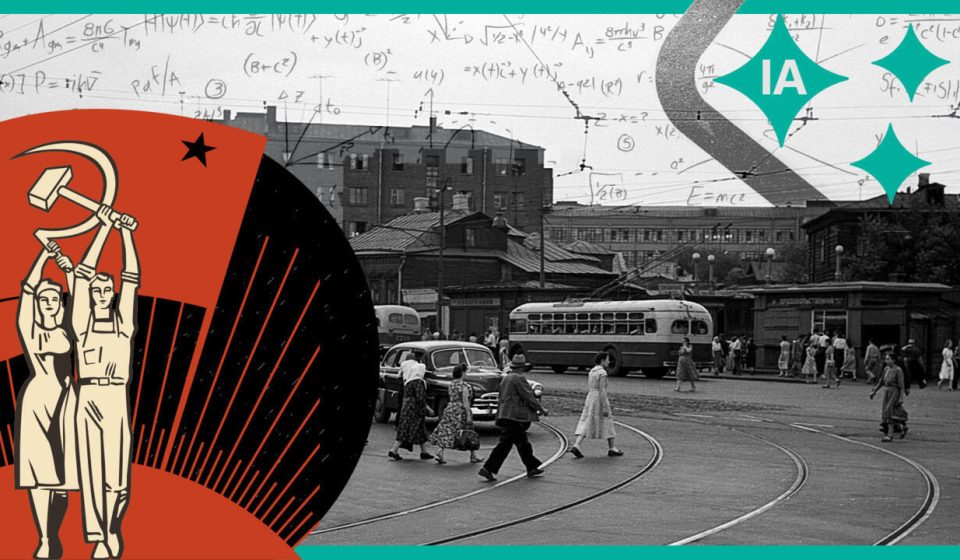
This victory proved to the world that the Soviets also had a say in the field of artificial intelligence. If, at the time of the triumph of the “tech bros” of Silicon Valley, the history of this technology seems to be written in America, the USSR had an ambitious AI program which left traces in history.
However, this story almost never happened. Indeed, at the beginning of the 1950s, artificial intelligence – which was not yet called that – was seen in the East with a pinch of Marxist suspicion.
The Soviets were interested in what would become AI mainly through the prism of cybernetics, a field of research then very popular for studying human-machine or machine-machine behavior.
“False bourgeois science”, some were indignant, while others judged cybernetics very promising to make a great communist and scientific leap forward. It is the latter who managed to impose themselves… and not just by a hair.
“Cybernetics has almost become a kind of official philosophy of scientific research in the USSR,” notes Olessia Kirtchik, a sociologist at the European Center for Sociology and Political Science who has worked on the history of AI in the Soviet era.
The corridors of research institutes and universities were then populated by mathematicians, philosophers and other researchers responsible for sharing the benefits of cybernetics with the communist regime. While it fell out of fashion in the United States at the end of the 1950s in favor of computing and AI itself, the Soviets remained attached to it, notably through the idea of a “thinking machine”.
The Soviet AI Gold Mine
Thanks to Kaïssa, one of the big names in Soviet AI to make history will be Alexander Kronrod, a mathematician in charge, in particular, of the team which developed the chess program. For some, Alexander Kronrod even embodies the figure of the “father of artificial intelligence” in the USSR.
But before him, another mathematician had a considerable influence on the development of AI: Dmitry Pospelov. He gave this discipline its nobility by “leading and supporting the artificial intelligence research community for years,” explains Olessia Kirtchik. A “lobbyist” work which led to the creation of the Soviet Artificial Intelligence Association in 1989.
Dmitry Pospelov’s pro-AI crusade in Moscow’s power circles also illustrates how this area did not escape the ideological battle of the Cold War period. The Russian mathematician strongly criticized the Western approach to AI, considered too “reductionist”. In his eyes, American researchers were reducing the human brain to a kind of supercomputer carrying out rigorous but disembodied calculations. For him, it was necessary to conceive of intelligence as a social activity dependent on its environment and not as a purely logical process.
This ideological debate was not enough for the kingdom of five-year plans and the command economy. In the land of the Soviets, AI had to respond to concrete problems and the USSR above all “used algorithms to optimize the management of the socialist economy”, explains Olessia Kirtchik.
Which is not to say that this is a purely bureaucratic application of AI. The oil and gas industries, for example, have used it to improve their operations.
Algorithms have even represented a real gold mine for Moscow. Literally, because in the 1960s, the authorities were trying to find where to dig on Soviet territory to find veins of this precious metal. To achieve this, Yuri Zhuravlyov, one of the most decorated mathematicians of the Soviet era, developed an algorithmic approach. Based on data from known gold mining locations around the world, Yuri Zhuravlyov developed a program in 1966 that identified sites in the Soviet Union for digging. And the USSR actually found gold there.
Simple stroke of luck, or first practical success of “machine learning” (ability for an algorithm to learn from the data provided to it)? For some, including in the Soviet Union, it was “shamanism” more than artificial intelligence, while others still see it today as proof that it is not necessarily necessary to build gigantic databases so that AI can find the right answers. “Through ingenious methods, small amounts of data can move mountains – or, in this case, reveal goldmines,” writes Valery Manokhin, a machine learning specialist, in a blog on the Medium platform.
When Russian AI inspires Apple
Big names in Silicon Valley can also say thank you to Soviet AI. Apple might never have released its Newton tablet in 1993 without the work of Shelia Guberman. This other great Soviet mathematician solved a puzzle that occupied many Western AI specialists: how to make machines recognize handwriting. Above all, “he achieved this by adopting an approach to AI called Gestalt (a kind of pattern recognition), ignored in the West,” underlines Olessia Kirtchik.
His solution was taken up by Soviet entrepreneur Stepan Pachikov in his company Paragraph. Its handwriting recognition software will be used by Apple to develop Newton, then the technology will be sold to Microsoft and used by the US Postal Service.
Other ideas, developed very early in the Soviet Union, are currently enjoying a second lease of life. This is the case of the “automata” imagined by Michael Tsetlin in the early 1960s. These ideas inspired the Norwegian computer scientist Ole-Christoffer Granmo who, in 2024, presented the concept of a “Tsetlin machine”, supposed to be a less energy-intensive alternative to current major language models, such as ChatGPT.
The approach developed by Michael Tsetlin would also be enough to irritate the Sam Altmans and Elon Musks of today. For him, the “operation of these automatons had to be perfectly transparent, unlike these black boxes” that are the AI models of the moment, underlines Olessia Kirtchik.
The Soviets therefore did not lack ideas, but as often in the history of the Cold War, they did not have the same means as the West. The concrete applications of this research remained, according to Olessia Kirtchik, “marginal, because the computers available to them often did not allow them to make the necessary calculations”.