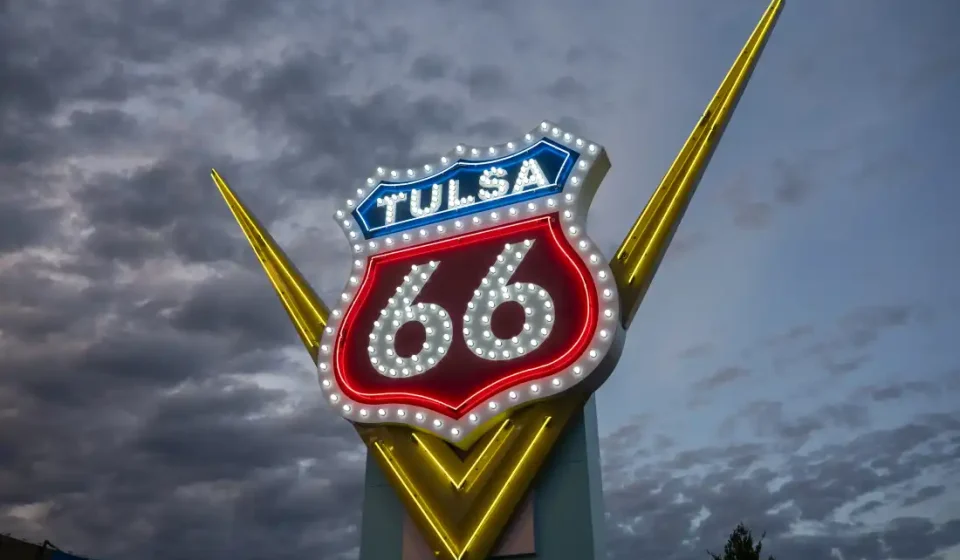


A neon sign lights up at sunset in Tulsa, Okla.
Nick Oxford for NPR
hide caption
Nick Oxford for NPR
In its heyday, Route 66 became an iconic road trip, connecting the main streets of cities and small towns from Chicago to Los Angeles. And the neon signs were the radiant jewels scattered along the side of the road.
Glowing glass lights were a novelty when Route 66 opened in November 1926. Parisian Georges Claude had invented the idea of running electricity through tubes filled with neon gas in 1910. The first neon sign arrived in the United States in 1922, at a Packard car dealership, and locals were amazed. It seems that the gapers caused traffic jams.
Claude sold franchises, including one to what is now Claude Neon Federal Signs, founded 100 years ago, as was Route 66. It is still in business in Tulsa, and the company’s website says it is the largest sign company in Oklahoma.
Neon: beautiful and dangerous
CNF Signs still has “neon benders,” artisans who heat glass tubes in a fire and bend the glass by hand to form shapes and letters, just like Claude did. One of them is Tom Wolski, who said he told visitors to his studio to take a step back.

High: Tom Wolski is one of two full-time neon masters at CNF Signs in Tulsa. LEFT: He heats two glass tubes to weld them together for a neon sign. RIGHT: A range of glass tubes for illuminated signs.
Nick Oxford for NPR
hide caption
Nick Oxford for NPR
“In this room, you have extreme electricity. You have fire, you have phosphorus, you have mercury. It’s pretty dangerous; you have to be careful what you do. God knows why I would want to do that, but I love it,” Wolski said with a laugh.
He was once one of two full-time neon benders at Enseignes CNF, but fewer and fewer companies are ordering them because they are so expensive.
Instead, many are turning to LEDs, which can seem like neon. LEDs are less expensive to manufacture and operate and are less dangerous. But Joe Kesterson, senior designer at CNF Signs, maintains that LEDs don’t look as good.

Joe Kesterson looks at a neon sign at the Route 66 Neon Sign Park during a neon sign tour in Tulsa.
Nick Oxford for NPR
hide caption
Nick Oxford for NPR
The neon glows like a candle, he explained. LED lights are brighter and sharper.

It can be easy to confuse LED lights with neon, he added, but “once you see them together, you can see that (LEDs) almost have a harshness to light.”
An interesting fact: not all neon lights themselves are neon gas.
“Neon gas is red when it lights up,” Kesterson said. “And so anything you see that has a warm color usually contains neon. But cool colors are created using argon gas.”

Neon gas is used in warm colors, but argon gas is used to create cool colors, according to Joe Kesterson, senior designer at CNF Signs.
Nick Oxford for NPR
hide caption
Nick Oxford for NPR
Plus a few balls of mercury, which keep the gas molecules unstable and energized.

The combination of argon and mercury interacts with a phosphor powder coating inside some tubes, making them glow in a rainbow of colors.
“And it never works the way you think it does,” Kesterson said. “It’s not like we learned in school, where blue and yellow make green. If I put blue gas in a piece of yellow neon, most of the time it turns orange or some strange color you wouldn’t expect.”
From migrants to vacationers

A neon sign invites visitors to stay at the Desert Hills Motel along Route 66 in Tulsa.
Nick Oxford for NPR
hide caption
Nick Oxford for NPR
Those bright colors “are part of the mystique of Route 66,” Kesterson said. “This is what you would have seen traveling as a child with your parents across the country.”
Route 66 was the nation’s first paved highway and served as the main route for migrant farm workers during the Dust Bowl. It later became a military transportation corridor during World War II. All that traffic led to gas stations, restaurants, and motels, and those amenities led to vacationers.
“And as you’re going down that highway, you need something that’s going to stop that activity and bring them to your door,” said Kathleen Franz, associate director of curatorial affairs at the National Museum of American History and a specialist in the history of technology.
“The companies that had neon seemed up-to-date, modern, new. Here was a company ready to invest in itself.”

A vintage sign design is featured in a book at CNF Signs.
Nick Oxford for NPR
hide caption
Nick Oxford for NPR
And that, Franz said, signified to travelers that the motel or restaurant was clean and safe. Suddenly neon was everywhere. And it was inventive.
The 1950s brought Googie-style signs with space-age shapes: boomerangs and dishes, stars and swirls. Companies learned how to animate their signs, making flashing arrows and looping lassos.
Tulsa was a place that became particularly big. The 1934 “Meadow Gold” sign, a local landmark advertising a dairy, is the size of a school bus, with letters up to 7 feet high. It was originally built by Claude Neon Federal Signs and restored approximately 70 years later.
A decline and a rebirth

The Meadow Gold neon sign along Route 66.
Nick Oxford for NPR
hide caption
Nick Oxford for NPR
Over time, five new interstate highways replaced portions of Route 66, and it ceased to be fully recognized as a federal highway in 1985. Traffic in small towns declined and businesses closed. Neon signs are expensive to operate and many have been turned off, sold, trashed or, like the Meadow Gold sign, stored.
But almost immediately, a movement began to preserve and memorialize the route, and in 1999, legislation authorized the National Park Service’s Route 66 Corridor Preservation Program. Along the old route, communities hoping to attract these tourists have begun restoring roadside attractions, including illuminated signs.
In 2004, the Meadow Gold sign was saved when the building it stood on was scheduled to be demolished. CNF Enseignes rebuilt the scaffolding and restored the porcelain letters which house the neon; it was relit and placed in what is now the Meadow Gold district of the city in 2009.
In 2019, as Route 66’s centennial approached, the Tulsa Route 66 Commission launched a grant program for businesses that wanted to make new signs from neon or LED tubes, or restore old ones. Today, there are more than 100 neon signs in Tulsa, including recreated vintage signs at Neon Sign Park, part of Cyrus Avery Plaza.

The Will Rogers Motor Court sign is on display at the Route 66 Neon Sign Park.
Nick Oxford for NPR
hide caption
Nick Oxford for NPR
These replicas include signs otherwise lost to history, such as the Will Rogers Motor Court, featuring a cowboy on a prancing horse (the name “Will Rogers” is surrounded by a gold lasso), and the Tulsa Auto Court, which features a red car with the silhouette of a driver in the window and what appear to be moving tires.
The park is on a very quiet section of Route 66, next to a river and a railroad track and below the highway. Above, traffic whizzes by on I-244.
You can’t see the signs on the modern highway, but they’re there, shiny.
Audio and digital edited by Steven Drummond. Chloee Weiner mixed the audio. Emily Bogle retouched the photos.
Gn bussni