
People who use cannabis are much more likely to be violent than those who do not use cannabis. This is the unsurprising revelation of an analysis carried out by researchers at King’s College London based on 63 studies, involving more than 265,000 people.
The effects of cannabis include significantly increased anxiety, increased feelings of vulnerability, and outright paranoia. This is especially true for the drug in its contemporary form, in which it contains much more of the active ingredient THC, than when marijuana was considered a countercultural drug or a teenage declaration of independence from Mom and Dad.
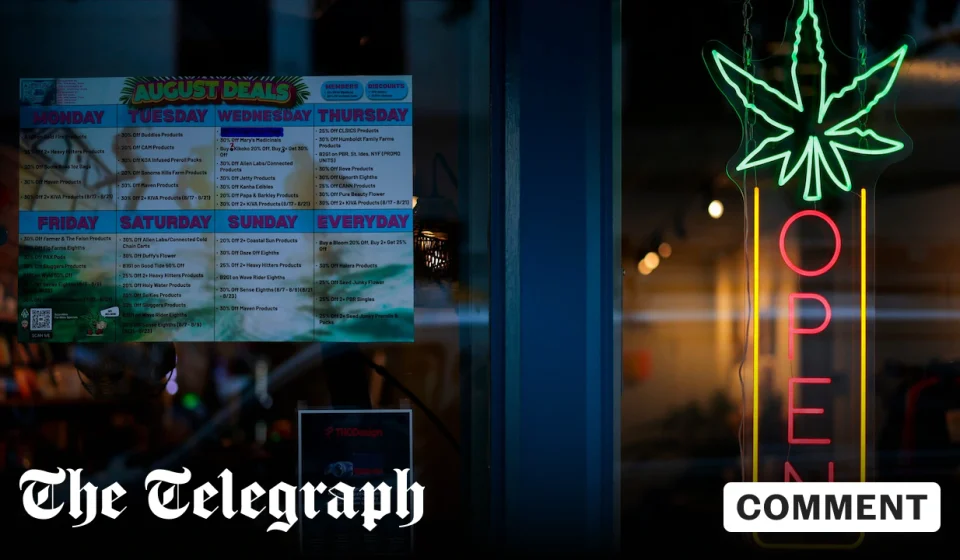
Legalization does not necessarily reverse the trend toward ever-stronger versions of cannabis – indeed, the American experience shows that legal weed has led to an unprecedented increase in the consumption of THC products.
There is strong evidence that cannabis can make people violent and cause paranoid psychoses of varying duration. Legalizing cannabis – that is, in other words, almost approving its use as normal – will make psychotic violence more widespread.
This violence is not the only socially harmful effect of cannabis. People who become psychotic, or even simply vacant, under its influence are less adapted to ordinary life, and disregard or ignore social norms and cause misery around them, thus distressing those who care for them.
Cannabis impairs perception, judgment and physical coordination. Cannabis and cocaine are now more often involved in fatal road accidents than alcohol. Indeed, driving a car is not the only activity that requires precise perception, judgment and coordination. No one, for example, would want to have an operation by a surgeon under the influence of cannabis.
Thus, it is not true, as legalization propagandists such as Sadiq Khan, the Mayor of London, sometimes claim, that the harms of drugs are caused primarily, or even solely, by their illegal status, and the criminal activity that results from it. The harms of drugs are often inherent in their pharmacological effects; Legalization is not a solution to the problems caused by cannabis. Nor are drug dealers likely to become respectable citizens once deprived of their current merchandise.
It is worth remembering that the largest recent epidemic of harm caused by drugs taken for recreational or non-strictly medical purposes, that of opioids in the United States, began with the perfectly legal prescribing of new opioid drugs by gullible, foolish, or sometimes even corrupt doctors. At the height of the opioid epidemic, they were responsible for far more deaths in America every two years than U.S. deaths in all of its foreign wars since the end of World War II combined (about 110,000). The main victims of opioids were those in formerly industrialized parts of the country.
It is often said that the so-called war on drugs has failed, but it is a failure more metaphorical than political. The goal was to limit drug use, not eliminate it altogether, which is no more possible than a war on crime eliminating burglaries or murder. But this lack of elimination is no reason to legalize burglary or murder.
A controlled cannabis market would be difficult to regulate and control. It is not as if the British public administration is distinguished by its efficiency. If the price of cannabis were too high, the black market would increase again (as has happened in some jurisdictions that have legalized cannabis). If the price was set too low, consumption would explode – and violence with it. This would require ever more surveillance and policing of the population. Paradoxically, liberalization would lead to more authoritarian control, unless society completely collapses.
Making the drug even more readily available than it already is and making it a commodity more or less similar to chocolate would be an irresponsible mistake.
Theodore Dalrymple was a prison doctor and psychiatrist
Gn Health