
Oil prices retreated on Tuesday, reversing recent gains as investors weighed signs of a recovery in exports from Middle East producers against uncertainty over the fate of the war in Iran. Brent crude for November delivery fell 1.5% to trade at $103.72 per barrel as of 1:10 p.m. ET, while WTI crude for October delivery fell 2.2% to change hands at $90.62/barrel. Crude exports from the region climbed to 15.5 million barrels per day in September, which represents more than 80% of pre-war levels and the highest level since the start of the conflict seven months ago. Saudi Arabia has spearheaded the recovery, more than doubling its crude exports from 2.45 million bpd in August to about 5.4 million bpd in September after returning parts of the damaged East-West pipeline to service.
And now, commodities analysts at Standard Chartered have raised their oil price forecasts, amid stagnating diplomatic efforts and regional escalation beyond Iran and Hormuz.
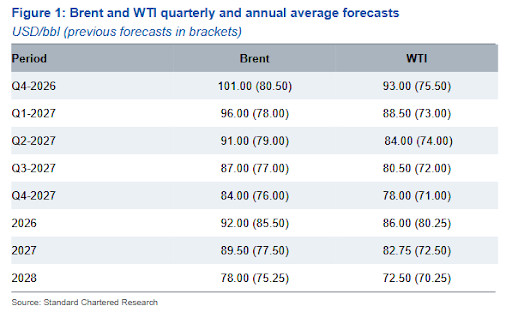
StanChart raised its average Brent crude forecast for 2026 to $92.00/barrel from its previous forecast of $85.50/barrel, while WTI crude is now expected to average $86.00/barrel, up from $80.25/barrel. StanChart also raised its oil price forecast for 2027 and now expects Brent to average $89.50/barrel from $77.50/barrel, while WTI crude will increase from $77.50/barrel to 89.50/barrel.
According to StanChart, the global energy market now faces a more persistent deterioration in the security environment in the Middle East, with little chance of a return to the pre-conflict status quo and no real path to a settlement yet visible. The conflict continues to spill over into a broader regional security issue, with the Houthi/Saudi escalation adding a second front and Saudi Arabia digging deeper.
Related: Iran talks dampen oil rally

Source: Standard Chartered
StanChart notes that Brent and WTI remain stuck between structural tightening and political risk. Supply reserves are extremely thin, meaning price movements are very sensitive to further disruption. StanChart expects only a gradual and imperfect de-escalation process, even if U.S.-Iran negotiations resume shortly, with periodic bursts of tension likely to maintain a premium built into prices.
Meanwhile, the events of 2026 accelerate the energy system’s shift from efficiency to resilience, StanChart notes. For years, companies have reduced inventories, consolidated supply chains, and prioritized efficiency over resiliency. Analysts say this approach is reversing as governments, producers and consumers build larger inventories, maintain more spare capacity and diversify their suppliers. This change increases costs, but it also favors a higher long-term floor for oil prices. As a result, they expect oil markets to normalize more slowly, with high prices likely to persist through 2027 and beyond.
In product markets, diesel price have reached an all-time high, with StanChart saying it has now moved from a market problem to a policy problem. The coming weeks could clarify to what extent Trump administration is ready to intervene in American product markets as the midterm elections approach. Significant domestic pressure persists for a U.S. ban on diesel exports, particularly from battleground states where high diesel prices coincide with a key agricultural harvest season (Iowa, for example).
Asset supported restrictions on diesel exports previously; However, many members of his cabinet (including Energy Secretary Chris Wright) have warned that this could also ultimately lead to a tightening of gasoline and jet fuel supplies. This would in turn worsen the global commodity problem and (after temporarily helping U.S. consumers) ultimately hurt the Gulf Coast refining economy, potentially reducing crude volumes.
StanChart notes that pressure to demonstrate action on domestic prices is leading the administration to consider less disruptive alternatives, including voluntary export reductions by refiners and broader use of tax-exempt dyed diesel.
In the natural gas marketsEuropean Commissioner for Energy and Housing Dan Jørgensen recently urged Member state energy ministers are expected to both support larger injections and consider measures to reduce demand for gas and electricity, warning of a potential price crisis linked to supply risk. However, the urgency in Brussels is less evident on the market, with European natural gas futures falling to €69.30 per megawatt hour on Tuesday, the lowest level in a month due to falling Chinese demand for LNG.
According to StanChart, this initiative by the European Commission aims to spark a stronger response and bridge the urgent gap between state and market. Analysts note that the current flexibility to lower the storage target to 80% could ease price pressure in the short term, but it will not completely eliminate Europe’s winter exposure.
By Alex Kimani for Oilprice.com
More important reading on Oilprice.com
Gn bussni