
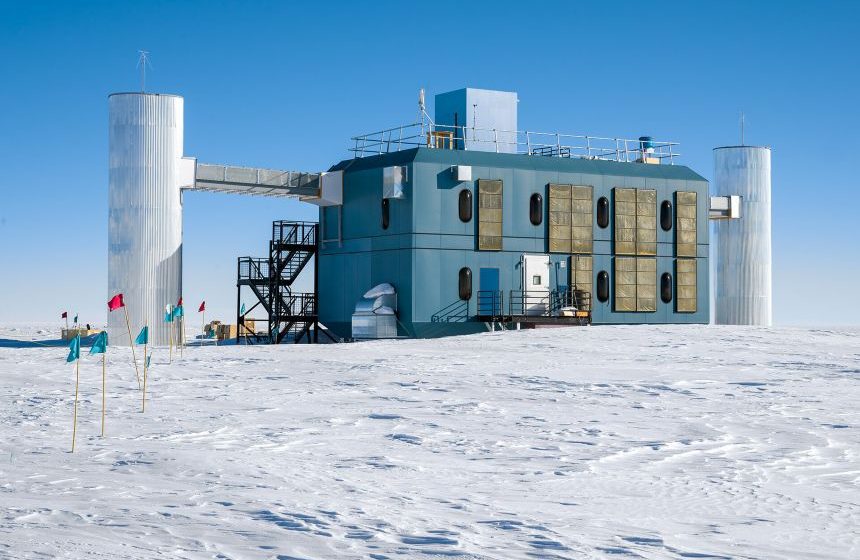
The Nobel Prize in Physics awarded to Francis Halzen for his work on the detection of “ghostly” cosmic particles

The 2026 Nobel Prize in Physics has been awarded to Francis Halzen, a pioneering Belgian astrophysicist whose work developing a massive observatory in Antarctica to detect “ghostly” cosmic particles laid the foundations for an “entirely new type of astronomy.”
These tiny, high-energy space particles, known as neutrinos, transmit information that allows scientists to better understand distant galaxies and exploding stars, Nobel committee member Eva Olsson said as she presented the prize Tuesday at the Royal Swedish Academy of Sciences in Stockholm.
“Francis Halzen led an international team of researchers and engineers who gave us a fantastic instrument,” Nobel committee chairman Mark Pearce said in a statement. “His tenacity and scientific vision paved the way for a new type of astronomy.”
Halzen, 82, told the Nobel news conference by telephone from Italy that it was a “big surprise” and a “pleasure” to win the prize.
“When we started this project, everyone realized that maybe it was a good idea, but very few thought it would work, including me,” he said. “So it was kind of an adventure where success wasn’t guaranteed.”
The professor, based at the University of Wisconsin-Madison, first presented plans for the IceCube neutrino observatory in 1988, envisioning a vast array of sensors in the Antarctic ice that could capture neutrinos.
The observatory exploits a key property of neutrinos: They produce a flash of light upon collision with an atomic nucleus that could be tracked by sensors embedded in clear, glacial ice.
Arriving on Earth from the far reaches of the cosmos, neutrinos are often referred to as “ghostly” because they are extremely volatile or vaporous and can pass through any type of matter without changing. They have almost no mass and no electrical charge. They can travel through the most extreme environments, such as stars, planets and entire galaxies, and remain the same.
“It’s been a long time since the Nobel Prize was awarded to a single individual, which shows the uniqueness of his vision,” said Richard Fitzgerald, editor of Physics Today, published by the American Institute of Physics. “It took a team of hundreds of people to build it, but it all started with one person. »
While billions of neutrinos come from the Sun, those from other regions of space are much rarer and more difficult to detect.
In the 1980s, Halzen first realized that Antarctica’s ice might be ideal for trapping these secret neutrinos, but installing sensitive equipment deep in the ice was a colossal effort requiring researchers to drill miles-deep holes and lower strings of light sensors.

IceCube’s predecessor, known as AMANDA, was completed in 2000, but it failed to detect the high-energy neutrinos Halzen sought, the Nobel Committee said. Work then began on IceCube, a cubic kilometer of ice equipped with light sensors, which reached its maximum size in 2011, with 5,160 light sensors spread across 86 cables.
In 2013, the research team reported the first evidence supporting the detection of cosmic neutrinos and a few years later had gathered enough data to be certain of their discovery.
The Nobel committee said IceCube would take neutrino astronomy to a new level, providing information about cosmic phenomena hidden behind dust clouds and deep space objects such as black holes.
A project to expand IceCube, allowing it to monitor eight cubic kilometers of ice, is planned.

Last year, the physics prize was awarded to John Clarke, Michel Devoret and John Martinis for their discovery of a phenomenon called quantum mechanical tunneling in an electrical circuit, an advance that laid the foundations for quantum computing and other related technologies.
The prize carries a cash reward of 12 million Swedish crowns ($1.2 million). On Monday, the Nobel Prize in Medicine was awarded to three scientists for their work developing a technique to decode the inner workings of the brain.
The awards ceremony continues on Wednesday with the announcement of the chemistry prize, followed on Thursday by that of literature. The Peace Prize will be announced on Friday, followed by the Nobel Memorial Prize in Economic Sciences on October 12.
This story and its headline have been updated with additional reporting.
Gn headline