
Los Angeles City Council member Nithya Raman has a slight advantage over incumbent Karen Bass in the mayoral race, according to the latest vote tallies.
But election experts say the early lead is likely a sign that Raman has what it takes to stay in the lead.
The ballots that have yet to be counted — mostly from mail-in ballots sent on or just before Election Day — tend to come from younger, more progressive voters, election experts say, so they expect future counts to lean more in Raman’s favor. Bass is considered the more moderate of the two Democratic candidates.
“The odds are in Raman’s favor at this point,” Zev Yaroslavsky, director of the Los Angeles Initiative at UCLA’s Luskin School of Public Affairs, said Wednesday morning. He’s a former city councilor and county supervisor who closely follows local elections. “I expect his lead to extend.”
Of course, no one knows how uncounted ballots will turn out, but local election experts rely on trends from previous elections.
A Times poll taken days before the election showed the candidates in a deadlock. There are still about 37% of the votes to be counted in the mayoral election, which translates to about 433,000 ballots, according to expected vote calculations from the Associated Press.
Bass trailed Raman by just over 16,500 votes, at 49 percent, as of Wednesday morning. Raman came first with 51.1% of the votes.
The next batch of counted ballots will be released around 5 p.m. Wednesday, according to the Los Angeles County Registrar of Voters.

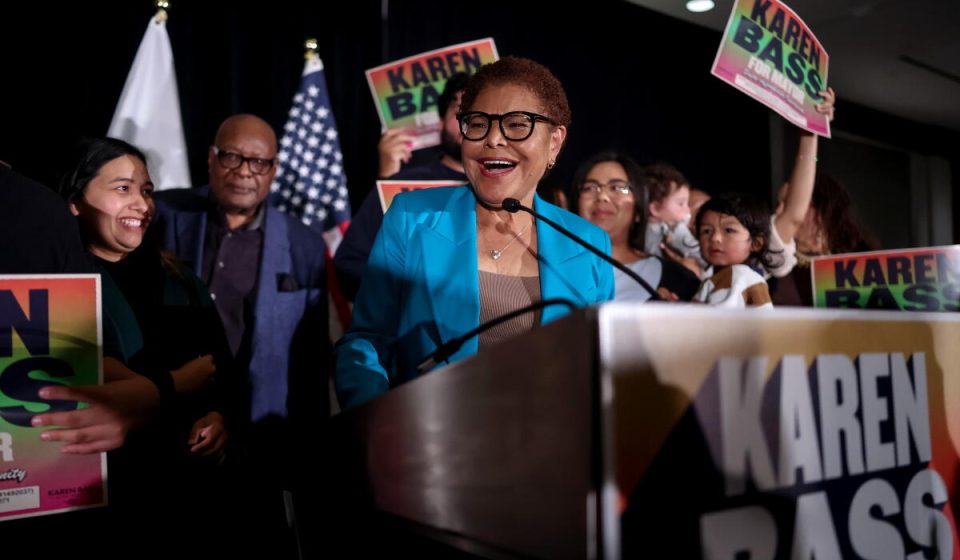
Los Angeles Mayor Karen Bass speaks during her election night event at the Loews Hollywood Hotel.
(Eric Thayer/Los Angeles Times)
Raman, first elected to the council in 2020, joined the race in February, launching a challenge against someone she had publicly supported just weeks earlier. Since then, the contest has in many ways been a generational fight, with the two men defending divergent positions on public safety, housing production and strategies to end homelessness.
Bass, 73, was supported by much of the city’s political establishment, including the Los Angeles County Federation of Labor and the county Democratic Party. Raman, 45, has aligned herself with groups that have emerged more recently at City Hall, including the left-leaning Democratic Socialists of America and Streets For All, a transportation advocacy group.
The first ballots counted on election night typically come from older, more conservative voters, a group Bass needed to win by wide margins, said Paul Mitchell, who runs polling data firm PDI. The fact that Raman took the lead late Tuesday night is not a good sign for Bass’s campaign, he said.
“These are probably better numbers than the Raman campaign could have expected,” he said.
Even without an initial lead, experts expected the vote count to eventually swing in Raman’s favor because those voters tend to be more liberal, younger and working class.
“At the moment, it seems like the numbers confirm what we thought: People who voted later, and therefore are counted later, are likely to be Raman’s main base of support — the younger voters, the more progressive voters,” said Jessica Levinson, a law professor at Loyola Marymount University. “It was a really good night for progressives, and it’s hard to see why or how Los Angeles doesn’t (follow suit).”
It should be noted, however, that late polls indicated an increase in support for Bass as Election Day approached. So Levinson said there’s a chance more undecided voters waited longer to vote, many of whom may have landed in Bass’s camp.
“There were a ton of undecided voters in the last few weeks of this race, so anyone who says it’s over…is kind of putting the cart before the horse,” Levinson said.
Nonetheless, she expects the majority of subsequent votes to go to Raman.
“Based on past experience, Mayor Bass probably has a steeper mountain to climb,” Yaroslavsky acknowledged.
This late progressive shift has occurred repeatedly in California elections, but particularly in the recent Los Angeles municipal elections. Most recently, in the June primary, Raman initially placed third behind Bass and Republican Spencer Pratt. But as mail-in ballots continued to arrive — verified and then counted — Raman continued to close the gap, eventually overtaking Pratt.
Similarly, in the 2022 primary, Bass – then considered the progressive candidate – initially trailed developer Rick Caruso, but took the lead as more ballots were counted.
“In every election since mail-in voting has existed, votes that are counted later tend to be more progressive,” Yaroslavsky said.
This late surge in momentum for a specific candidate or ideology is not a sign of fraud, a counting mishap, or people voting after the polls closed — it is a function of California’s election system. Mail-in ballots, the most popular way to vote in California, are accepted up to seven days after the election if they are postmarked on or before Election Day, and the official count can take up to 30 days.
“Anyone who sent in their ballot on Monday, Sunday – or Tuesday – will not arrive until today or tomorrow, and they all have to be validated,” Yaroslavsky said. “There are still a lot of ballots to be counted. »
Staff writers Noah Goldberg and David Zahniser contributed to this report.
Gn usa