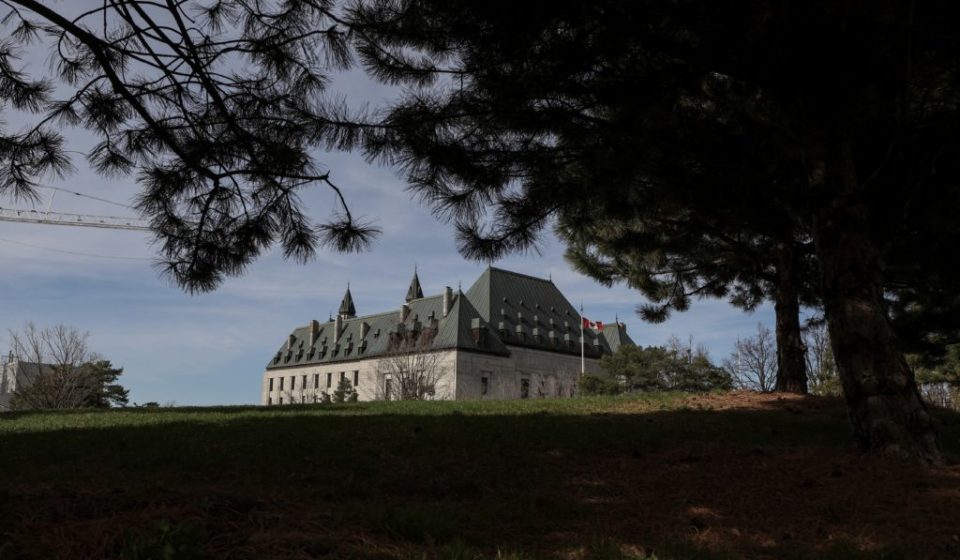
The Supreme Court of Canada largely confirms Quebec’s ban on religious symbols for civil servants

TORONTO (AP) — The Supreme Court of Canada on Friday upheld most of a Quebec law banning public school teachers, police officers and other public employees in positions of authority from wearing religious symbols at work. The decision upheld Quebec’s authority to override certain constitutional rights to keep the ban in place.
The 2019 law, known as Bill 21, bans religious symbols – including Muslim headscarves, Sikh turbans, Jewish skullcaps and Christian crosses – for workers covered by this law.
Canada has long embraced multiculturalism, encouraging people to maintain their cultural and religious identity. Supporters of the Quebec ban say civil servants should avoid wearing religious symbols to demonstrate government neutrality.
READ MORE: Pentagon sharply criticizes Canada for military modernization
Quebec Premier Paul St-Pierre Plamondon hailed this decision as “a victory for secularism” and for Quebec’s ability to make choices different from the rest of Canada.
The court upheld Quebec’s use of the “notwithstanding clause,” which allows lawmakers to override certain rights, including religious freedom and equality. These rights are protected by the Charter of Rights and Freedoms, the Canadian equivalent of the American Bill of Rights. Lawmakers must renew the waiver every five years to keep it in effect.
Prime Minister Mark Carney said he respected the decision, but promised his government would not use the constitutional override. He emphasized that constitutional rights are particularly important for minorities and vulnerable people.
“Canada is a mosaic,” Carney said, adding that it represents much more than different backgrounds and identities. “It’s a commitment, in my opinion, a commitment to how we treat each other.”
Carney also praised the Court’s finding that judges can still rule that a law violates constitutional rights even when the waiver allows it to remain in effect. He said the scrutiny helps inform Canadians and is useful in a democracy.
Chief Justice Richard Wagner wrote that the law reflected Quebec’s “legitimate and historic commitment” to maintaining the secularity of government.
READ MORE: China and Canada extend tariff relief as relations with US strain
The Court upheld an exemption allowing members of the Quebec Legislative Assembly to cover their heads — or potentially, for women, to cover their faces — while carrying out their duties.
Quebec’s commitment to secularism grew out of its rejection of the once-dominant influence of the Roman Catholic Church.
Opponents say the law discriminates against religious minorities, particularly Muslim women who wear headscarves.
“Quebec continues to tell qualified people that they must put aside their faith,” said Mehramat Kaur of the World Sikh Organization of Canada.
France, Belgium, Austria and the Netherlands completely or partially ban the wearing of the veil, including the wearing of the veil by some Muslim women.
Other Canadian provinces have used this exemption for laws restricting transgender rights or ordering striking employees to return to work.
Manitoba Premier Wab Kinew called Bill 21 “legal discrimination” against Muslims, Sikhs and other religious minorities. He said his government would never use this waiver.
“If I have to go after someone to get elected, I don’t deserve this position,” Kinew said.
A free press is the cornerstone of a healthy democracy.
Support trusted journalism and civil dialogue.
Gn headline