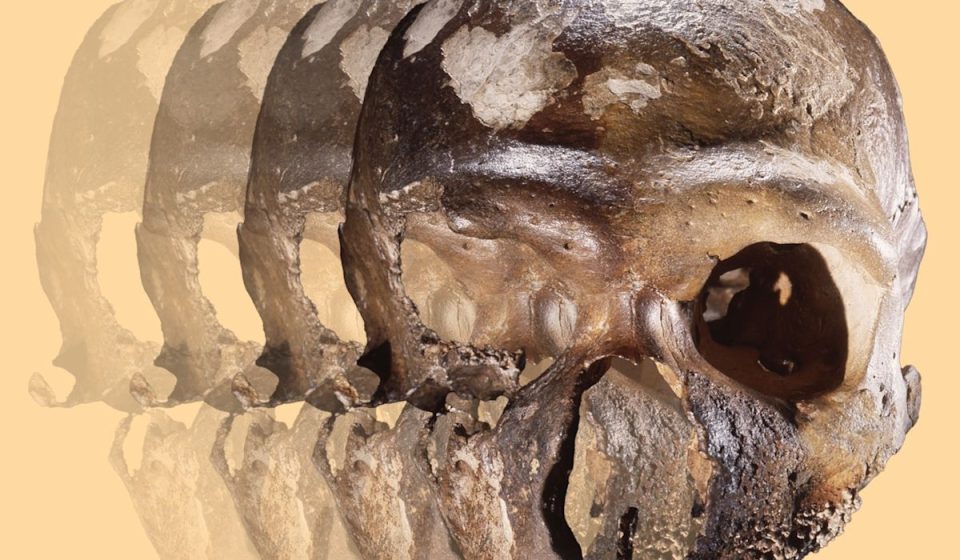
Neanderthals passed on some of their DNA when they interbred with humans tens of thousands of years ago. New research shows that an ancient Neanderthal gene variant is linked to a smaller occipital lobe in modern humans, even though Neanderthals themselves had larger occipital lobes than Homo sapiens. Photographic illustration, NGM staff. Photo source for illustration: Werner Forman, Universal Images Group, Getty Images
When we interbred with Neanderthals around 47,000 years ago, our brothers from the past passed on their genes to us. Among the stack of hereditary transmissions are genetic signals that influence our height, muscles, noses, teeth, head shape and much more. Even the blood that flows through some people’s veins clots more because of the Neanderthals in their lineage.
Researchers have discovered that a Neanderthal genetic variation could reduce the size of our occipital lobes, the part of the brain that manages vision, and provide some protection against schizophrenia.
“It amazes us that DNA inherited from Neanderthals influences our brain anatomy today,” says Svante Pääbo, an evolutionary geneticist at the Max Planck Institute for Evolutionary Anthropology in Germany and author of the study recently published in the journal Proceedings of the National Academy of Sciences.
(You May Have More Neanderthal DNA Than You Think.)
Pääbo won the 2022 Nobel Prize in Physiology or Medicine for his work sequencing the Neanderthal genome. The genetic insights he and others have gained from this research help tell the story of how closely we are related to our extinct cousins.
In their latest study, Pääbo and his colleague Hugo Zeberg, an evolutionary geneticist at the Karolinska Institute in Sweden, discovered that a genetic variant close to DAAM1 The gene inherited from Neanderthals was associated with slightly smaller occipital lobes in modern humans. People with two copies of this genetic variant – one from their mother and one from their father – had even smaller occipital lobes.
Although the size difference found is statistically significant, the actual size difference is relatively modest. Those who had the Neanderthal gene variant had an occipital lobe whose volume was only 0.85 cubic centimeters smaller than that of non-carriers, which is a little smaller than an average blueberry. Those who owned two copies had a smaller volume of 1.7 cubic centimeters. Researchers aren’t sure why the genetic variant was associated with smaller size in this region of the brain, especially since the fossil record suggests that Neanderthals generally had larger occipital lobes than Neanderthals. Homo sapiens.
(Neanderthals finally get their due from scientists.)
“Our anatomy is influenced by many genes,” explains Pääbo. “A single Neanderthal variant can reduce the volume of the occipital lobe even if the cumulative effects of many genetic variants in Neanderthals resulted in larger occipital lobes.”
Researchers have tracked genetic variation through large genome-wide studies of intelligence, which they say showed that carriers of the genetic variant who had smaller occipital lobes showed no negative effects on their intelligence.
Instead, Pääbo and Zeberg found that these people had an interesting advantage over the rest of us: those who had one copy of the genetic variation had a 5% reduced risk of developing schizophrenia, and those who had two copies had a nearly 10% reduced risk.
“A 10 percent reduction is substantial compared to other genetic risk variants,” says Pääbo. But he cautions that environmental factors and the way people take care of themselves are often much more powerful factors than these ancient genes. “In terms of personal risk, I don’t think it’s something to worry about or consider.”
(What a 55,000-year-old fetus reveals about the decline of Neanderthals.)
Pääbo also pointed out that the frequency of this genetic variant in different European populations varies between around 5 and 15 percent. “Most Europeans don’t even have a copy of this Neanderthal variant,” he says. “In addition to this, there are clearly many genetic and non-genetic factors that influence schizophrenia risk.”
To conduct their study, the researchers first examined four genetic variants already known to influence the size of the occipital lobe. They found that one of these variants occurred exclusively in modern people outside of Africa, meaning it was likely inherited from Neanderthals. They then compared this genetic variant to five sequenced Neanderthal genomes and found that it was present in all of them. This meant that people carrying this genetic variant had most likely inherited it from their Neanderthal ancestors.
Joshua Akey, an evolutionary biologist and geneticist at Princeton University who was not involved in the research, calls the genetic evidence “pretty compelling.” He added that the researcher’s findings that the genetic variant came from a Neanderthal were well supported and that its association with brain structure was statistically very strong.
“I also found the association with reduced risk of schizophrenia intriguing, particularly because the study finds little evidence that this genetic region influences general cognitive ability,” he says. “This reinforces the point that differences in the size of a particular brain region do not necessarily translate into differences in cognitive performance.”
(This may be the first evidence of the existence of Neanderthal “dentists.”)
Although the genetic association discovered by the researchers is strong, Akey notes that scientists still don’t understand the biological mechanisms responsible for it. He also cautions against extrapolating the effects of these genetic variants in modern-day humans to conclusions about the anatomy, cognition, or behavior of Neanderthals themselves.
In addition to schizophrenia, the researchers also examined whether the genetic variant inherited from Neanderthals impacted three other psychiatric disorders, including bipolar disorder, ADHD and major depression. They only found an impact in schizophrenia.
Zeberg adds that they haven’t finished looking at this variant and how it appears in people living today. For example, he says they recently performed an analysis using a recently published large genome-wide association study on the Big Five personality traits.
“We just found out today that carriers of the variant perform better on extroversion,” he says.
Nicolas Saint-Fleur is a digital science editor at National Geographic based in Washington, DC. It covers archaeology, paleontology and ancient human origins.
Gn Health