The United States investigates Megaspeed and Alice Huang, new personality linked to the Nvidia affair

The logo of data center company Megaspeed International is pictured at its offices at the Ocean Financial Center in Singapore on November 10, 2026.
Taryn Ng | Afp | Getty Images
Director of National Intelligence Jay Clayton said the United States was investigating Alice Huang and her former company, Megaspeed, because a report identified one of her associates as a key decision-maker at the Singapore-based company.
Alice Huang, with whom ousted Nvidia CEO Jensen Huang was allegedly romantically involved, was a key figure at Megaspeed International, a cloud computing company that operates data centers across Southeast Asia, linked to the fallout from the management shakeup.
“There’s an ongoing investigation into her company and her,” Clayton told ABC on Sunday, adding that “Nvidia chips are the crown jewel. They’re the absolute top that everyone wants, so that’s why we’re focused on that.”
Alice Huang’s associate, Chinese national Li Ming, currently out on bail in Singapore, was “deeply involved” in Megaspeed’s activities and took part in major decisions, the Wall Street Journal reported Saturday, citing people familiar with the matter.
The charges in Singapore against Li relate to alleged false statements to Super Micro Computer, a US-based company with known ties to chipmaker Nvidia, although Megaspeed is not named in those charges.
Last week, the Commerce and Justice departments said the investigation into Megaspeed began in 2024 for potential export control violations. Their joint statement said the Bureau of Industry and Trade Security and Singapore law enforcement questioned Huang during an on-site check in June 2025.
The Department of Justice then took charge of the criminal investigation.
Treasury Secretary Scott Bessent told CBS on Sunday that the administration was seeking answers from Nvidia regarding its chip sales to China, including who oversaw compliance and what levels of the company were aware of that activity.
Separately, the New York Times reported Sunday that Alice Huang had been in contact with an officer at a top Chinese intelligence agency from spring 2025 to fall 2026, citing people briefed on U.S. intelligence reports.
Bloomberg reported last week that the Justice Department was investigating whether entities linked to Alice Huang helped smuggle Super Micro products into China.
Li faces five charges in Singapore, including two counts of fraud by misrepresentation, as well as allegations relating to the operation of a company he controlled, unauthorized access to a bank account and the duties of another company director.
Prosecutors say he falsely told Super Micro that the company would own and lease the servers it purchased.
The Journal reported that Li was free on bail and his case was ongoing. He was offered bail of S$1 million in March 2025. The Singapore charges do not name Megaspeed.
Earlier this month, Singapore’s Home Affairs Ministry said police had not found enough evidence to establish that Alice Huang had committed offenses related to the possible misrepresentations under investigation.
The ministry said she received a stern warning for providing information that police found to be knowingly inaccurate and for downplaying her role at Megaspeed. He also said Singapore had not investigated her for espionage.
Megaspeed said it was a “legitimate and legal company” and that Huang left the company in August 2025.
Several smoking weapons
Surveillance will intensify in Washington. Former Nvidia CEO Jensen Huang and the company’s general counsel, Tim Teter, agreed to grant closed-door, transcribed interviews with three House committees on December 1 and December 2, respectively.

The committees said they wanted answers about Nvidia’s role in giving Chinese players access to advanced chips and the involvement of a potential Chinese intelligence agent.
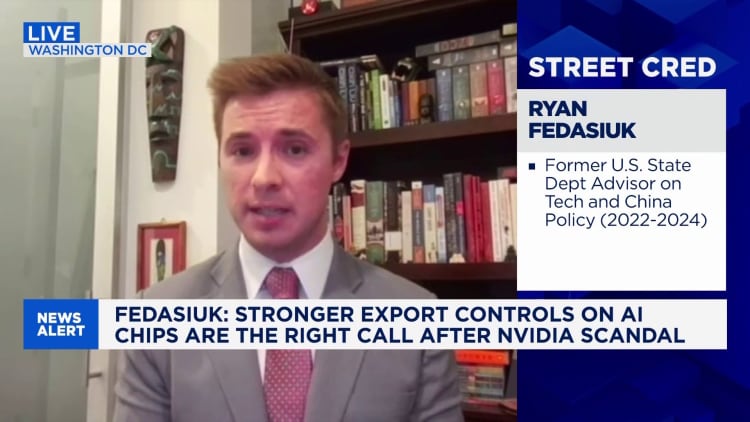
Speaking on CNBC’s Squawk Box on Sunday, Ryan Fedasiuk, former adviser for U.S.-China bilateral affairs at the State Department, said there is “still a lot we don’t know” about the case.
He said lawmakers would likely focus on Nvidia’s customer relationships and “who knew what at the company and when.”
Fedasiuk added that there was a “very good chance” that investigators would find that people at Nvidia knew their products could be used for restricted purposes. He called the existing evidence “several” smoking guns.
Gn bussni