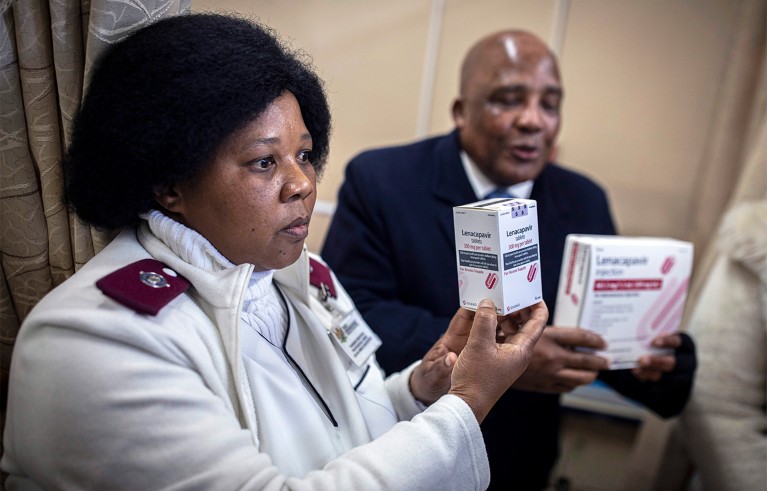

South African health officials at the June launch of lenacapavir, a drug that provides strong protection against HIV when given twice a year.Credit: Per-Anders Pettersson/Getty
Earlier this month, the U.S. Food and Drug Administration (FDA) approved a generic version of the anti-HIV drug lenacapavir for use as a preventive treatment. Biannual injections of this revolutionary drug – originally developed by Gilead Sciences in Foster City, California – have been shown to be more than 95 percent effective in preventing the acquisition of HIV.1. At the same time, as Nature reports in a news article, an HIV vaccine – which would ultimately be a stronger solution to preventing HIV – is closer than ever.

A powerful HIV vaccine is finally within reach – thanks to these super antibodies
In 2024, Gilead signed licensing agreements with six pharmaceutical companies, allowing them to manufacture and sell generic versions of lenacapavir in 120 low- and middle-income countries, subject to regulatory approval. The recent FDA approval brings access closer in these countries. The cost for users has been set at $40 per year, fueling hopes that the drug will help control the global HIV epidemic.
These welcome developments contrast with the state of public funding for HIV research and treatment, which is suffering from deep and unacceptable budget cuts by the US government. Many of the researchers that Nature spoke for the news report had been funded by a preclinical HIV vaccine research program run by the U.S. National Institutes of Health (NIH). But the agency ended the program last year, forcing researchers to scale back their research and seek other funding. Whatever funding follows will likely be less stable and less predictable than NIH funding. It is imperative that the cuts are reversed – or that new sources of government funding are found.
Costly failures
The road to an HIV vaccine has been long and rocky, with decades of high-profile and costly failures, but there is now light at the end of the tunnel. The latest strategy – known as germline targeting – is designed to trigger the production of rare and highly potent antibodies that can prevent infection by various strains of HIV. The technique has shown encouraging results in animal models2–4 and in the first trials in humans5. Researchers are more optimistic than they have been in years about the possibility of an effective HIV vaccine.

The end of AIDS is in sight: don’t give up on PEPFAR now
But in the meantime, antiretroviral drugs such as lenacapavir appear poised to have a big impact on preventing infections. In Africa alone, new infections could be reduced by about a third if just 5 percent of adults most likely to contract HIV received the drug, and by half if it was given to a fifth of adults, according to the Gates Foundation’s Disease Modeling Institute in Seattle, Washington.
But lenacapavir alone is unlikely to completely bring the HIV epidemic under control. There are several reasons for this: first, it is not always easy to determine who needs the medication most. Second, to be effective, the drug must be taken for most of a person’s life – or at least while they are sexually active. Third, even $40 a year is unaffordable for people on the lowest incomes.
Unstable access
Until recently, the United States was the main funder of antiretroviral drugs for people living with HIV in low- and middle-income countries. This stopped in January 2025, when the US administration suspended funding. Although a limited amount was subsequently restored, the effects were devastating. A survey published earlier this year found that some 1,700 facilities previously offering treatment to people living with HIV had closed as a result (see go.nature.com/4a7ftp4).

Trump has exploded the global fight against AIDS. Can he recover?
Such instability highlights the importance of vaccines. “Budget cuts over the past two years have made even more evident the fragility of this system of dependency” with regard to access to medicines, says Penny Moore, virologist at the South African National Institute for Communicable Diseases in Johannesburg. And that fragility, as Rogier Sanders, an HIV vaccine researcher at the University Medical Center Amsterdam, says, is why vaccine research remains a priority: “A vaccine makes you independent of access to drugs. »
But U.S. budget cuts not only reduced the preclinical vaccination program, they also forced the postponement and scaling back of an HIV vaccine trial in South Africa. They have also affected research support, such as surveillance efforts that track HIV developments in African countries, says Nairobi-based Vincent Muturi-Kioi, who leads HIV vaccine development at the International AIDS Vaccine Initiative in New York.
Success stories such as the repurposing of lenacapavir as a preventive treatment and advances in vaccine development show the importance of investment in health. It is imperative that HIV vaccine research and deployment continues to be supported, while deploying lenacapavir as widely as possible.
It may take more than a decade to translate the encouraging results of germline targeting into an effective HIV vaccine, and the current strategy may face more obstacles.
The world is closer than ever to an effective HIV vaccine and has a drug that can prevent infections. Now is the time for donors to increase their investments, not reduce them.
Gn Health