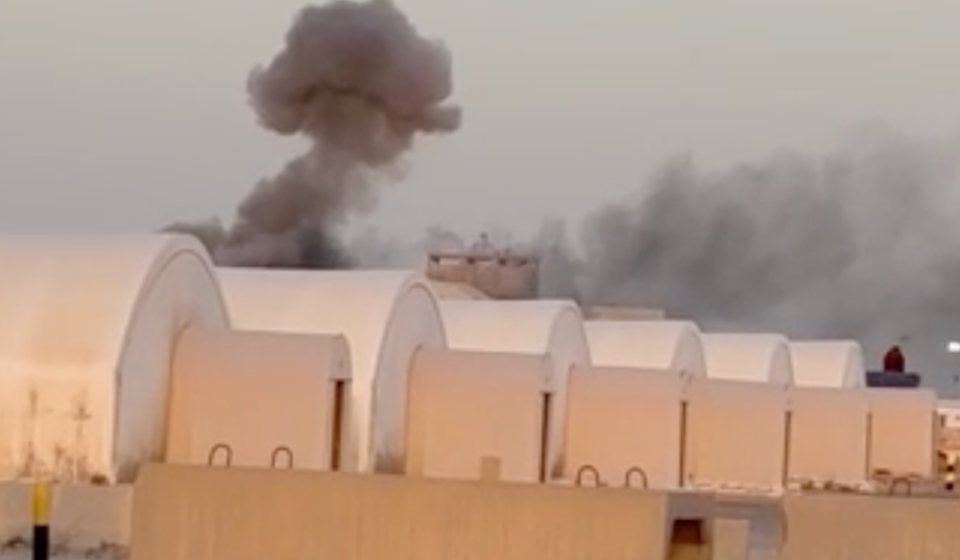
“They hit us hard.” Newly obtained footage and eyewitness accounts detail Iranian attack – and US retreat – on major post in Kuwait

Washington — New videos obtained exclusively by CBS News show Iranian attacks on a major U.S. military base in Kuwait. war with Iran started seven months ago. U.S. forces faced ballistic missiles, drones and what witnesses described as Iranian F-5 fighter jets.
The footage obtained by CBS News was recorded by a person stationed on the ground at Camp Buehring and captures the moments of impact and its explosive aftermath. Damage to buildings and military equipment is also visible in the videos.
The attacks on Camp Buehring provide a window into the strain Iranian attacks placed on American forces during the early days of the war. CBS News has learned that soldiers defending the base are critically short of .50 caliber ammunition as some soldiers are repositioned in Kuwait’s Udari Desert. Two soldiers were injured there by lightning in late April, according to U.S. officials familiar with the matter.
When contacted by CBS News, U.S. Central Command, the main unit that oversees U.S. military operations in the Middle East, declined to comment.
The Pentagon did not comment, but pointed to Defense Secretary Pete Hegseth’s March 4 comments regarding withdrawing U.S. troops from bases and employing defensive measures.
“As we developed our offensive combat power, we moved the vast majority of American troops — over 90 percent of the Americans who were in our bases — what we say, out of the X, out of range of Iranian fire,” Hegseth told reporters in March.
Camp Buehring, or CBKU, is about 25 miles from the Iraqi border and has served for more than two decades as a major staging location for U.S. forces deployed across the Middle East.
CBS News authenticated the videos using metadata embedded in the files and compared the footage to other photographs showing base damage.
Before the war, sources indicated that most of the approximately 7,000 soldiers there were moved elsewhere – as were the majority of US forces in Kuwait – as part of the Pentagon’s “get out of the X” plan, military shorthand for moving away from a position vulnerable to attack.
Once the war began, Iranian attacks, some originating from Iraq, repeatedly threatened the installation. Missiles and drones forced soldiers to take refuge in bunkers. Three U.S. military personnel told CBS News that Iranian F-5 fighter jets were also used in the attacks, a detail first reported in April by NBC News.
“They ran so close to us that I could see their helmets,” the eyewitness described. “They came, they hit us, then they left.”
While most U.S. troops were evacuated from Camp Buehring, a group of more than 100 soldiers remained behind. The military feared the isolated base would be ill-equipped to handle a mass casualty event if the attacks continued.
“They hit us hard,” the source told CBS News on condition of anonymity due to the military’s strict restrictions on the media. “It was horrible. There were a lot of brave guys who stayed to fight there – and the people back home don’t know what happened. We had to abandon the base.”
A senior Army official working in logistics and managing operations from another post in Kuwait, confirmed to CBS News that there were concerns about the availability of .50-caliber and other “exquisite” munitions like Patriot missile batteries.
The decision was ultimately to leave. The soldiers packed up, loading their vehicles with all the equipment they could, and drove through the night into the heart of the Kuwaiti desert. Their remote locations would become forward operating bases, or “FOBs,” where soldiers would stay indefinitely.
No one was killed by enemy fire at Camp Buehring or the FOBs, but several were injured, including two soldiers struck by lightning during sandstorms in the desert. One soldier suffered burns after the direct strike while the other suffered a ruptured eardrum, according to U.S. officials with knowledge of the matter.
Before the lightning strike, Army leaders had tried to move troops out of the area, but were unable to do so quickly enough. In May, the soldiers left the FOB for Camp Arifjan and then transferred to other positions in the Middle East and elsewhere.
“CBKU has been demolished,” the source added. “They need to do an investigation. How come no one came to reinforce us?”
The last inspector general of the Department of Defense month of release a report on the war with Iran that revealed “equipment losses” worth up to $3.7 billion, including nearly 60 aircraft. On Monday, the Congressional Research Service, which provides nonpartisan analysis to members of Congress, reported that 81 fixed- or rotary-wing aircraft, including drones, had been lost or damaged by Iran since February, according to Department of Defense information and statements.
In a first-of-its-kind mandatory report to Congress, the inspector general added that U.S. Central Command had reported Iranian strikes at US bases in Kuwait, Bahrain, Qatar, United Arab Emirates, Saudi Arabia, Iraq, Oman and Jordan.
Although strikes were mentioned in the report, photos and videos of the impact areas are extremely limited. Beyond Camp Buehring, CBS News obtained earlier exclusive photos of the damage at Prince Sultan Air Base in Saudi Arabia and Camp Arifjan in Kuwait.
CBS News also extensively covered the war’s deadliest attack on U.S. troops at the port of Shuaiba, which killed six U.S. service members.
Gn headline