‘They’re blowing this’: Amazon’s efforts against New York’s delivery worker bill could backfire

Amazon issued an ultimatum to New Yorkers on Thursday, warning that its deliveries would become more expensive if lawmakers pass a bill requiring the company to hire many of its contracted delivery workers as regular employees.
People across the five boroughs who opened their Amazon apps to order dish soap or dog treats were greeted by a new banner ad with the word “ATTENTION” bold and highlighted in red.
“The New York Council is considering Intro 518, legislation that could increase fees for New Yorkers by up to $5.00 per order,” the announcement reads. “This bill would increase costs at the very time we need to make New York more affordable. »
But this decision seems to backfire by upsetting Council President Julie Menin, who could soon put the measure to a vote.
Menin, a moderate Democrat who is often seen as an ally of the city’s business class, has become visibly frustrated in recent days in her public statements as the online retail giant ramped up its lobbying efforts against the bill, called the Delivery Protection Act.
“Amazon’s campaign is nothing short of a cynical ploy to deceive New Yorkers,” Menin said at a news conference Thursday. “It’s a last-ditch effort to try to evade accountability to the workers and customers who made the company’s success possible.”
Supporters of the bill immediately cried foul.
“Amazon is a multi-billion dollar company,” Mayor Zohran Mamdani said on social media. “If Jeff Bezos adds $5 to your order, it’s not because of the City Council’s efforts to protect workers’ rights and keep our streets safe. It’s because of greed.”
“It’s a bunch of nonsense,” said Tiffany Cabán, a Queens Council member and lead sponsor of the measure. “We knew they were desperate.”
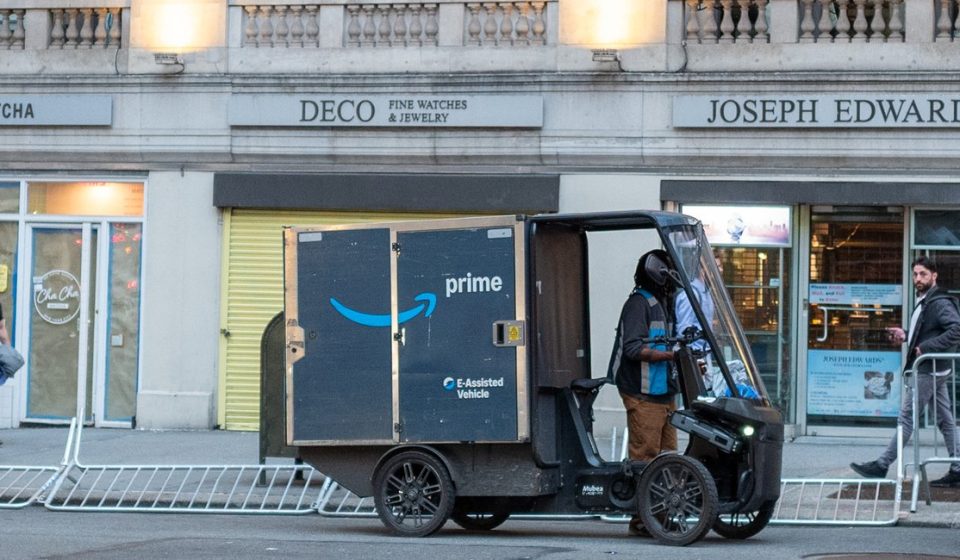
The Delivery Protection Act would ban third-party arrangements that Amazon currently uses to deliver packages. Although most of the company’s delivery drivers wear blue Amazon vests and drive Amazon-branded vans, they work for independent contractors called delivery service partners. There are more than 40 such companies in New York, according to Amazon, employing about 5,000 people.
Amazon says the system empowers small businesses and ensures packages are delivered quickly and at low cost. The company cites a study it helped fund that found the Delivery Protection Act would increase costs for customers by about $400 to $660 a year.
“As the City Council continues to review this bill, we want to be transparent with our customers about what it would cost them if it were passed as written — that’s why we’re doing it,” Amazon spokeswoman Kelly Nantel said in a statement. The company threatened to move its warehouses out of New York if the bill passed.
The banner ad Amazon posts on its app includes an “Act Now” button allowing customers to send emails to city council members. The company said its users sent around 20,000 messages within six hours of launching the campaign.
Supporters of the bill argue the measure won’t increase costs for customers, but would improve the livelihoods of thousands of delivery workers. Delivery drivers organized by the Teamsters union say the system allows Amazon to escape liability for unsafe working conditions and defective vehicles. City Council advocates say the bill would force Amazon to hire its own drivers.
“There is no world where this common-sense bill would cost Amazon $5 for every delivery,” Cabán said in an interview. “This is just one example of corporate harassment. They want to intimidate New Yorkers with unwanted fees.”
City lobbying data shows that the Five Borough Jobs Campaign, a group almost entirely funded by Amazon, has spent more than $8 million this year to oppose the bill.
The scorched-earth PR tactics echo another episode in New York politics where a tech giant organized its users against a proposed law.
In 2015, then-Mayor Bill de Blasio and members of the City Council attempted to institute a cap limiting the number of for-hire driver’s licenses issued to companies like Uber and Lyft. Uber hired Bradley Tusk, a public relations consultant and tech startup investor who managed Mayor Michael Bloomberg’s 2009 re-election campaign, to help defeat the proposal.
Tusk describes in his book, “The Fixer: My Adventures Saving Startups from Death by Politics,” how he flooded the area with negative television, radio and digital ads while ordering his team of lobbyists to “stifle” individual council members and their staffs. Similar to Amazon issuing a notice to its customers, Uber added a feature to its app known as the “de Blasio view” in New York, which told users to expect long wait times for a car if the legislation passed.
The strategy worked and de Blasio withdrew the bill before the vote. According to city data, there were about 12,500 vehicles operating for Uber and Lyft in the five boroughs. In 2019, the year lawmakers finally capped licenses to drive for-hire vehicles, that figure topped 86,000. The rapid growth of e-hailing companies in New York correlates with increased traffic congestion and the demise of the city’s yellow cab industry.
In an interview with Gothamist, Tusk said that while Amazon’s strategy may seem similar on the surface, the company has failed to deliver a credible message.
“No one believes Amazon is going to stop delivering to New York,” he said. “So saying, ‘Oh, well, it might be a little slower,’ or ‘It might be a little more expensive’ – that doesn’t move people.”
Tusk said Menin could have been a listening ear. Instead, he said the negative ads seemed to bring her closer to politicians to her left, like Mamdani and Cabán, both members of the Democratic Socialists of America.
“Julie is no pushover,” Tusk said. “They’re ruining it.”
While supporters of the Delivery Protection Act, like the Teamsters, called for an immediate vote on the bill, Menin pumped the brakes, saying the legislation needed to be amended to address legal concerns.
Menin insists the changes do not weaken the basic intent of the bill, but protect it from possible legal challenges. A spokesperson for Cabán’s office said they expected the proposal to be put to a vote by the end of the year.
“I have a very clear message for Amazon,” Menin said directly to the camera during his Thursday press conference. “If you think this is going to mislead New Yorkers and intimidate the City Council from enacting basic protections for workers and consumers, you are dead wrong.”
Gn bussni