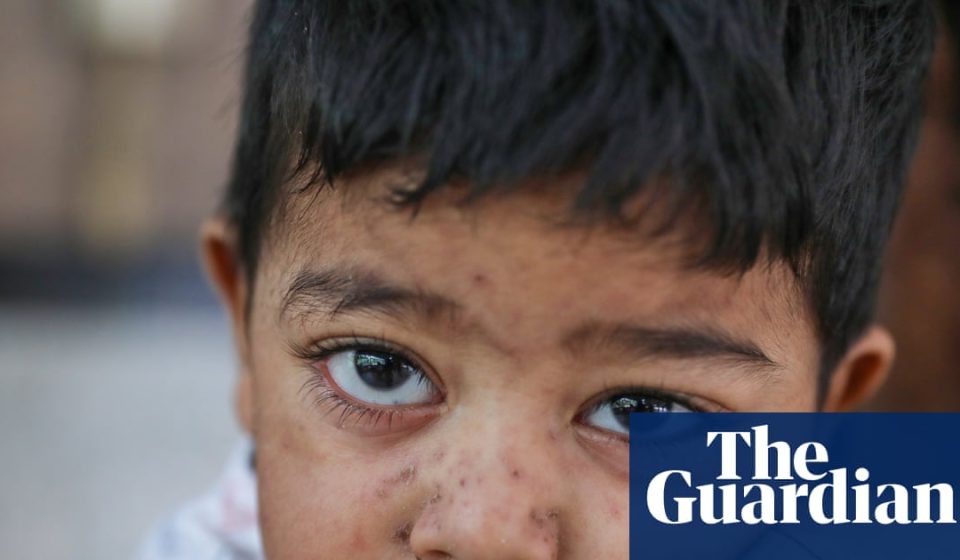
‘They’re fighting for oxygen’: Children pay the price as countries let measles resurface | Global development

Deaths caused by measles are not peaceful. At his hospital in Uganda, Dr. Eric Wobudeya treats young infants after the virus attacks their lungs and airways, or triggers pneumonia.
“These are children who are dying and struggling to get oxygen,” he said.
Children around the world face the consequences of low or declining measles vaccination rates.
This week, international health authorities announced an alarming development: the United States, Mexico and Bolivia had lost their measles-free status. They joined the unenviable club of nations that once had the deadly infection under control but have seen its return – including earlier this year the UK, Canada, Austria, Armenia, Spain, Azerbaijan and Uzbekistan. Countries lose their measles elimination status if the same strain of the disease has spread within their borders continuously for more than a year.
It’s a trend driven by factors such as misinformation, disruption to services during the Covid pandemic and even vaccination successes in previous decades, which mean people have forgotten how dangerous measles can be. Aid cuts from rich countries, including the United States and the United Kingdom, risk exacerbating the situation in poorer countries, experts fear.
The frustration of health advocates is palpable. “We are seeing cases of measles in places where the disease was under control, and children are paying the price,” said UNICEF Executive Director Catherine Russell. “We have a measles vaccine that protects children and has saved nearly 59 million lives since 2000. We should not lose ground against this preventable disease. »
Measles infection weakens a child’s immune system, making them more vulnerable to other infections for months or years, especially if they are malnourished. This can cause brain damage, hearing loss or blindness. In 2024, according to World Health Organization figures, around 11 million people contracted measles – most under the age of five – and 95,000 died from it.
The virus is extremely contagious and persists in the air for up to two hours; up to 90% of unprotected people exposed to measles will get it. There are fears that this could be the canary in the coal mine for the resurgence of other vaccine-preventable diseases.
Wobudeya, a senior consultant pediatrician at Mulago National Referral Hospital in Kampala, says measles disappeared from his hospital for a while.
Speaking at the Union’s Global Conference on Respiratory Health, held in Brazil this week, he said: “Until 2023, we haven’t seen measles, for a period of about 10 years. We had a full (measles) ward – that ward went dry, and actually that translated into another ward.
“But in the last three or four years, measles has re-emerged. What causes measles to re-emerge is basically the failure of vaccination.”
Global measles vaccination rates have remained below the 95% threshold needed to create herd immunity and prevent outbreaks of the virus. In 2025, 84% of eligible children received a first dose of measles vaccine, compared to 77% for the second dose.
The news from the Americas is not just bad for the countries involved. A measles outbreak anywhere can spread to other countries during travel, experts warn. Although the risk is lower in countries with relatively high vaccination rates, almost everywhere there will be vulnerable pockets. In Hackney, east London, for example, only 58% of five-year-olds starting school in 2025 had received two doses of the MMR vaccine.
Some children cannot be vaccinated because their immune system is weakened in some way, for example from blood cancer. Others are too young for routine vaccination. They rely on high vaccination coverage across the population to reduce their risk.
Their parents could face difficult decisions, said Dr Boghuma Titanji, assistant professor of medicine at Emory University in Atlanta, US. “How do you keep these children safe in shared spaces like public transportation, daycares, schools, or just when traveling the world in general? Do you keep them indoors, make them wear masks all the time, or do you live in perpetual fear of an infection that could change your child’s life?”
In the United States, Health Secretary Robert F. Kennedy Jr. has issued anti-vaccine messages, including questioning whether the MMR vaccine – which protects against measles, mumps and rubella – causes autism. The myth of a link between the vaccine and autism was first spread by British doctor Andrew Wakefield in a 1998 article. It was removed from the medical register due to discredited research.
“The United States has always been a leader in public health and a pioneer in health interventions globally. I am concerned that the dominant anti-vaccine narratives, which have contributed to declining vaccination rates and the resurgence of measles in the United States, are at risk of being exported to other countries as well,” Titanji said, potentially harming “vaccine confidence, acceptance and uptake” in those countries.
But the anti-vaccination movement is not solely responsible for falling vaccination levels, said Professor Alex Richter, an immunology expert at the University of Birmingham.
“We also need to take into account the lack of positive messages about the benefits of vaccination and the fact that many people no longer remember the seriousness of diseases such as measles,” she said. “When people rarely encounter a disease, it becomes easier to underestimate the risks it presents. »
Practical barriers such as “difficulties making or attending appointments, language barriers, housing instability and difficulties accessing health care” should not be overlooked, she added. “If we want to reverse this trend, we must address both vaccine confidence and access. »
Simple systems, like offering after-hours appointments or sending reminders, have been shown to drive adoption.
Many parts of the world have never been free of measles. The Democratic Republic of Congo is dealing with the virus just as authorities are trying to combat the Ebola outbreak. In Bangladesh, a measles epidemic is raging, with nearly 240,000 suspected cases and 1,282 deaths since March.
“I see an increase in cases when poverty levels are high and food security low. And these conditions increase the risk of children developing serious complications,” said Dr. Duot Kezekiah, general surgeon at Kuajok Public Hospital in South Sudan.
In countries like his with struggling health systems, a lack of laboratory facilities means the virus can remain unidentified for too long, the important support needed for a patient is unavailable, and the isolation needed to protect other patients is impossible.
Dr Ben Kasstan-Dabush, assistant professor of global health at the London School of Hygiene & Tropical Medicine, said the Covid-19 pandemic had disrupted routine immunization programs around the world “and required intense catch-up and resourcing to identify and invite children who remained under-vaccinated”.
He said efforts to increase vaccination coverage could be affected by “significant reductions in global health and development funding from the United States, and particularly the United Kingdom.”
But losses in measles elimination status can be reversed. And even in some of the hardest-to-reach places, new children are receiving their vaccines. Since 2022, the Reach consortium, led by the International Rescue Committee, has negotiated with governments and de facto authorities to vaccinate more than a million children in Chad, Nigeria, Ethiopia, Sudan, South Sudan and Somalia, living in areas previously closed to humanitarian teams.
“We cannot afford to be complacent. We need to make it easier for people to vaccinate, tackle misinformation wherever it arises and remind the public why vaccination is important,” said Dr David Hughes, senior lecturer at the University of St Andrews’ school of biology. “Protecting ourselves against measles is a collective responsibility (being vaccinated yourself protects our family, friends and the strangers we travel with), and we must act to prevent a disease we know how to control from becoming a serious threat again.
Gn Health