‘This is a deadly threat’: Indigenous groups fear Bolsonaro’s hold on voters in Brazil’s Amazon cities | Brazil

IIt was the day before the first round of the Brazilian presidential election and Rosimari Monteiro was so excited she couldn’t sleep. The 38-year-old spent hours tossing and turning at her home in the Amazon town of Mucajaí before getting up at dawn to vote.
“I was the first person to vote in my polling place…I voted 22, so we had a good start,” Monteiro recalled, standing in his living room with his two young daughters.
Twenty-two is the number used by Brazil’s electronic voting system to identify far-right candidate Flávio Bolsonaro, who hopes to beat left-wing incumbent Luiz Inácio Lula da Silva in this year’s election.
“For us, he represents the future. We want light at the end of the tunnel. We want a better future for us and for our children, who are the future of our nation,” enthuses Monteiro, who was far from being the only one in Mucajaí to vote Bolsonaro.
In fact, it was in this sunny roadside settlement that Bolsonaro scored his biggest proportionate victory in Roraima, the northern state where the future president also recorded his best national result. Nearly 79% of the 11,734 votes obtained in Mucajaí went to Bolsonaro.
Monteiro gave several reasons for his decision, including Bolsonaro’s commitments to fighting crime and creating jobs. But one problem explains why the son of disgraced former president Jair Bolsonaro is so popular here and across Roraima, where 14 of 15 municipalities have supported the far-right politician.
Mucajaí was the starting point for much of the illegal gold rush in which tens of thousands of miners invaded neighboring Yanomami indigenous territory during Jair Bolsonaro’s environmentally calamitous 2019-2022 presidency. Prospectors used the meandering Mucajaí River to sneak onto these protected indigenous lands near the border with Venezuela, bringing malaria, mercury poisoning, hunger and destruction to its 32,000 natives. Ranches carved out of Mucajaí’s rainforests hide clandestine airstrips from which helicopters and planes ferried supplies, miners and sex workers into jungles that Yanomami ancestors are believed to have occupied for at least 1,000 years.
When Lula defeated Bolsonaro’s father in the 2022 election, the left winger launched a crackdown to expel these miners and cripple a multibillion-dollar illegal industry that he accused of “genocide” against the Yanomami. A broader environmental offensive across the Amazon has reduced deforestation to its lowest level since the late 1980s.
Now, almost four years later, Mucajaí’s electorate is hoping that a Bolsonaro victory in Sunday’s runoff will end that repression and allow the 21st century gold rush to resume. “The closure of the mines caused a total shortage. It became very difficult to find work,” complains Monteiro, a driving school instructor whose brother-in-law worked in the mines.
Like many in the region, Monteiro believes that if elected, Bolsonaro will legalize mining on indigenous lands “so people can go back to work.” Speaking in the Amazon on Tuesday, Bolsonaro promised to be a president “who will transform the riches that God has given us into riches for each of you,” adding: “Lula doesn’t care about the Amazon. »
The prospect of a second Bolsonaro presidency has caused panic among indigenous leaders and environmental advocates – here in Roraima and across the Amazon. Starting in January, when the new president takes power, at least seven of the nine Amazon states, including Roraima, will have pro-Bolsonaro governors. Congress will have a record number of right-wing politicians hostile to indigenous rights and environmental issues.
“By voting 22, Brazilians are signing a death certificate for the Yanomami and for indigenous people in general,” says Yanomami leader Júnior Hekurari, 40, who was on the front lines of efforts to protect his people during the humanitarian crisis that erupted under Bolsonaro.
Hekurari already sees signs that miners are once again preparing to flood Brazil’s largest indigenous territory. In the days following the October 4 first round, which Bolsonaro won by 47% to Lula’s 45.1%, Yanomami villagers reported receiving calls from illegal prospectors ordering them to clear remote tracks so they could return.
Nilton Tubino, who has led Lula’s anti-mining crusade since 2023, says “strange movements” have been detected on the territory’s outskirts, reinforcing suspicions that miners are preparing to plunder precious metals and tin ore used to make cell phones.
Tubino, who considers Mucajaí the “nerve center” of illegal trade, believes that Lula can recover from his first round defeat. “The election isn’t over until it’s over,” Tubino says.
But speaking at his group’s headquarters in Boa Vista, the capital of Roraima, Tubino admits that his unit will close its doors if Bolsonaro wins. He fears that environmental and indigenous people leaders who led the crackdown against Lula will be sidelined and persecuted, as happened under Jair Bolsonaro, who is serving a 27-year prison sentence for plotting a coup after the 2022 elections. The consequences for the Yanomami will be dire.
“This is a mortal threat… for the very existence of these people, for their culture, their cosmovision and their way of life,” warned Lula’s former Minister of the Environment, Marina Silva.
Gold mining is not the only reason voters in Roraima support Bolsonaro, a 45-year-old evangelical Christian baptized twice in the Jordan River. The rapid advance of the evangelical church in the Amazon has also strengthened its support, with prosperity theology striking a chord among those on Brazil’s rapidly growing agricultural frontier.
Leandro Gentil, a political activist and pastor from Boa Vista, considers Bolsonaro a champion of Christian values that his church fights “tooth and nail” to defend. “Bolsonaro is virtually unanimous in our congregation… He is the fresh oxygen we need to breathe,” adds Gentil, citing the politician’s opposition to same-sex marriage, abortion and drugs.
Similar opinions can be heard in Mucajaí, where small evangelical temples can be found on most streets.
Marinalva Ferreira Barbosa, a 40-year-old housekeeper who worships at a local branch of the powerful Assemblies of God church, says she opposes Lula because he advocates “things forbidden by the Bible.” “Like men getting along with men, women getting along with women, that kind of filth,” adds Barbosa, who works at Paradise Pousada, a 15-room hotel that, because of mining repression, is empty.
Bolsonaro’s uncompromising pledge to eliminate “narcoterrorists” – despite his own well-documented ties to members of Rio’s underworld – also appealed to voters in the Amazon, where organized crime groups are tightening their grip.
“Drugs could destroy our future,” says Bolsonaro activist Luciano Gomes as he views Mucajaí from a tourist perspective. Many of the dilapidated streets below are covered in graffiti celebrating Brazil’s largest criminal organization, the PCC, or threatening to take down rivals from the Red Command gang.
But the main reason Gomes supports Bolsonaro is his desire to free mining. “Our state has a wealth of mineral resources…gold, diamonds and rare earths that have been discovered recently,” he says, insisting they can be mined responsibly. “Bolsonaro defends the idea that miners are not crooks, but workers.”
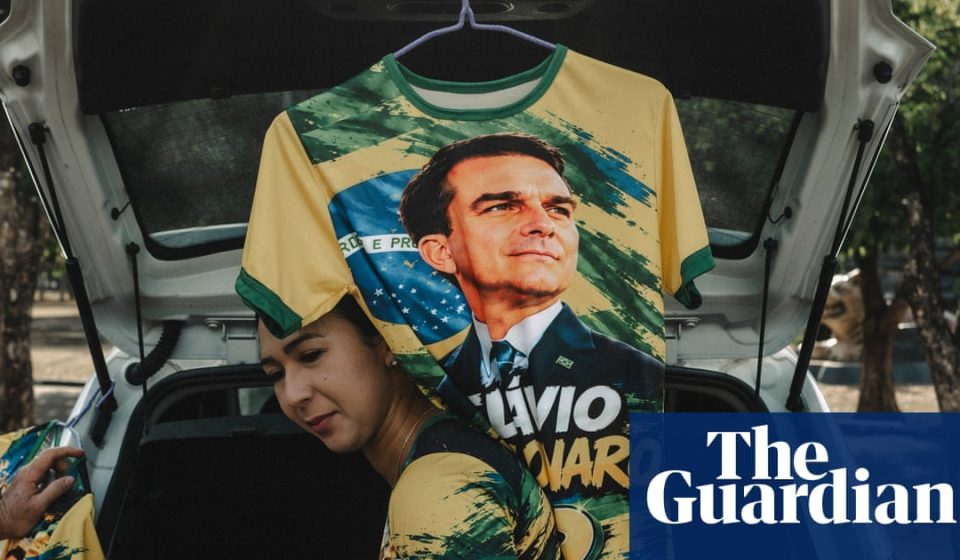
On Sunday, Gomes will return to the polls to vote “22,” sporting a garish shirt adorned with images of the Bolsonaros and their ally, U.S. President Donald Trump.
If Bolsonaro triumphs, Gomes will lead a procession of cars draped in Brazilian and American flags 80 km north of Boa Vista, to attend a nighttime party in a square centered around the statue of a gold miner.
The most famous Yanomami leader, Davi Kopenawa, had other ideas. “I will vote for my friend Lula… The Lula government is a friend of the indigenous people,” says Kopenawa, 70, warning of conflict and resistance if Bolsonaro wins.
“There will be a war between indigenous and non-indigenous people. Violence, death, bloodshed,” predicts Kopenawa’s son Dário, 44, whose association’s offices in Boa Vista resemble a prison, surrounded by high walls, security cameras and an electric fence to guard against attacks.
On a recent evening, dozens of students and indigenous activists took to the streets of Boa Vista to denounce Bolsonaro’s plans. Among them is Joênia Wapichana, a lawyer and politician who headed the Funai indigenous protection service under Lula.
“Roraima is not the backyard of bolsonarismsays Wapichana, 53, who insists indigenous communities will not give up without a fight.
“No people in Brazil are more resilient than indigenous peoples…that’s why we still exist in 2026,” says Wapichana. “We are born fighters, we are born resistant. »
Gn world