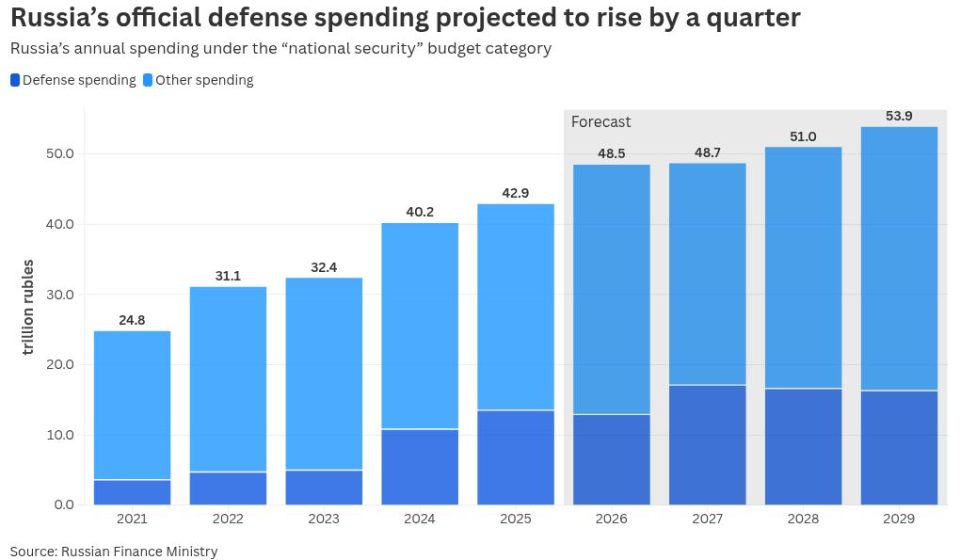

Russia plans to increase its defense spending to a post-Soviet record next year while cutting civilian programs and raising taxes, signaling that the Kremlin is preparing for a protracted war in Ukraine even as it claims it is. ready for peace talks.
The draft 2027 budget unveiled on Thursday allocates 17.1 trillion rubles ($205.2 billion) for defense, 26% more than what was planned for this year in the previous budget and 375% more than the 2021 pre-war level.
Defense would account for about a third of federal spending next year, setting a post-Soviet record in nominal ruble terms.
Analysts say Russia still has the resources to continue the fight, but households, businesses and utilities will bear more of the cost.
Economist Boris Grozovsky said Russia’s wartime economy still had a “considerable” financial cushion.
“But the message is clear: everyone will pay for the war, as much as they can. Wherever a little more money appears, the government will come and get it, while distributing as little as possible itself,” he said. wrote in an analysis published by the exile media IStories.

The published defense allocation does not reflect the full cost of the war. Russia has only published planned military spending rather than actual spending since 2022, while classified budget items make the overall bill difficult to establish.
Skyrocketing war costs are putting increasing pressure on state finances. The federal budget deficit reached 5.65 trillion rubles ($67.8 billion), or 2.6% of gross domestic product, in 2025.
The government projects a deficit of 7.3 trillion rubles ($87.6 billion), or 3.2% of GDP, for 2026, before narrowing to 5.4 trillion rubles ($64.8 billion), or 2.2%, in 2027.
In a forecast published Before the draft budget was unveiled, economists at Sberbank, Russia’s biggest lender, estimated next year’s deficit at 2.7% of GDP, questioning whether the government would be able to rein in spending and increase non-oil and gas revenues needed to meet its earlier target.
This deficit is high by recent Russian standards, but it remains manageable and remains lower than that of many European countries, such as France (5.4% of GDP) and Great Britain (4.3% of GDP).
The projected deficit does not in itself indicate an impending fiscal crisis, but it is becoming increasingly difficult to contain it while increasing military spending.
The government plans to borrow 6.1 trillion rubles ($73.2 billion) next year, up from 5 trillion rubles ($60 billion) in 2026, to help finance the deficit.
Still, debt service is expected to reach 4.6 trillion rubles ($55.2 billion) in 2027, or 9.4% of total federal spending. These costs remain high because the central bank has kept interest rates high to contain stubborn inflation fueled by heavy public spending.
To help narrow the gap, Moscow is also cutting civilian spending and planning a new round of tax increases for the third year in a row.
The project reduces allocations for health by 5.5%, education by 5.4% and social programs by 6% compared to the amounts previously budgeted for 2027.
Some Russian national projects, government programs targeting priorities such as health care and infrastructure, will also face cuts in the future.
Funding for the Long and Active Life Project, which supports health initiatives, would decrease by about 20 percent, from 181.1 billion rubles ($2.17 billion) in 2026 to 145.9 billion rubles ($1.75 billion) next year.
The allocation for the federal cancer program would increase from 44.9 billion rubles ($538.8 million) to 3.9 billion rubles ($46.8 million).
The proposed tax measures are expected to raise an additional 1.5 trillion rubles ($18 billion).
They include a 22 percent value-added tax on purchases from foreign online retailers and a customs fee of 100 rubles, or about $1.20, on each package worth less than 200 euros.
Tax rates on income from sources such as interest on deposits, dividends and property sales would increase from a range of 13% to 15% to a range of 13% to 22%. The Finance Ministry has also proposed a one-off tax on windfall profits from mining and metallurgical companies.
Changes to taxes on passive income are expected to raise the most revenue, up to 700 billion rubles ($8.4 billion), followed by levies on online purchaseswhich would bring in an additional 500 billion rubles ($6 billion).
Analyst Alexandra Prokopenko said the budget showed that defense spending was growing faster than overall spending, thereby reducing funds available for other purposes.
In a analysis for Carnegie Politikashe warned that the government could soon approach the limits of the additional revenue it can raise through taxes to finance the war.
That could increase pressure on the central bank to support the wartime economy by cutting interest rates to reduce borrowing costs for the government and businesses, as well as increasing debt restructuring for struggling companies, she said.
A message from the Moscow Times:
Dear readers,
We face unprecedented challenges. Russia’s Prosecutor General’s Office has designated The Moscow Times an “undesirable” organization, criminalizing our work and exposing our staff to legal action. This follows our earlier unfair labeling as a “foreign agent.”
These actions constitute a direct attempt to silence independent journalism in Russia. The authorities say our work “discredits the decisions of Russian leaders.” We see things differently: we strive to provide accurate and unbiased information about Russia.
We, the Moscow Times journalists, refuse to remain silent. But to continue our work, we need your help.
Your support, no matter how small, makes all the difference. If you can, please support us monthly from just $2. Implementation is quick and each contribution has a significant impact.
By supporting the Moscow Times, you are defending open and independent journalism in the face of repression. Thank you for being by our side.
Continue

Not ready to support us today?
Call me back later.
×
Call me back next month
THANKS! Your reminder is set.
We will send you one reminder email per month from now on. For more details on the personal data we collect and how it is used, please see our Privacy Policy.
Gn world