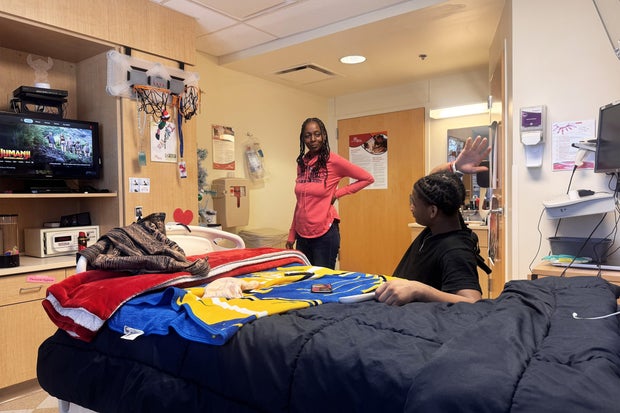
St. Louis — The teen’s hospital stay began in room 3005.
At first the room didn’t feel like home. At the time, Jaloni didn’t have posters on the walls or snacks on the shelves, and he hadn’t yet heard of the morgue.
He just wanted to survive. New gunshot wounds filled the 14-year-old’s body with unbearable pain. That first night, Jaloni said, he could barely move.
But in his own way, Jaloni could fly. His painkillers were so strong that the teen said he felt like he was high in a dream.
In reality, Jaloni was a teenager caught between two worlds. Around his friends, he took risks and knew how to steal without being caught. In the hospital, Jaloni was now a boy who needed his grandmother to tell him that everything would be okay and that somehow life would get better as soon as he got out of the hospital.
But she couldn’t make that promise. Nobody could.
He ended up staying at SSM Health Cardinal Glennon Children’s Hospital for more than 475 days over the next three years, according to his medical records. Part of that time was not because he needed medical attention in the hospital, but because he had no safe place to go. The now 18-year-old man asked KFF Health News to only use nicknames or first names to protect his family’s safety.
Cara Anthony/KFF Health News 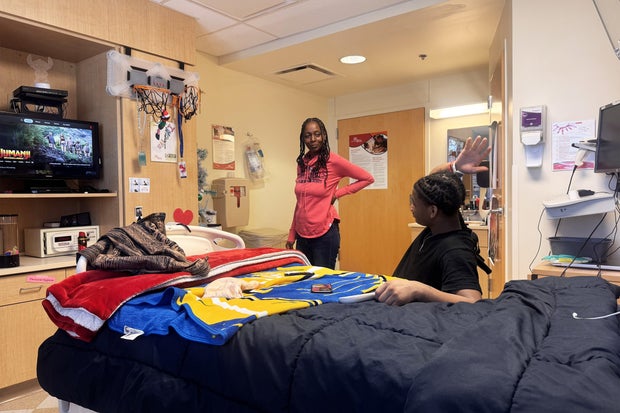
Like thousands of children across the country, Jaloni experienced what is called a social stay. The practice, also known as hospital boarding, in which children remain in hospitals “beyond medical necessity,” has become a costly and intractable issue nationwide.
A shortage of suitable foster homes can mean children with mental health problems, chronic physical illnesses or disabilities requiring special accommodations find themselves stuck in hospitals. A Minnesota study found that housing a child with a complex health condition in a hospital cost about $3,932 per day in 2017.
It is unclear to what extent Jaloni’s hospitalization exceeded what was medically necessary or how much those extra days cost the hospital. The hospital system declined to comment on the details of Jaloni’s stay. In a statement, SSM Health spokeswoman Liz Sharpe-Taylor said the health system is committed to its “mission to serve those in need” and that when “patients remain hospitalized due to a lack of discharge options, hospitals like ours often incur significant uncompensated costs.”
Over the past five years, according to state records, Missouri has spent more than $64.7 million to house children in state custody in hospitals because they had nowhere else to go. But Missouri Hospital Association spokesman Dave Dillon said the problem is vastly underreported and hospitals often don’t always have staff to register and request reimbursement for children’s accommodations.
And these figures also do not take into account the harmful consequences of living in this limbo on children.
“Well, you almost killed him.”
Jaloni slept a lot during his first hospital stay, starting in June 2023. Bullets had pierced his right arm and the right side of his chest, piercing his torso. He was happy to be alive.
The teenager already knew a lot about death – he had been surrounded by it. An older sister died after being shot, as did her 17-year-old brother. He had also lost a few cousins to gun violence in and around St. Louis.
He had continued to walk in the shadow of death over the next few years. “There were a lot of deaths,” Jaloni remembers. “People were dropping like flies.”
He did not want his name added to this list. But he came close one summer evening when the war in his community erupted into a shootout. He was injured and a 22-year-old died. A 16-year-old boy has been charged in the death.
“I felt like Superman with my gun,” Jaloni said. “But when you get older, you realize it’s just stupid.”
At the hospital, Jaloni tried to focus on healing from the gunshot wounds and what his doctors said was a spinal cord injury. After three weeks, he was transferred to a rehabilitation center and then sent home.
There, his mother and grandmother struggled to care for the teenager, who now needed a wheelchair.
His grandmother, who had been his legal guardian since he was little, was herself a double amputee and wheelchair user. Her mother juggled her care with her job as a paid caregiver for another family. Changing Jaloni’s bandages, cooking, cleaning and turning him every four hours as directed to prevent bedsores was simply too much to handle, his mother repeatedly told hospital officials.
“I just couldn’t take care of him anymore,” said his mother, Quette. “It was something I wasn’t ready for.”
She said she asked hospital officials for help, but it never came. Jaloni was in bad shape with what appeared to be an infection the November day they called 911 for help. He had bedsores. He felt sick and weak.
Jaloni then ended up at Cardinal Glennon Children’s Hospital, less than five months after his release.
“They said, ‘Well, you almost killed him,'” his mother recalled.
The family was accused of negligence. Because they lived just across the river from St. Louis, Illinois, Jaloni became a ward of that state.
This meant he couldn’t go home to his mother and grandmother. Jaloni’s mother thought about asking her ex-boyfriend to watch over her son. She also considered asking other family members. A social worker raised the idea of sending Jaloni to a home in Chicago where he could get the kind of attention he needed.
Chicago? “I’m not going,” he remembers thinking.
He wanted to go home, not 300 miles away. So he stayed in the hospital while the adults around him looked for where he could go.
This time, his hospital stay was longer than anyone could have imagined: 250 days.
Looking for a home
Jaloni knew life would be different in a wheelchair. But he didn’t think his new condition would make it more difficult to find housing. A place with ramps or a lift for his wheelchair. A place where he could keep all his medical equipment and medications. A place where someone could care for him safely.
Thousands of children across the country are in similar situations. In the fiscal year ending June 2025, the Illinois Department of Children and Family Services recorded 304 youth staying in psychiatric hospitals beyond medical necessity, according to a state annual report, while 312 spent more than 24 hours in hospital emergency rooms waiting for a safe place to go.
The problem is also well-documented in Missouri: 648 youths in state custody were committed to hospitals during the fiscal year ended in June, according to data obtained by KFF Health News through a public records request.
Missouri lawmakers have introduced several bills over the years to try to end the practice, without success.
Ignoring politics and rising costs, Jaloni was stuck waiting on the third floor of the hospital, with the busy medical center effectively becoming his new home.
For most of his life, Jaloni’s grandmother had provided him with a safe space to land. She taught him how to cook his favorite dish, fried tilapia served with spaghetti. She kept him company during his early days at the hospital. She kept her secrets.
But in 2024, while he was hospitalized, his grandmother died.
Jaloni wasn’t sure what was going to happen, until his aunt Deborah agreed to be Jaloni’s adoptive mother. Taking on this role brought back memories for Deborah, or Tete, as he called her, as Jaloni lived with her during her first year of life. But this time it was different. Jaloni was no longer a baby and he was harder to bring home than a newborn.
Deborah had to move into a one-bedroom apartment on the first floor with a ramp for her wheelchair. He needed a specialized hospital bed. While his aunt reorganized her life, Jaloni remained hospitalized until she was ready to receive him into their new home.
At the hospital, members of his care team gave him gifts, braided his hair and did their best to communicate with the teen. But to Jaloni, the third floor still felt like a different world.
“If you stay in the hospital for a whole year without doing anything, it will be the worst year of your life,” Jaloni said. “I was angry at being in there for so long.”
“My kingdom”
During his third hospital stay – this time for a bone infection, starting in October 2025 – Jaloni changed his mind. During his recovery, Jaloni explored almost every corner of the hospital. He was playing his favorite video game, Fortniteat the nurses’ station. Sometimes he ate in the cafeteria instead of in his room. He went out from time to time to get some fresh air. He finally discovered a completely forbidden place in the hospital.
“They have a basement downstairs with a morgue, with a lot of corpses,” Jaloni said while at the hospital in March. “Someone just died the other day. She was 13.”
The girl made a bracelet for Jaloni before she died. A nurse brought it to him, Jaloni remembers.
Cara Anthony/KFF Health News 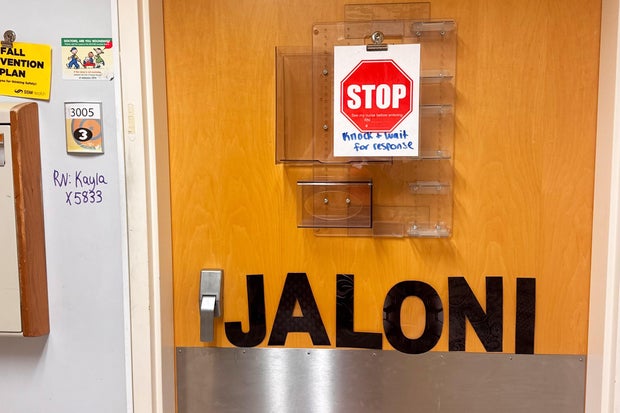
A group of nurses, a friendly guard and a talkative cook decided to…
Gn Health