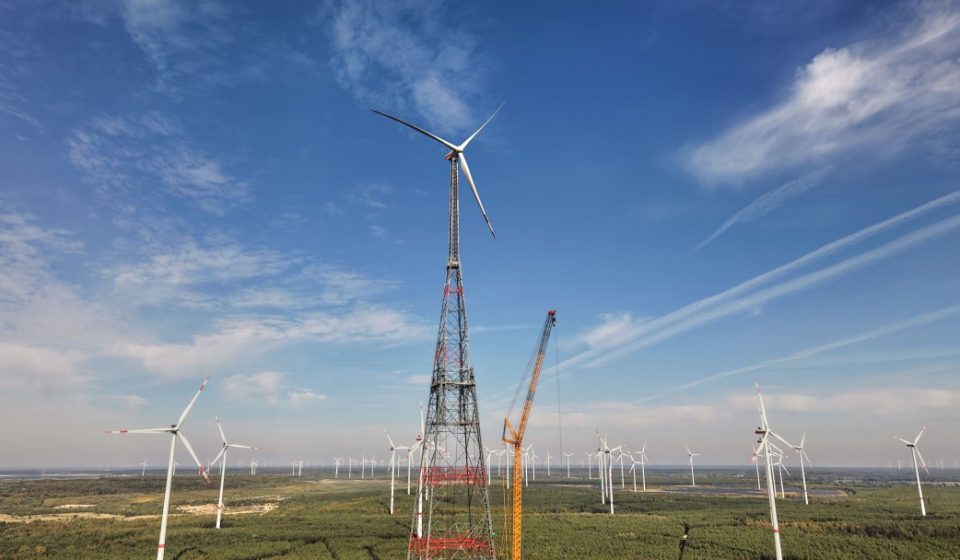

A wind turbine described by its developer as the world’s tallest now rises nearly 1,200 feet above the sparsely populated landscape of eastern Germany, surpassing the height of the Eiffel Tower. The colossal turbine was built on an existing wind farm in the Lusatia region, southeast of Berlin, the AP reports. Once a major center of lignite mining, the region has increasingly turned to renewable energy in recent years. The prototype reached its peak this week and is expected to be unveiled in mid-November.
Jochen Grossmann, chief executive of Gicon, the Dresden-based engineering company that built the tower, said the structure would exploit the stronger, more reliable winds found at higher heights. Conventional wind turbines typically have a hub height (the distance from the ground to the center of the rotor) much lower than 650 feet. “At (about 985 feet) we have such a constant and strong wind that we can produce more than twice as much electrical energy as with the same installation at current heights,” Grossmann said Thursday. He added that it would also be possible to produce electricity for a much larger part of the year than with existing turbines.
The turbine rotor blades bring its total height to 1,197 feet. That makes it taller than the Eiffel Tower in Paris (1,083 feet) and leaves it just below Berlin’s TV Tower, Germany’s tallest building, at 1,207 feet. Work on the turbine is not yet complete and internal cabling still needs to be installed before its inauguration scheduled for November 19. The prototype is intended to measure the potential gains linked to building turbines at such heights. Gicon plans to use the results to develop a wind farm containing three to five extra-tall turbines, paving the way for possible large-scale production.
Grossmann also sees giant wind turbines as a potential solution to the lack of suitable land for wind farms. Existing sites could be expanded into “double-decker” wind farms combining shorter and taller turbines, while new sites could be designed this way from the start. Germany has been working for years to expand the use of wind, solar and other renewable energy sources. According to the Federal Statistical Office, 59.1% of the energy produced in Germany in the first half of 2026 came from renewable sources. Wind power was the main source of energy, providing 29.4% of the total.
Gn world