HASver the weeks go by, the world continues to experience the severity of what already constitutes one of the most serious energy crises in its history. The executive director of the International Energy Agency, Fatih Birol, has estimated for months that the current disruption of hydrocarbon supplies is more serious than during the oil shocks of 1973 and 1979. Shortages can unfortunately no longer be ruled out if this crisis drags on. It is also not limited to gasoline and diesel but also affects the fertilizer and petrochemical sectors.
As shown by the televised intervention of the President of the Republic, Emmanuel Macron, on Thursday September 24, from Asia, which is severely affected, to the Old Continent, governments are everywhere called upon to respond according to the means at their disposal. Even if France can count on its nuclear fleet for the production of electricity, the state of its public finances does not allow it to support consumers as well as some of its European neighbors.
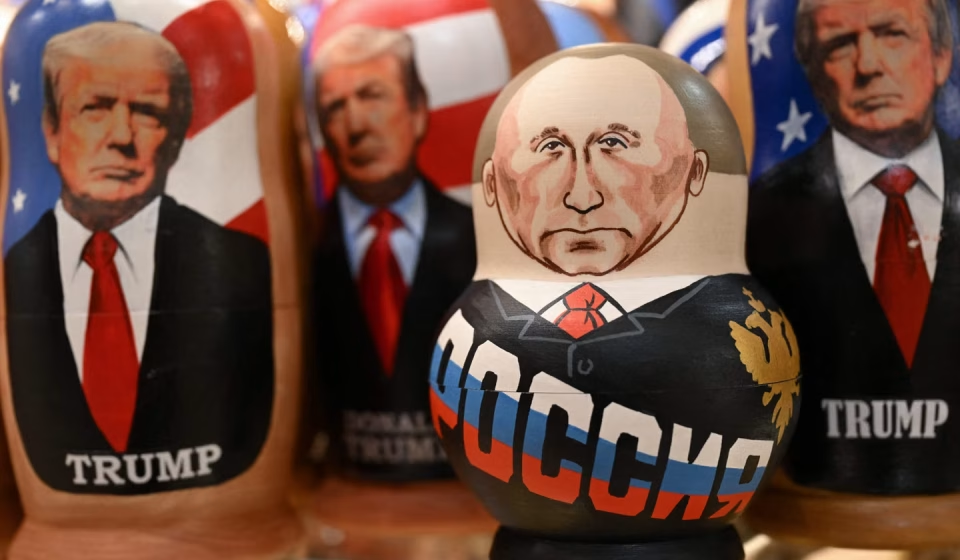
This drastic increase in fuel prices, which obviously weighs on purchasing power, fuels anger that Mr. Macron considered “normal”. This anger, however, should not obscure the fact that the person responsible for this situation is not in Paris, Rome or Berlin, but in Washington.
Donald Trump’s risky decision to attack Iran on February 28, taken in concert with Israeli Prime Minister Benjamin Netanyahu, set in motion the mechanism that led to the blockade of the Strait of Hormuz by the Iranian regime. The threats that the Houthi rebels now pose to the other strategic passage in the Middle East, the Bab Al-Mandab Strait, are the consequence of this war that the world’s leading army has shown itself incapable of winning until now.
Not content with having caused this disaster, the tenant of the White House does not now rule out making it worse by evoking a ban on exports of diesel produced in the United States, in the hope of lowering prices on the eve of delicate mid-term elections. The first affected would be European countries.

The impasse that this war against Iran has resulted in is reinforced by another conflict, that taking place in Ukraine, which can only be attributed to another man, the Russian president, Vladimir Putin. It is because the aggressor is incapable of breaking the resistance of the Ukrainians in the Donbass that he has engaged in a devastating war against the cities. In retaliation, kyiv decided to shell Russia’s infrastructure, particularly energy sites, to the point of forcing it to import hydrocarbons to avoid shortages.
It is regrettable that in France a candidate for the 2027 presidential election could imagine blaming Ukraine by considering that its response, particularly against the city of Moscow, is the cause, and not the consequence, of the current escalation. “Who can imagine that a country allows its own capital to be attacked and provides no response to such a situation”declared the candidate of La France insoumise, Jean-Luc Mélenchon, while referring Vladimir Putin to his role of invader in an attempt to explain a growing Russian threat. The Ukrainians would not say any better, they who have suffered indiscriminate Russian bombings for several years now.