


As of 2023, Apple’s new iPhones have an 80% charge limit for those who want to extend battery life. Charging to 80% instead of 100% is supposed to put less strain on the battery, improving its longevity.

For the past three years I have used this setting on my iPhone. I started with the iPhone 15 Pro Max, then the iPhone 16 Pro Max, and most recently the iPhone 17 Pro Max.
After 12 months with a maximum load of 80%, my iPhone 17 Pro Max is at 97% of its maximum capacity with a number of cycles of 277.
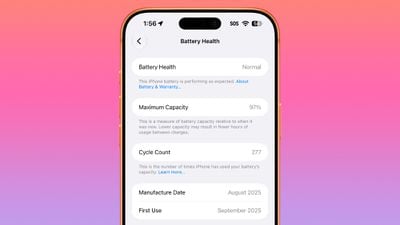
Last year, my iPhone 16 Pro Max was at 94% capacity after 12 months, and in 2024, my iPhone 15 Pro Max was also at 94% capacity.
During the year I tested the iPhone 16 Pro Max, I tried not to let the battery drop below 20%. This year I did the same thing, but also tried charging more via USB-C than Qi2 or MagSafe. I don’t know if this helped, but 97% capacity is the best result I’ve gotten so far with the charge limit enabled.
I don’t know how my battery’s reading compares to others, but if you’ve kept yours at 100%, you can compare your capacity to mine to see if there’s a real difference.
Apple switched to aluminum and added vapor chamber cooling with the iPhone 17 Pro Max, and I thought my iPhone spent less time uncomfortably hot than the iPhone 16 Pro Max. It may be that the vapor chamber cooling made the biggest difference and limiting wireless charging didn’t matter.
I no longer use the iPhone 15 Pro Max or the iPhone 16 Pro Max as my primary iPhones, but I use them daily as test devices. The 80% limit is still enabled, so I can share longer term battery results.
- iPhone 15 Pro Max (36 months) – 88%, 369 cycles
- iPhone 16 Pro Max (24 months) – 93%, 343 cycles
- iPhone 17 Pro Max (12 months) – 97%, 277 cycles
Last year, my iPhone 16 Pro Max reached 299 cycles on September 24th. This year, I’m only at 277 cycles. That’s nearly two weeks later than the usual results reporting date, so the bigger battery meant less charging.
The iPhone 17 Pro Max has a bigger battery and faster charging than the iPhone 16 Pro Max, so an 80% charge limit wasn’t as difficult to live with as in the past. I rarely ran out of battery, although I always carried a battery with me most places. My favorite batteries right now are ones with built-in USB-C cables, especially ones that can magnetically connect to my iPhone but charge it via USB-C. It’s a faster charge that remains practical. I also continue to be a fan of ultra-thin batteries that add little bulk and weight to an iPhone.
For the iPhone 15 Pro Max and the iPhone 16 Pro Max, I didn’t think sacrificing a fifth of my battery was worth the capacity I ended up with, and that’s still largely the case. I’m guessing my 97% capacity isn’t too far off from the battery health readings on iPhones that didn’t have charge limit enabled.
As for older devices, my two-year-old iPhone 16 Pro Max only lost 1% of its capacity between 2025 and 2026, and my iPhone 15 Pro Max lost no capacity over the course of the year. Both phones had fewer battery cycles (44 and 17, respectively), but they maintain capacity even after being dead for short periods throughout the year.
The easiest way to manage battery health is to use Optimized Battery Charging, as it minimizes the time spent at 100% battery while still charging fully. Setting a limit of 80 percent and then turning it off on days when you need 100 percent is also a good compromise that could save your battery capacity over time. Apple also offers 90% and 95% options, which might be a better choice.
My iPhone 18 Pro Max is already set to 80%, so I’ll check in again in September 2027. I’ll stick to USB-C charging as much as possible, and I’m curious how an even bigger battery will affect longevity and what the 80% limit looks like in everyday use.
What is your iPhone battery capacity and number of cycles? Share it in the comments below and see if you think the battery charge limits are worth it.
Gn tech