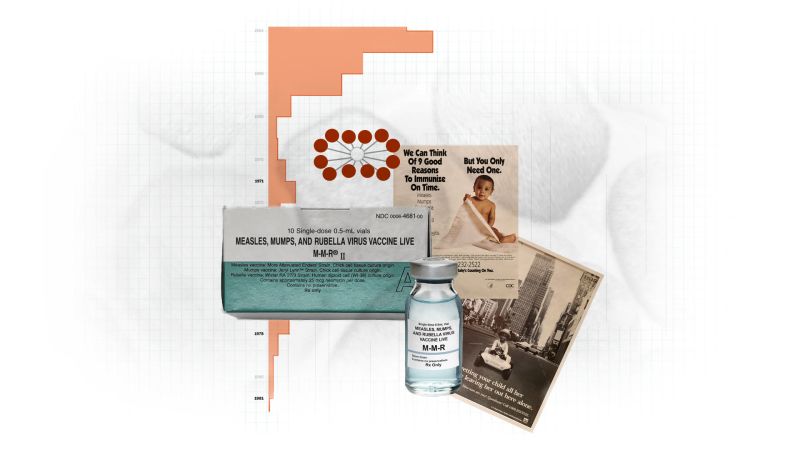
Deadly measles outbreaks have resulted in higher case numbers than in the United States since the early 1990s, and the country is on the verge of losing its measles elimination status.
When the US Centers for Disease Control and Prevention convened a panel of experts to discuss measles in March 2000, cases had been so low for so long that the country’s disease situation could be completely redefined: the experts concluded that measles was no longer endemic in the United States.
Although measles was not completely eradicated, the disease was considered eliminated in the United States. A precise definition of what eliminating measles entailed would come later, but the importance of this moment – particularly reflecting the power of vaccination – was profound for many of those involved.
Dr. Yvonne Maldonado, a pediatric infectious disease expert at Stanford University who represented the National Vaccine Advisory Committee at the meeting, remembers a feeling of “cautious optimism” afterward.
“We felt like we were doing well and we were very happy to do well, but clearly we shouldn’t rest on our laurels,” she said. “With infectious diseases, you really never know or feel comfortable that you’ve accomplished the task. »
Current authority for determining the elimination status of measles has been transferred to an international advisory group appointed by the Pan American Health Organization, a branch of the World Health Organization. In a closed-door meeting this month, the committee will assess whether there has been sustained local transmission of measles in the United States for at least a year, making it endemic again.
Experts widely expect the United States to lose its measles elimination status, largely due to years of declining vaccination rates — a well-established threat but one against which the United States has lost ground in recent years.
“This is truly tragic and unnecessary, and all of this is completely avoidable,” Maldonado said.
“Two doses of vaccine, which are highly safe and effective, will essentially limit the number of cases in the United States, and we are just throwing them away,” she said. “We have now spawned an entire culture of denial about the impact of measles and active and vastly exaggerated misinformation about the safety of the measles vaccine. »
This is how the United States managed to combat a deadly virus – the most contagious disease known – and how it came back with a vengeance.
By the time measles was eliminated in 2000, the power of vaccination had been proven time and time again – but the celebration also gave rise to reflection on the work ahead.
“This achievement is the result of the efforts of millions of parents and children, hundreds of thousands of health workers, and thousands of policymakers and legislators who provided political and financial support,” committee members wrote in a summary of the meeting published in the Journal of Infectious Diseases in May 2004.
“Despite the enormous progress that has been made, it is essential to understand that this is an inherently unstable situation and that we must maintain (and improve) our efforts to ensure that vaccination levels remain very high and that surveillance is of high quality,” they wrote. “We must also strengthen our support for global measles control and work towards the ultimate global eradication of measles. »
The United States will be able to restore its measles elimination status once it demonstrates that transmission of the outbreak has been interrupted for at least 12 months.
Public health experts involved in efforts to contain measles over the years say they have always been aware of the precariousness of success, but they worry about how current conditions could hamper the country’s ability to recover lost progress and turn things around.
“It will be more difficult for us to get back to elimination than the first time,” said Janet Hamilton, executive director of the Council of State and Territorial Epidemiologists.
Trust in the public health system and more generally in science is particularly low and still far from recovering from the blows suffered during the Covid-19 pandemic, she said. The epidemiology of measles has also changed, with immune protection lagging not only in children but in some pockets of adults.
“When we started to eliminate the virus, we had an adult population that was immune because they had all contracted it as children, so we only had to focus on vaccinating the child cohort,” Hamilton said. “How we try to approach this problem will have to be very different.”
The public health system is also not as well funded or resourced – or as well supported – as it once was.
Typically, large outbreaks like the ones currently experiencing the United States have led to crucial public health and policy changes intended to prevent broader resurgences, said Dr. Walter Orenstein, who led the CDC’s national immunization program.
“We’ve had presidential initiatives in the past that were focused on providing resources while also being big advocates for measures to eliminate measles,” he said, referring to the Children’s Vaccine Program and the National Childhood Immunization Initiative, which encouraged school mandates and other state laws to encourage mass vaccination.
“We didn’t see that in those days,” he said.
CDC Director Dr. Erica Schwartz said in November that the agency would not fundamentally change its response to outbreaks, even if the United States lost its measles elimination status.
And U.S. Department of Health and Human Services Secretary Robert F. Kennedy Jr. has long questioned the safety and effectiveness of the measles-mumps-rubella (MMR) vaccine. As the nation’s top health official, he sought to reduce the number of federally recommended childhood vaccinations, launched a federal program focused on vaccine injuries and gave a speech at the conference of the anti-vaccine advocacy group Children’s Health Defense, which he founded. Medical experts said his speeches and actions fueled “declining vaccination rates.”
But public health experts say outspoken federal leadership is exactly what we need.
“There must be — at very high levels — people talking about how incredibly effective the MMR vaccine is, how incredibly safe it is, how we know what the side effects are and they tend to be mild. We don’t see autism,” said Dr. Jonathan Temte, who attended the 2000 elimination meeting as a representative of the American Academy of Family Physicians.
“I think this needs to be made public at the highest level. We know better,” said Temte, who is now professor emeritus and associate dean emeritus for public health and community engagement at the University of Wisconsin. “In the meantime, I think we’ll have a hard time getting by.”
Yet public health in the United States is resilient – and very accustomed to adjusting and adapting.
“We’re not developing a vaccine; we already know how well it works. And we don’t have as many people to vaccinate. So everything is in our favor,” Hamilton said.
There have also been new developments in behavioral science and understanding the science around what drives change that we can take advantage of, she said.
“Success now depends on how seriously we focus on this moment and how much energy we actually devote to thinking carefully about the strategies we need,” she said.
Gn Health