
Tinnitus – that terrible ringing, buzzing or ringing in the ears – can be a living torment.
These common ghost sounds are created by the brain and follow people wherever they go.
For some, sleep can offer a temporary escape.
Neuroscientists at the University of Oxford now suspect that sleep and tinnitus are closely linked in the brain – and not always in a good way.
Sleep seems to be a switch that can not only turn tinnitus off, but also turn it on.
In 2024, neuroscientist Linus Milinski of the Sleep and Circadian Neuroscience Institute in Oxford found that among 8 ferrets exposed to loud noise, sleep provided temporary relief from sound-evoked brain activity.
The results suggest that tinnitus could be alleviated by a good night’s sleep. In fact, some human patients report changes in their tinnitus after sleep, although for some it gets louder.
“We could see these sleep problems appearing at the same time as tinnitus after noise exposure,” Milinski told ScienceAlert last year.
“This suggests, for the first time, a clear link between the development of tinnitus and sleep disturbances.”
But now, in mice, Milinski and his colleagues have found something new.
Sleep doesn’t always alleviate tinnitus, they say; this can actually exacerbate ringing in the ears.
In fact, sleep can help tinnitus settle down.
When eight mice were kept awake for 6 hours after experiencing a high-pitched, piercing noise, they showed fewer behavioral signs of tinnitus compared to six mice allowed to sleep.
Results are available ahead of peer review on the bioRxiv preprint server.
 ))>
“The negative effect of tinnitus on sleep has long been recognized, as its
potential to disrupt and disrupt sleep,” the authors write.
“There has been less emphasis on studying the effect of sleep, or lack thereof, on tinnitus. Likewise, the likely bidirectional relationship between tinnitus and sleep and how sleep may be harnessed to treat tinnitus have received little attention to date.”
The research on mice and ferrets may not apply to humans, but it’s an intriguing start.
In humans, a single traumatic audio event is not enough to cause tinnitus.
Scientists suspect that something must then consolidate the brain activity produced by a traumatic acoustic signal.
This is what likely leads to tinnitus, which can cause a constant ringing in the ears or a random buzzing sound.
This uncontrolled neuronal activity is experienced by 15 percent of the world’s population, yet there is currently no cure.
Understanding how the brain changes to produce tinnitus could help in its treatment.
Scientists suspect that sleep is an essential way of consolidating what we’ve learned throughout the day, but that’s not always a good thing.
After all, what if it consolidates a traumatic event?
This is why Milinski and his colleagues at Oxford believe that neuronal plasticity during non-REM sleep could contribute to the formation of tinnitus.
During non-REM sleep, slow-wave activity is more pronounced, “a process considered essential for maintaining brain plasticity,” Milinski and colleagues explain in their preprint paper.
While it is true that during sleep many parts of the brain’s sensory systems are disconnected from outside noise, sleep does not completely prevent noise from shaping brain plasticity.
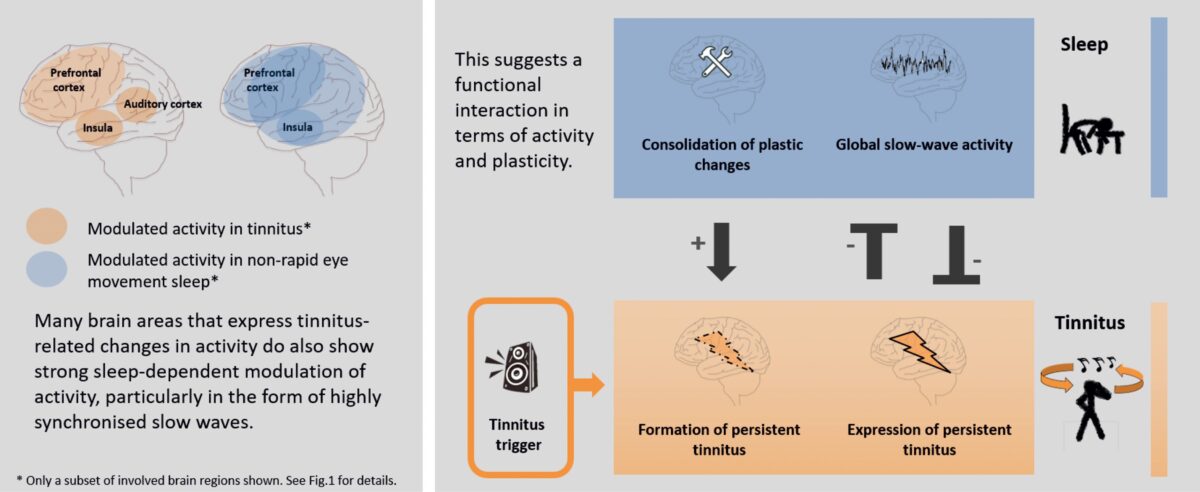
For example, adjustments to neural synapses that can occur during sleep, the authors suggest, could increase the number of processes involved in tinnitus formation.
Once tinnitus is established, the picture is less clear.
Last year, a Chinese study found that tinnitus-related hyperactivity in patients’ brains persisted through every stage of sleep, even deep sleep.
“This study establishes sleep as a critical therapeutic target for interrupting the dysfunctional 24-hour cycle of tinnitus,” concluded first author Xiaoyu Bao of South China University of Technology and colleagues.
This does not show that poor sleep leads to worsening tinnitus hyperactivity, but it does suggest a mechanism linking the two.
Related: This Sleep Factor Matters More Than How Many Hours You Have, Study Finds
“Tinnitus can make sleep worse, and poor sleep can, in turn, make tinnitus worse. It can be a kind of vicious cycle, although I don’t believe it’s unbreakable,” Milinski told ScienceAlert in 2025.
“When we don’t sleep well, we become more vulnerable to stress, and stress is one of the most powerful factors known to make tinnitus worse. Stress can even trigger tinnitus.”
In the mice in the current study, stress from staying awake is unlikely to explain the results, the authors say, because it should have made the tinnitus worse, not better.
Related: Scientists Have Identified a Biological Signature for Tinnitus, and It’s in Your Blood
“Although future studies are needed to determine what aspect of sleep may affect
development and consolidation of hearing loss and noise-induced tinnitus,” Milinski and colleagues write in their preprint.
“The results of this study suggest that modulation of the natural dynamics of the brain state provides fertile ground for mitigating the consequences of noise overexposure.”
The new research is awaiting peer review and a preprint is available on bioRxiv.
The research was published in biorXiv.
This article was fact-checked by Rebecca Dyer and edited by Rebecca Dyer. Although we are proud of our process, we are only human. If you spot an error, please let us know.
Gn Health