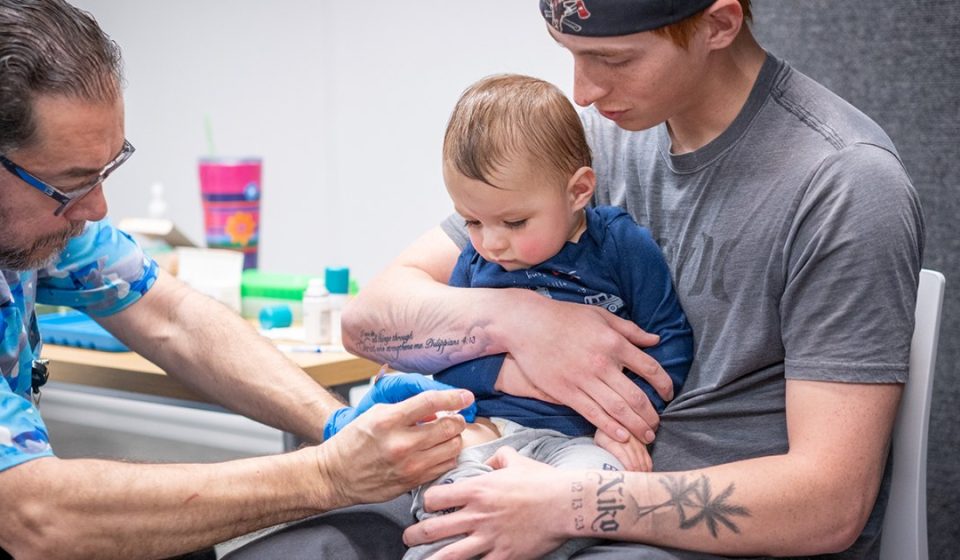
As measles outbreaks continue to expand nationwide, increasingly spreading from small, close-knit communities to the general population, a new question has emerged: Should doctors give measles vaccines earlier to better protect babies?
Dr. Kristen Panthagani, an emergency room doctor in Connecticut, worries about her baby, who just turned 6 months old – too young for the measles-mumps-rubella (MMR) vaccine given after age 1.
“I’ve been trying to figure out what to do to protect my son,” Panthagani said on his public health blog, titled “You Can Know Things.” He is “in a delicate period with regard to measles. He is in a window of vulnerability where he probably has no protection against the virus.”
Babies are born with antibodies against measles if their mothers have been vaccinated. But new evidence shows that protection doesn’t last as long as previously thought.
“The assumption has always been that until 6 months of age babies are protected, and then from 6 to 12 months there is some decline,” said Dr. Buddy Creech, a pediatric infectious disease specialist and director of the Vanderbilt Vaccine Research Program at Vanderbilt University Medical Center. “That’s why we give the vaccine at 12 months.”
New research by Creech’s team shows that protection disappears well before a child’s first birthday. Researchers analyzed blood samples from 92 mother-child pairs and found that less than 20% of 6-month-old babies still have these protective antibodies.
“Between 4 and 6 months, the majority of children have completely lost the level of seroprotection that would be necessary to protect against measles,” Creech said. He presented the research at an October meeting of the Infectious Diseases Society of America. It has not been peer reviewed.
To learn more about the measles outbreak, read The vaccine dividea data investigation into how the deadly virus is making a comeback and how children’s vaccine defenses continue to crack and collapse.
Now that cases have exploded in the United States, babies aged 6 to 11 months are increasingly defenseless against the virus.
“We’re going to have to rethink when we should give the first dose of the measles vaccine,” Creech said.
When should children get vaccinated against measles?
For decades, the guidelines were simple: Children receive their first MMR shot between 12 and 15 months of age, followed by a second dose between 4 and 6 years of age. Together, the shots are 97% effective in protecting against measles, usually for life.
However, in areas with active outbreaks, babies aged 6 months may receive an early or “zero” MMR shot before their two regular doses.
And toddlers who have already received their first regular dose don’t need to wait until age 4 to receive their second dose. They are eligible for the second dose 28 days after the first for maximum protection.
Many parents in outbreak areas have taken advantage of the change in guidelines. “We’ve seen a huge uptake of the zero dose as well as the start of the second dose,” Pennsylvania Health Secretary Dr. Debra Bogen said last week during a briefing with the Association of State and Territorial Health Officials. More than 67,000 early MMR shots have been administered in Pennsylvania since July, according to the state health department.
The growing question now is whether these exceptions should be used more widely — or whether the routine immunization schedule itself should be reexamined — now that the United States has lost its measles elimination status.
“There are people looking at this right now. They’re looking at all the latest science and seeing if the recommendation should change,” said Dr. Deanna Behrens, a Chicago-area pediatrician and secretary of the Illinois chapter of the American Academy of Pediatrics. “We are on high alert.”
As of Friday, the Centers for Disease Control and Prevention had confirmed 5,838 cases, although that number is likely a gross underestimate. More than 1,000 of these cases involved children under 5 years old. About 17% of these children required hospitalization.
Most children recover from measles without problems. But as the virus has spread across the United States, doctors in outbreak areas have reported serious complications in some children, including difficulty breathing, severe dehydration, pneumonia and brain swelling. Babies with measles are also at greater risk of developing a condition called subacute sclerosing panencephalitis, or SSPE, years after their infection. It is almost always fatal.
Twelve people have died from measles this year, according to state health departments. At least half of these deaths involve babies or young children.
The Vaccine Integrity Project, part of the Center for Infectious Disease Research and Policy at the University of Minnesota, recently summarized the latest data on zero doses of the MMR vaccine. The vaccine is 58% effective when administered between 6 and 9 months and 83% between 9 and 11 months.
Side effects of the injections, such as fever and, rarely, febrile seizures, were the same in younger and older children.
But there is also evidence, according to the Vaccine Integrity Project study, that the zero dose may impact how children’s immune systems respond to the two routinely recommended MMR shots.
“It’s a trade-off right now,” said Dr. Heidi Moline, a pediatrician and clinical advisor at the Center for Infectious Disease Research and Policy. “When a significant amount of measles virus is circulating, the short-term benefit of protection against measles outweighs the long-term reduction in antibodies.”
At this time, there is no indication that the CDC plans to change the childhood vaccination schedule. The AAP said the group would review all of its vaccination recommendations early next year. The CDC did not immediately respond to a request for comment.
Vaccines recommended by the CDC’s Advisory Committee on Immunization Practices are generally free. According to the AAP, health insurance claims have been denied for early MMR vaccination.
“This is something that people in vaccine policy are really going to have to look at,” said Dr. Peter Hotez, co-director of the Texas Children’s Hospital Center for Vaccine Development.
Gn Health