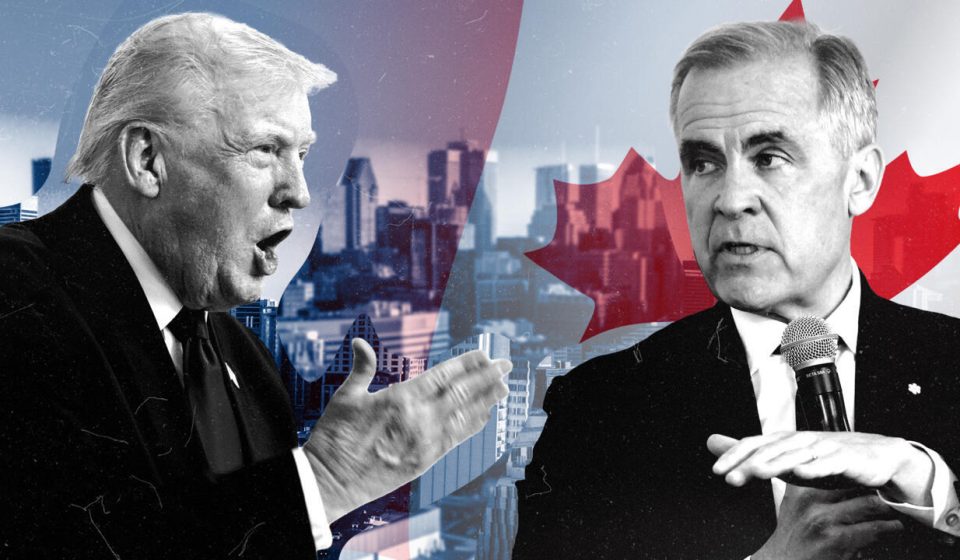
“The joke is over.” It was in French that Mark Carney, the Canadian Prime Minister, confirmed, Monday August 24, that the language of Molière was among the reasons, and not the least, for his decision to put an end to negotiations with the United States.
But how could French – one of the two official languages in Canada alongside English since 1969 – become an obstacle to economic and tariff negotiations between Washington and Ottawa?
Defending French would be discriminatory for Washington
The head of the Canadian government assured that Washington had formulated demands that would have weakened the protections for French provided by federal legislation and regulations in Quebec. French is the main language of approximately 85% of the province’s population. Canada “could not accept” an agreement that would have “jeopardized the French culture and language” in the country, argued Mark Carney.
Jamieson Greer, US Trade Representative, denied any hostility towards French, adding that he “appreciated Quebecers” and the fact that they are French-speaking. The American negotiator called the Canadian allegations “fun funny fake news”, while recognizing that certain Canadian rules on this subject were not appreciated by American companies.
Also readCanada hits back at Trump with 15-50% tariff surcharges
“The Trump administration is speaking out for American business circles who consider certain laws unfair, such as the obligation of double labeling (French and English) on products sold in Canada or even regulations in Quebec which force platforms like Netflix to optimize their recommendation algorithm to highlight content in French,” explains Andrew Gawthorpe, specialist in American foreign policy at Leiden University in the Netherlands.
An extension in your browser appears to be blocking the loading of the video player. To be able to watch this content, you must disable or uninstall it.

Cover image: © France 24
Washington maintains that these linguistic protection rules constitute “all discriminatory measures which favor the Canadian and French-speaking competitors of American companies, obliged to provide additional costs of translation and compliance”, explains Christian Lammert, specialist in American-Canadian relations at the John F. Kennedy Institute at the Free University of Berlin.
Netflix against French in Quebec?
An argument that struggles to fully convince. “American companies that export to France or Germany are obliged to produce labeling in the local language and find that normal,” says Craig Moyes, director of the research network on Quebec and French-speaking Canada at King’s College London.
The opposition of American digital platforms like Netflix to the obligation to highlight French-speaking content “is a new commercial battle front, which is becoming particularly important”, judges Christian Lammert.
American Tech giants have found an attentive ear in the White House since Donald Trump’s return to power, while “regulations which further strengthen the protection of French in Quebec, particularly in the digital domain, were adopted as recently as last year”, underlines James Kennedy, director of the Center for Canadian Studies at the University of Edinburgh.
Canada vs Trump: the tone is rising, border residents are organizing
An extension in your browser appears to be blocking the loading of the video player. To be able to watch this content, you must disable or uninstall it.

Cover image: Focus © France 24
Faced with this American pressure, Mark Carney “has clearly made the protection of French a red line that he will absolutely refuse to cross during these trade negotiations”, assures James Kennedy.
In this context, could the French question permanently damage relations between the two neighboring countries? For the experts interviewed, the protection of this second official language is not just a commercial question. “Giving in on this point in the face of American pressure would amount to giving up a part of sovereignty,” assures Craig Moyes. Because this would mean that American commercial interests prevail over the will of the people which was expressed during the adoption in Parliament of the laws to protect French.
A question of sovereignty for Canada
This is “a question that is all the more sensitive as it comes at a time when Donald Trump has repeatedly said that he wants Canada to become the 51st American state. In this context, respect for the two official languages represents in the eyes of Canadians an essential aspect of national identity that must be preserved,” explains Andrew Gawthorpe.
As such, Mark Carney has no other choice but to defend French at all costs. Even if he wanted to give in on this ground against Washington, it would be politically suicidal for him, believe the experts interviewed.
It is also a way of acting as a unifier. By taking on the role of champion of the French-speaking cause, he can hope to generate broad support because “even if internally, certain inhabitants of English-speaking regions may consider the protection of French as irritating, they defend it against what they consider to be an act of aggression on the part of the United States”, believes Craig Moyes.
It remains to be seen whether Washington, for its part, can backtrack on this issue. “This is not the first time that Canada has wanted to protect its cultural policy in the face of American commercial pressures,” underlines Christian Lammert. These issues were already present during the negotiations that resulted in the Canada–United States Free Trade Agreement (FTA) in 1988.
In the past, the United States has always known not to push the envelope too far, “this time, the reason there is a problem is called Donald Trump and his associates”, notes Craig Moyes. “This administration’s approach is much more aggressive,” confirms Christian Lammert.
Donald Trump seems to have let go a little on this issue on Tuesday, saying that he “will never interfere in the affairs of French-speaking Canadians.” A wording that is vague enough, however, to give them the opportunity to interfere with the laws that protect their language…