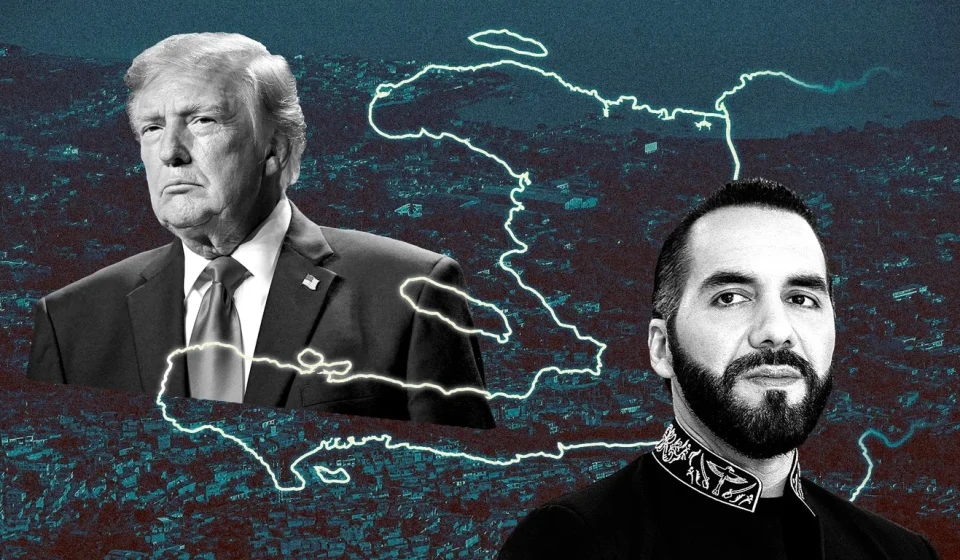
Salvadoran President strongman Nayib Bukele is sending thousands of troops to Haiti to bolster the island’s efforts to eliminate the gang problem – and find four of his troops captured in a recent ambush.
- Bukele called President Trump on Tuesday to ensure he had no problem with this major military escalation, to which the Haitian government agreed.
- “Do what you have to do,” Trump told him, according to sources briefed on the call.
Why it’s important: If it works, Bukele’s troop surge could stabilize Haiti, a country 700 miles from Florida that has been devastated by deadly gang violence and has lacked a president since the last one, Jovenel Moise, was assassinated five years ago.
- If it doesn’t work, it could increase Haiti’s death toll well beyond the 5,700 killed in gang violence this year, embarrass Bukele and mark another failure of international efforts to restore stability to the country.
Haiti could also be a test case for Bukele and security contractor Erik Prince — a Trump and Bukele ally also operating in Haiti — to act as public-private proxies for U.S. power in the hemisphere.
- El Salvador announced Wednesday that it was deploying up to 2,000 troops to Haiti. This figure could double or triple, according to sources.
- “We didn’t come to Haiti to make money, because no one pays us to do that. We came to Haiti to fight against the bad guys,” Bukele wrote, in Haitian Creole, Thursday on X.
Zoom: Along with other countries, El Salvador was part of a UN-established initiative called the Gang Suppression Force, or GSF, operating in the Haitian capital, Port-au-Prince.
- On October 18, four Salvadoran aviation technicians were ambushed and remain missing, according to the Miami Herald.
- Three days later, Bukele posted a warning on »
- “We are already done with the gangs in El Salvador, and we can be done with you too,” he wrote.
Zoom out: First elected in 2019, Bukele gained political fame and infamy for wiping out the MS-13 gang in El Salvador in a campaign of brutal military force and mass incarceration.
- Bukele’s efforts transformed El Salvador from a murder capital to a country widely considered one of the safest countries in the Western Hemisphere.
- Bukele, who has a close relationship with U.S. Secretary of State Marco Rubio, endeared himself to the new Trump administration by agreeing to accept third-country migrants who were expelled en masse from the United States and then locked up in Bukele’s notorious CECOT prison.
Driving the news: Bukele’s force was authorized to operate on the island under a bilateral agreement with Haiti approved Wednesday as Salvadoran special forces and equipment began pouring in.
- Also on Wednesday, Haiti’s electoral council postponed presidential elections until next year due to gang violence.
Between the lines: Bukele’s force appears to operate in parallel with the GSF – to which it currently belongs – and Prince’s private security company, Vectus Global, successor to Blackwater.
- Florida Rep. Brian Mast (R), chairman of the House Foreign Affairs Committee, said the U.N.-backed GSF was too bureaucratic and timid. The GSF’s Kenyan-led predecessor was too irresponsible and, at a billion-dollar cost, too expensive, he said.
- “We spent the equivalent of a million dollars per Kenyan and it was worse at the end,” Mast said.
To show the butchery Haitian gangs, Mast shared with Axios a video of a Haitian killed with a machete for helping the GSF. Rape, arson, extortion and kidnapping are commonplace on the island.
- Beyond El Salvador’s search for its four missing members, Mast said, “I hope the mission will be revenge, retribution and destruction of the gangs.” Someone has to be there with a motive and motivation. »
- “Now the fight is personal to them and the fight will be against the gangs,” he added. “The United States wants to get out of this situation and not spend millions for nothing.”
The plot: Bukele had proposed that the Trump administration let El Salvador pacify Haiti as a proxy force for the United States, but “Rubio wanted to stay away from that. He wants to keep Haiti off the radar,” a source close to the discussions told Axios.
- Bukele had requested military equipment from the United States, including drones and transport aircraft, but this was officially denied, according to another source who said Colombia could ultimately serve as an unofficial intermediary to provide Bukele’s force with no U.S. footprint on the mission.
Inside the room: When Bukele called Trump on Tuesday, the president expressed sympathy and condolences for the plight of Bukele’s missing service members, a White House official said.
- “Bukele doesn’t want the United States to suddenly cut him off at the knees for entering,” said a source briefed on the call.
- Trump’s focus on Haiti is largely limited to ensuring the country returns to its citizens who were in the United States under temporary protected status, which Trump ended last year.
- “Bukele told the president he was confident he could do the job. But it could get complicated,” said the source briefed on the call. “The gangs fucked with the wrong guy. He’s got something to prove.”
Gn headline