
Unlock the White House Watch newsletter for free
Your guide to what Trump’s second term means for Washington, business and the world
Warmongering officials in Washington and Israel are urging President Donald Trump to resume strikes against Iran, as U.S. military planners warn their forces risk becoming overwhelmed if the standoff persists into the new year.
U.S. Central Command, which oversees military operations in the Middle East, has informed U.S. officials that the consequences of a sustained military buildup after the end of December could erode military readiness, according to three people familiar with the matter, including U.S. officials.
The sources added that U.S. military planners were also mindful of the prospect that the new Democratic-led Congress would cut defense spending and increase oversight of foreign operations, particularly the unpopular war with Iran.
A person familiar with the matter said that “Centcom is telling the administration that they are running out of time, they are spending money and they are ready,” including to deal with other global threats, as the massive deployment against Iran approaches a full year.
A US military official disputed this characterization. They said it was not true that Centcom was telling the administration that U.S. forces were running out of time, nor was it true that the forces would be overwhelmed if the strikes were not renewed before the new year.
Israeli government officials — who have repeatedly argued for a resumption of war — used the argument of a shrinking window for action to urge Trump to launch new strikes against Iran before the new year, according to two of the sources.
Another person familiar with the matter added that some U.S. officials were also pressuring the president to “finish” the job.

Trump, however, seemed to indicate that he had not yet made up his mind, telling Axios on Thursday that he was “not rushing into a decision” and that “we’ll see what happens after the start of the year.”
The president has repeatedly wavered in his intentions, alternating between bellicose statements threatening military action and calls for Iran to accept a diplomatic solution. Trump recently downplayed the prospect of a deal, saying he was content to leave the status quo — in which the United States imposes a costly naval blockade on Iran — in place.
He finally resisted pressure last month from Israeli Prime Minister Benjamin Netanyahu to restart large-scale military operations, including attacks on Iranian energy facilities and civilian infrastructure, ahead of Israeli and US midterm elections.
But while Trump appeared to calm down about the prospect of military action after the midterm elections – in which the Republican Party suffered a historic setback, due in part to the unpopularity of the war – Netanyahu used the weeks that followed to repeatedly warn of “great threats” from Iran.
The Israeli prime minister, who is transitioning after last month’s inconclusive election results, also claimed without evidence that Tehran was pushing to renew its nuclear program and that “Israel’s fate was at stake.” Netanyahu and Trump had previously indicated that Iran’s program had been “wiped out” in previous bombings.
Roman Gofman, the head of Israel’s Mossad intelligence agency, traveled to the United States last week to speak with senior American officials, including CIA chief John Ratcliffe, in an effort to “provide information and persuade” the Trump administration to renew joint strikes against Iran, a person familiar with the matter said.
Discussions are also underway within Israel’s security services about a smaller Israeli operation against Iran – “something more specific” than the kind of large-scale, multi-day joint assault that the United States and Israel launched at the start of the war in February and was considered last month, this person added.
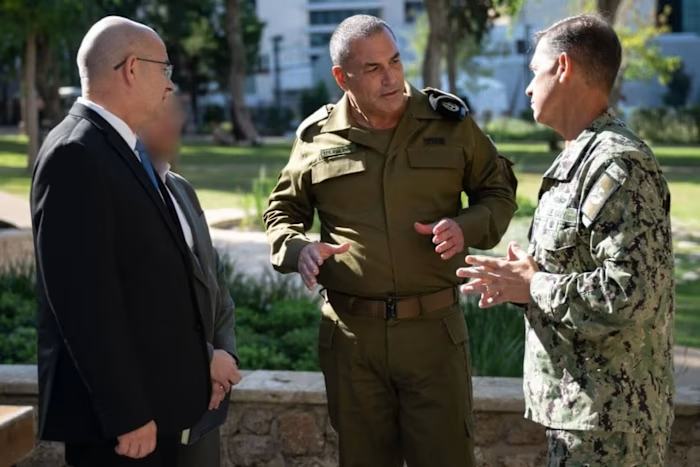
Brad Cooper, the boss of Centcom, also met this week in Israel with Gofman and the general staff of the Israeli army.
The White House and the Israeli prime minister’s office did not respond to requests for comment.
The United States and Iran have traded sporadic blows in the months since a tentative April truce that ended large-scale hostilities and remain locked in a tense standoff over the Strait of Hormuz, which has roiled energy markets and strained the global economy.
In Israel, the prospect of a return to war at a time when the country remains in a political vacuum has alarmed many.
While Netanyahu’s far-right coalition lost its parliamentary majority in recent polls, a group of opposition parties led by former military leader Gadi Eisenkot has so far been unable to form a new government to replace the veteran prime minister.
Eisenkot and other opposition leaders have warned since election night of the danger that Netanyahu could seek military escalation in a bid to save his premiership, and vowed to support the Israeli military and other security chiefs to resist any pressure.
Over the past week, Eisenkot and other opposition leaders held security consultations with Netanyahu over what they later described as “the particular sensitivity of the coming days.”
Gn headline