WEST PALM BEACH, Fla. (AP) — President Donald Trump is doubling ideas that voters say they don’t like, a historically unique response to a mid-term beating during which Democrats gained majorities in the House and Senate.
Just this week, Trump seemed to reject the type of post-election pivot that presidents before him have made. Instead, he recommitted himself to tariffs, tech billionaires, and autocrats, and he did nothing to correct course and address the affordability pressures that caused voters to reject Republicans.
Trump successfully pushed to have billionaire Jensen Huang reinstalled as CEO of Nvidia, after 7 in 10 said so The AP Voter Poll that the economy has become rigged in favor of the rich.
“He’s so happy to come back. He calls it his second term,” Trump said Thursday of his ally who was ousted after admitting to an extramarital affair with a woman, Alice Huang. linked to the Chinese government. Beijing denies having been a spy.
Trump deployed a new series of prices which hit China as well as its traditional partners such as Japan, South Korea and the European Union. But two-thirds of voters said his import taxes have already hurt the economy as inflation has worsened. The Republican president hailed the term “tariff” as one of his watchwords. favorite words in the English language, but in this case he did not take the time to personally promote the higher rates.
His Thanksgiving message, posted on social media, defended his obsession with renovating the White House and accused his own government of publishing false economic data. As vacation week approaches, he defends calling Russian leader Vladimir Putin a friend and offered no assurances about its next steps in the Iran war.
This is not a typical response to a midterm election rout
Past presidents have changed course after midterm defeats, said Matthew Dallek, a professor and political historian at George Washington University.
Democrat Bill Clinton overhauled welfare after the 1994 election. Republican George W. Bush sent troops to Iraq after his party’s setback in 2006. Democrat Barack Obama reached a bipartisan agreement on deficit reduction after his 2010 election defeats.
But Trump’s apparent unwillingness to adapt to the new realities of his unpopularity and a Democratic Congress is a sign that the White House may be heading down a path to self-destruction, Dallek said.
“If you’re thinking about engaging in political hari-kari, Trump seems to be doing it on behalf of his party,” he said.
Dallek added that the midterm results represented a “deeper rejection” of Trump nationally that “potentially undermines the fundamental assumption of American politics that there are red and blue states and a handful of purple states.”
The White House did not respond to questions about whether the Election Day results prompted it to seriously reconsider its policies or whether it believed the public might eventually buy into its agenda.
Trump suggested a willingness to work with Democrats, even as he posted a caricature online of himself as the mob boss from “The Godfather.” The meme of Trump as Vito Corleone played on the joke that he would “freely veto” anything Democrats sent him.
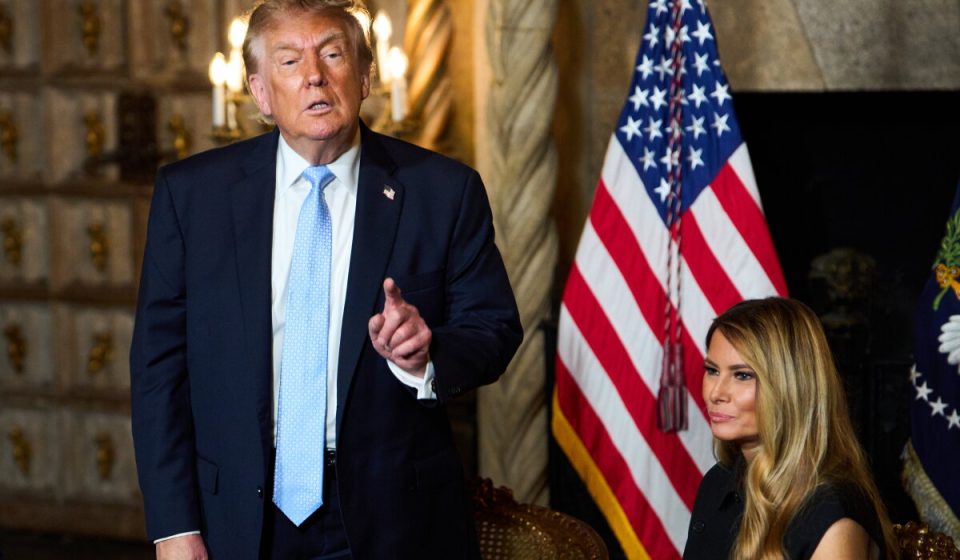
Yet before video cameras Thursday at his Mar-a-Lago estate in Florida, he said he expected a “very bipartisan relationship” because Democrats — who promise to hold Trump accountable — would be intimidated by his ability to veto the legislation.
“So I hear Democrats,” Trump said. “They’re calling because I have veto power, and I’m not looking to use it, but it’s a very powerful power.”
Sen. Tim Kaine, D-Va., posted on
“Read the room!” » said Kaine.
Trump still seems to ignore Americans’ concerns about the cost of living
Voters I sent a message mid-term that they expect Washington to help make basic necessities more affordable. Trump has yet to present concrete solutions.
On Wednesday, he sidestepped a government report showing that the key inflation gauge tracked by the Federal Reserve, the main price index of personal consumption spending, rose 3.8% over the past 12 months.
Instead, Trump focused on the recent drop in gasoline prices, implying that they had been artificially high before the Nov. 3 election, as a form of political pressure on Republicans. Energy costs initially soared after Trump launched war on Iran in February.
“Gasoline is down,” Trump said Thursday. “This happened right after the election was over.”
The American Petroleum Institute in a report on falling prices this month suggested that the onset of colder weather played a significant role, saying that “as Americans drive less, refiners turn to cheaper gasoline blends and fuel stocks replenish.”
Yuval Levin, a senior fellow at the American Enterprise Institute, a conservative think tank, said Trump led “no organized political response to the election” — nor did he expect Trump to undertake one. Trump’s hints of a willingness to work to expand access to health care and pursue an immigration overhaul have not been followed by any formal presidential action.
“I would expect him to continue to play a more reactive and inconsistent role, unbalancing people inside and outside the administration, but not following a consistent course,” Levin said.
Trump demonstrated this strategy on Thursday, in celebration of the holiday, in part accusing his own Commerce Department of issuing a “false” report on gross domestic product before the election.
The department had GDP revised upwards for the third quarter Wednesday at a strong annual rate of 4.3%, well above the “advance estimate” of 3.4% released at the end of October. It was part of a standard procedure in updating GDP figures.
But Trump claimed without proof that it was an “intentional” mistake and he took to social media to order an investigation.
Questioned by a reporter who would lead the investigation, Trump changed the subject.
Gn usa