
Washington- President Trump faces bipartisan backlash following his surprise decision to lift new sanctions against Russia two days before their entry into force.
Congress approved the bipartisan legislation – championed by the late Republican Senator Lindsey Graham of South Carolina, who died before it was passed – and it was signed into law by Mr. Trump on September 18. It also deals a blow to Graham’s legacy, given that the senator, a close friend of Mr. Trump, made this legislation one of his final acts.
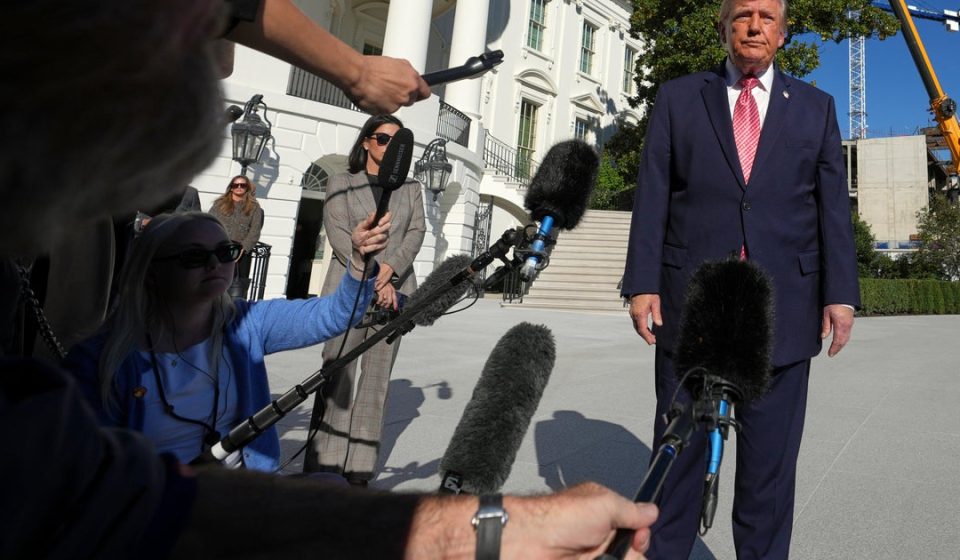
But Mr. Trump is increasingly frustrated with Ukraine and criticized Ukraine on Monday, even as Russia continues to strike civilian sites in Ukraine. “Frankly, Russia has done well with Ukraine, they haven’t done much,” the president told reporters on the South Lawn of the White House on Monday. He added: “We gave a lot to Ukraine, they gave us nothing.”
In its most recent strikes, Russia recently hit Ukraine’s energy sector and infrastructure, as well as a medical clinic, school, metro station and residential buildings, Ukrainian President Volodymyr Zelenskyy said Monday.
The economic restrictions were aimed at penalizing Russian figures and the biggest buyers of Russian oil and gas, as the United States seeks to end Russian President Vladimir Putin’s four-year war in Ukraine. But the legislation gives Mr. Trump the power to waive parts of the law if he certifies to Congress that lifting sanctions is “in the national interest of the United States.”
The Trump administration faces intense pressure to act to lower fuel prices as the midterm elections approach.
“I hereby waive the sanctions, restrictions and obligations provided for in the Graham Act,” Mr. Trump said in an executive order issued Friday. “I have submitted to Congress a certification that granting such a waiver at this time is in the national interest of the United States.”
The order does not explain Mr. Trump’s decision, which comes a week after the president eased sanctions on Russia’s energy sector and announced an agreement with Putin to import diesel into the American market.
“Beyond irresponsible,” Republican Sen. Thom Tillis of North Carolina said of the president’s latest move, calling it “unconscionable that this administration is capitulating to a Russian dictator who illegally invaded Ukraine and is massacring innocent civilians every day.”
“If the president really wants to lower energy prices, he can do it by solving the Iran problem, not by doing a solid job for Vladimir Putin,” Tillis added.
The 300,000 tons of diesel consumed by the United States buy in Russia That’s about 2.2 million barrels, or a little more than half of the 4.1 million barrels of diesel the United States uses in a single day. And because Ukraine has damaged much of Russia’s refining capacity, it’s unclear when Russia will be able to deliver the fuel. Experts say the deal with Russia will not compensate for oil supply disruptions resulting from the Iran war.
Republican Sen. John Cornyn of Texas agreed and said of waiving sanctions: “Lindsey would be appalled.”
“Helping Putin in Ukraine is reckless,” Cornyn said. “He wouldn’t stop at Ukraine and our NATO allies would be next. Putin is fanatically determined to restore Russia’s glory days, calling the collapse of the Soviet Union ‘the greatest geopolitical catastrophe of the century’ and claiming that Russia was ‘robbed’ during the breakup.”
Sen. Kevin Cramer, a Republican from North Dakota, said on “Face the Nation with Margaret Brennan” that he shared his colleagues’ position, arguing that “capitulating to a bully usually means they’re going to make more demands in the future.”
“That’s the problem with taking a thug approach to trade negotiations, which is what Vladimir Putin is,” he said.
Several Republicans in the House of Representatives also denounced the president’s decision.
“The president is prolonging the war, not ending it,” Republican Rep. Don Bacon of Nebraska wrote Friday. On Saturday, Bacon added that “Mr. Trump’s agenda is dead.”
“The President has an agenda: Supplementary, Reconciliation, Ballroom, etc.,” Bacon wrote. “Many of us will not fund these projects knowing that he is supporting the invasion of a dictator and throwing an ally under the bus.”
Republican Representative Michael McCaul, former chairman of the House Foreign Relations Committee, urged Mr. Trump to reconsider his decision.
“Time and time again, we have seen how Putin responds to American concessions: with contempt for the United States and increased violence against innocent Ukrainians,” he said on Saturday.
Rep. Gregory Meeks of New York, the top Democrat on the House Foreign Affairs Committee, said the waiver should come as no surprise. Meeks had opposed passage of the bill, saying it would expand presidential tariff authorities.
“He has had the power to sanction Russia for years. What he lacks is the will,” Meeks said in a statement Saturday.
“By providing vital support to the Russian economy, Trump’s deal with the devil keeps getting dirtier and dirtier,” Senate Minority Leader Chuck Schumer, who represents New York, said in a separate statement.
The president’s decision to lift sanctions against Russia also immediately sparked criticism and concern from Zelensky. Earlier this month, Mr. Trump said Ukraine should “find a new leader.”
Zelenskyy told reporters last week that he believed the president’s actions that contradicted the intent of the Lindsey Graham Act would continue, “unfortunately.”
“It’s unfortunate because we all had great respect for Lindsey,” Zelenskyy said. “He dedicated his life to America. We had a great relationship with him. And shortly before the tragedy, Lindsey was in Ukraine. He always supported us very strongly and insisted that Ukraine get as much help as possible. It’s difficult without him, I’ll be honest. I want to thank the Democrats and the Republicans who supported his bill. It was a major victory: this truly bipartisan support. And now the decision to cancel all of this, to block everything, seems to me “Wrong and it definitely only helps the Russians.”
On Sunday, Mr. Trump sought to explain the lifting of sanctions by saying he did not want to push Russia away from the negotiating table.
“My decision regarding Russia is very simple,” he wrote on Truth Social in the face of growing public criticism. “I am negotiating peace in the war between Russia and Ukraine, and I do not want to do anything that would stupidly push Russia away from the negotiating table.”
But Mr. Trump has long touted a friendlier relationship with Putin, a departure from all his predecessors. New photos of Mr. Trump with Putin and Chinese President Xi Jinping adorn the White House Palm Room, where reporters exit and enter the White House to watch the president take off and land from Marine One.
Mr Trump blasted Ukraine for hitting diesel refineries in Russia. He called on Ukraine and Russia to end the war, even though it was Russia that started it, and could end it by withdrawing all occupying troops and stopping its attacks.
Mr. Trump faces political pressure to lower gasoline prices, two weeks before the midterm elections in which Republicans are expected to struggle. The cost of living and gasoline prices remain major issues for voters, with the war in Iran driving up gasoline and diesel prices and also pushing overall inflation higher. Mr. Trump has claimed that the war would end once the midterm elections are over, although it is unclear how, and that gas prices would then fall precipitously.
At the same time, Ukrainian officials have recently reported difficulties with Starlink, the commercial satellite network owned by SpaceX’s Elon Musk, and Starshield, the military version built on the same network.
Zelenskyy said over the weekend that throttling Starshield network speeds meant Ukraine was unable to use its interceptors to shoot down Russian Shahed drones, raising questions about who was behind the slowdown. Mr. Trump on Friday denied limiting Ukraine’s access to Starlink and added that he also did not believe Musk was responsible.
Musk said last Wednesday that he was not responsible for deciding how Starshield was used, writing on
Secretary of State Marco Rubio also told reporters Saturday that the administration had “nothing to do with this.”
On Monday, Mr. Trump said he did not know who ordered the shutdown, “but I would like to know.”
The explanations did not satisfy a number of lawmakers, including some Republicans.
Last week, a bipartisan group of nine senators, including Republican Sens. Thom Tillis of North Carolina, Susan Collins of Maine, John Cornyn of Texas and Lisa Murkowski of Alaska, asked the Defense Department’s inspector general to investigate. They asked the IG to examine “whether the actions or decisions of the Department of Defense or its contractors contributed to these dangerous circumstances.”
“Any restriction of these capabilities, particularly without prior notification, raises serious questions about the Department of Defense’s contractual oversight and its responsibility to ensure the continuity of essential services,” the senators wrote in the letter.
Cramer and Republican Rep. Mike Turner of Ohio also joined growing calls for a congressional investigation into the “Face the Nation” decision Sunday.
“There needs to be an investigation; we need to find out who these people are because lives are in danger and lives are being lost because of these things,” Turner said. said.
Tillis and Democratic Sen. Richard Blumenthal of Connecticut held a video call with Zelenskyy on Monday and said they confirmed that “critical Starlink services remain degraded,” preventing Ukraine from intercepting Russian drones. The senators said Zelensky also reported disruptions in U.S. intelligence sharing regarding early warning of Russian ballistic missile launches.
The two men said Zelensky also expressed “serious concerns” about critical air defense interceptor delays and Mr. Trump’s decision to lift sanctions on Russia.
“Trying to appease a murderous thug like Vladimir Putin will only prolong this war and lead to greater losses,” Tillis and Blumenthal said.
Gn usa