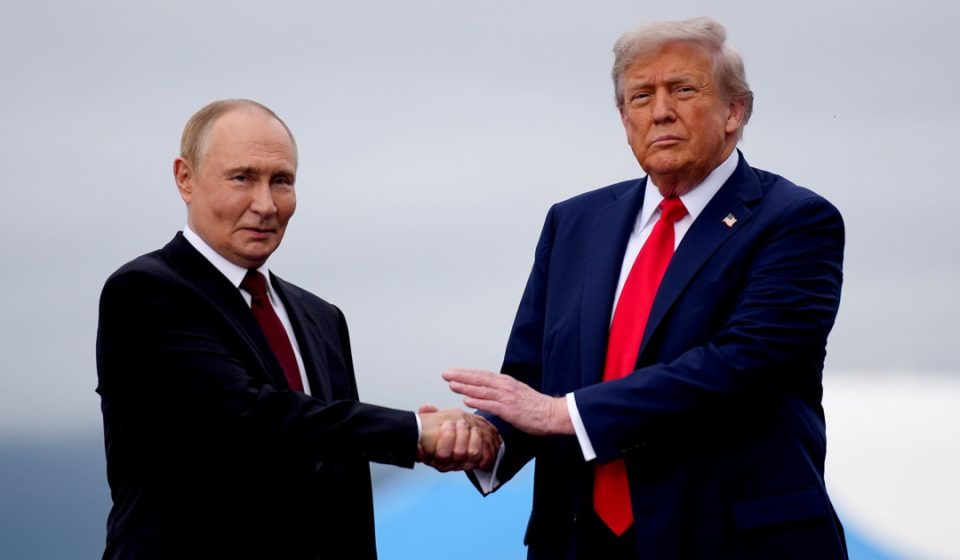

WASHINGTON — In recent weeks, President Donald Trump has taken steps that strengthen Russia’s position and could improve the image of Russian President Vladimir Putin in the international community.
Trump returned to power promising to quickly end the war between Russia and Ukraine, proclaiming last year that he was “on no one’s side” except “the side of humanity.” But the neutral posture he says he has adopted is crumbling.
A specific strategic goal underlies Trump’s overtures to Putin, foreign policy experts say. The idea is to entice him to come to the negotiating table and end a war that is now in its fifth year. Whether it will work is another question.
Trump’s top negotiator in the Russia-Ukraine war, Steve Witkoff, called Putin “humanitarian” Wednesday in St. Petersburg after the release of retired American teacher Stephen Hubbard, whom Russia had held since 2022. Even Republican lawmakers balked at the remark.
00:43
Witkoff thanks Putin for release of retired US teacher
00:0000:00
“I would describe Putin as a warmonger, a thug. He’s certainly not a humanitarian,” said Senator Susan Collins, Republican of Maine, who is leading a tough re-election fight, on Wednesday.
“He is the aggressor in the war against Ukraine,” she added during a campaign stop at a factory in Norway, Maine.
Sen. Thom Tillis, R-N.C., who is not running for reelection following public disagreements with Trump, was more blunt. “WTF, Steve? Look up the definition of ‘humanitarian’,” he posted on social media.
Freedom House, a nonprofit organization that works to expand freedom and democracy, describes Russia as an authoritarian country where power is “concentrated in the hands of President Vladimir Putin.” The Kremlin “manipulates elections and suppresses genuine dissent,” the group claims.
Trump tends to view diplomacy through the prism of personal relationships, and he has made no secret of his esteem for Putin. When he hosted Putin for a summit meeting in Alaska last year in a vain attempt to end the war, the United States rolled out a red carpet. A photo of Trump and Putin side by side hangs in the Palm Room of the White House.
On the other hand, Trump intensified his recurring criticism of Ukrainian President Volodymyr Zelenskyy. As he left the White House on Monday for a campaign trip, he said Zelensky “is a man who should have settled this war a long time ago. I think it’s time for someone else to negotiate on behalf of Ukraine.”
Flattery is a tool Trump uses to get Putin to make a deal, said Robert O’Brien, who was national security adviser in the White House during Trump’s first term. Nothing else worked.
“We thought we could resolve the war two years ago, but Putin was intractable by not coming to the table. President Trump is using cordiality to get Putin to negotiate,” O’Brien said in an interview.
“There would be no hope of getting Putin to engage in negotiations, with the United States as mediator, if he considered Trump to be 100% aligned with Ukraine in this situation,” he added.
Michael Kimmage, a foreign policy expert at the Brookings Institution think tank, said that “the Trump administration’s theory is that by distancing themselves from Ukraine and flattering the Russians, they can accomplish something at the negotiating table.”
However, he does not expect this bet to succeed.
“In the absence of a clear agenda from the White House and in the absence of very serious forms of influence on Russia – which the Trump administration has avoided – it is very difficult to imagine progress at the negotiating table,” he said.
Asked about Trump’s warmer attitude toward Putin in recent weeks, the White House pointed to his comments during a cybercrime roundtable when asked whether Witkoff called the Russian leader “humanitarian.”
Trump responded: “I guess you could say for that particular purpose – for the purpose of enabling a man who thought he was going to be in prison for life. »
He added that the United States was negotiating with Russia to end the war in Ukraine and praised Russia for not getting involved with Iran. Trump said some “stupid people” were criticizing his position and that “the last thing I want to do is overturn an apple cart when we’re about to settle a war.”
Ending the war between Russia and Ukraine was one of Trump’s signature promises during the 2024 campaign. He confidently predicted he would achieve it on his first day back in office, but he has since admitted the problem is more stubborn than he imagined.
As Trump works to broker a peace deal, one of his recent gestures toward Putin is to treat him like a statesman rather than a global pariah.
Trump thanked Putin on October 9 after reaching a deal in which Russia agreed to release hundreds of thousands of tons of diesel fuel into global markets. Trump said the move would lower energy costs, but relief at the pump has yet to happen. Since then, the average price of a gallon of diesel has increased 4 cents per gallon, from $6.26 to $6.30.
Trump invited Putin to attend the G20 international summit at his Doral golf resort in Miami, and he said this week he was open to a trilateral meeting with Putin and Chinese President Xi Jinping to discuss nuclear weapons.
A summit meeting alongside the leaders of the world’s two largest economies would be a boon for Putin, who the West has ostracized since Russia invaded Crimea in 2014. World leaders expelled Putin from an elite international organization called the G8 after that attack.
“There is no doubt that Trump attempted to reintegrate Putin into polite society,” said Brett Bruen, director of global engagement in the Obama White House.
At the G20 summit at Trump’s golf club in December, Putin would be “the shiny object that Trump would brandish in front of the world press as supposed progress toward peace,” Bruen said.
One question Europeans are asking is what kind of peace deal Trump envisions. Would this be fair to Ukraine or divide the country at Putin’s behest, they ask? If Ukraine ceded territory to Putin as the price for ending the war, it would only encourage him to threaten more states, a European official said.
Marko Mihkelson, chairman of the foreign affairs committee in the parliament of Estonia, a country bordering Russia, said in an interview: “If you reward the aggressors” and signal that they can “achieve their goals through aggression, that does not stop them from continuing.”
Faced with a war in Iran that he started and a war in Europe that he cannot stop, Trump is advised by an inner circle. A senior aide, press secretary Karoline Leavitt, left the White House over the summer. Sen. Lindsey Graham, R-S.C., one of Trump’s confidants and a Russia hawk, died suddenly in July.
Two months later, Trump signed a bill named after Graham that sanctioned Russian officials and parts of the country’s economy.
Trump lifted those sanctions last week – which Graham could have warned about during his many phone calls and rounds of golf.
“Lindsey Graham is rolling over in her grave,” Senator Mark Warner, Democrat of Virginia, said Wednesday.
Gn usa