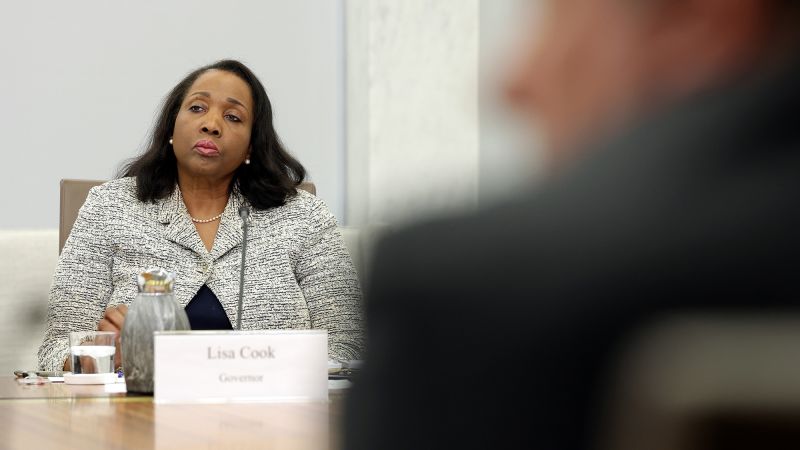

President Donald Trump is launching a new offensive in his battle to oust Federal Reserve Governor Lisa Cook by forming a committee of his own people to investigate allegations against her.
The committee will investigate Cook’s alleged misrepresentations regarding mortgages on two properties and will hold an in-person hearing at the White House on Nov. 5, the White House announced Friday.
Analysts say the formation of the committee and setting a hearing date indicate that Trump officials are tackling procedural issues addressed by a June Supreme Court ruling that initially blocked the administration from impeaching Cook.
Newly installed Labor Secretary Keith Sonderling, who is also acting director of the Office of Government Ethics, is one of the three members. So is National Economic Council Director Kevin Hassett, a staunch defender of Trump’s economic agenda, whom the president has considered to chair the Fed. The third member is Andrea Lucas, chair of the Equal Employment Opportunity Commission.
Cook’s lawyers, Abbe Lowell and Norm Eisen, said they were in contact with the White House “to evaluate whether the proposed process has the potential to be genuine and not simply a box-checking exercise.”
“Governor Cook welcomes the opportunity to present the facts so that she can clear her name and demonstrate that there is no legal basis to fire her,” they said in a statement provided to CNN on Friday.
The committee’s formation marks the latest salvo in Trump’s current attempts to reshape the Fed and comes just weeks before his next monetary policy meeting, where officials will consider whether interest rate changes are warranted.
“This seems tailor-made to address the biggest criticism the Supreme Court made in its last attempt: that Gov. Cook was not given a chance to defend himself,” said Tim Mahedy, a former head of the Federal Reserve Bank of San Francisco who is now CEO of the research firm Access/Macro.
Mahedy said the outcome of this review “is clear” given the composition of the committee. He said he was surprised that Hassett, a White House economist, was on a committee investigating a legal issue regarding paperwork.
Trump has long chastised the politically independent Fed for not lowering interest rates to his liking, publicly targeting Cook and former Fed Chairman Jerome Powell. But Trump spared the current chairman, Kevin Warsh, whom he appointed to the post earlier this year after Powell’s term as head of the central bank expired. Instead, Trump insisted Warsh was blocked by a “political” board of governors.
The central bank’s eight-member board votes on interest rate decisions, alongside regional Fed presidents. Although the Fed chief often plays an influential role in shaping the debate over policy measures, decisions are ultimately the result of the 12-person committee process.
At their September meeting, all 12 members, including Warsh, voted to raise rates for the first time in three years, in an effort to contain inflation, which has heated up largely because of the U.S.-Iran war.
Trump later said Warsh should not have green-lighted a rate hike. “I don’t blame Kevin Warsh. I probably would have voted against the board if I were him,” Trump said in a Time Magazine interview published earlier this month.
Separately, Trump reiterated that he wanted Warsh to “vote the way he wants.”
Trump previously sought to fire Cook over unproven allegations of mortgage fraud. Ultimately, in a 5-4 decision earlier this year, the Supreme Court ruled that Trump could not immediately remove her.
“The Supreme Court’s 5-4 decision did not prohibit President Trump from firing a Fed governor, it gave him a road map to do so,” Ed Mills, a Washington-based policy analyst at Raymond James, said in an email to CNN.
Chief Justice John Roberts wrote in his majority opinion released in June that Cook was entitled to sufficient time and notice to respond to a firing and that she was not given a fair opportunity to respond last year when Trump initially sought to remove her.
But that doesn’t mean Trump can’t legally fire her, he said. The law allows a president to remove Fed governors “for cause,” which is generally interpreted to mean negligence or malfeasance in the performance of their duties.
The “ultimate question of whether the President can impeach Cook for cause will depend in part on the underlying facts,” Roberts wrote. “We have not addressed the facts, because they have not yet been discovered or analyzed according to the relevant legal standards. »
Mills said Cook “is very clearly at risk of being fired, and it’s unclear whether the Supreme Court would block President Trump in a runoff.”
He added that two of Cook’s colleagues, Powell and Gov. Michael Barr, are also on the “potential termination for cause” list.
Kurt Lewis, a former special adviser to Powell and now head of central bank policy at Piper Sandler, said it will ultimately depend on how much deference the Supreme Court gives the president for “cause” once the justices think he has “followed some semblance of procedure.”
Cook was nominated by former President Joe Biden in 2022 and is the first Black female Fed governor, whose term will expire in 2038.
This story has been updated with additional content.
Gn headline