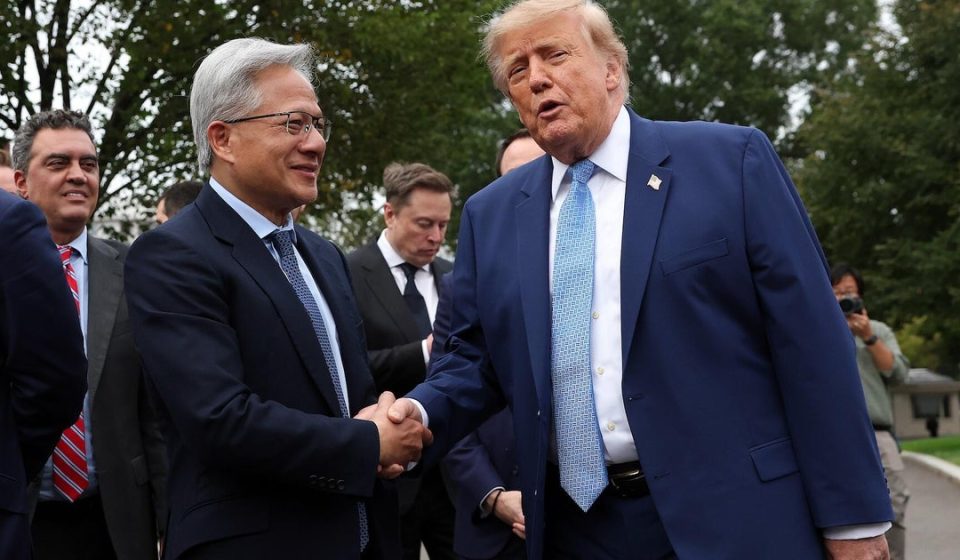
President Trump owns tens of millions of dollars’ worth of Nvidia stock, giving him a personal stake in the company’s stock market roller coaster over the past two weeks, according to financial disclosure documents.
Mr. Trump stood to lose large sums of money with the abrupt departure of CEO Jensen Huang, and could reap big profits after successfully convincing the chip developer’s board to reinstate Huang. Nvidia stock jumped more than 30% when Huang returned to the company on Monday, reversing a weeklong decline.
Huang resigned two weeks ago following reports of an affair with an alleged Chinese spy who ran a company accused of diverting Nvidia chips to China, and another alleged affair with a subordinate. Mr. Trump said Monday that he personally spoke with Nvidia’s board and “convinced” them to rehire Huang, offering “assurance” that there was no threat to national security.
Mr. Trump held between $13 million and $58 million worth of Nvidia stock in his investment accounts at the end of 2025, according to financial disclosures filed with the Office of Government Ethics. He bought or sold the company’s stock in more than 100 transactions worth between $27 million and nearly $98 million between January 2025 and September 2026.
The value of Nvidia Chairman’s stock rose $1.3 million to $14.8 million on Monday, before paring some of those gains when Nvidia’s stock price fell on Tuesday. The range is so wide that it’s unclear how many Nvidia shares the president currently owns, but it can be roughly estimated based on his sales and purchases this year.
“President Trump’s stock and bond portfolio is independently managed by third-party financial institutions,” a White House spokesperson told CBS News on Tuesday, adding that his investments reflect indexes like the Schwab 1000. “Neither President Trump nor any member of his family has the ability to direct, influence or provide input on how the portfolio is invested or when investments are bought or sold. All investment decisions are entirely made. by independent managers.”
Besides the president, several of his appointees to positions in the State, Commerce and Treasury departments as well as the IRS have reported millions of Nvidia shares in their investment portfolios. Many have since sold their holdings.
Forbes estimates Mr. Trump’s net worth at more than $6 billion, making Nvidia a small portion of his total wealth. And Nvidia is one of the most valuable public companies in the world, worth more than $3.7 trillion, which is why many investors own shares in the tech giant.
Some ethics experts have nevertheless questioned Mr. Trump’s significant stake in Nvidia, especially after his intervention to increase the company’s fortunes.
“This goes beyond a conflict of interest,” said Kathleen Clark, a law professor and government ethics expert at Washington University in St. Louis. “He is bluntly and explicitly using his power as president to gain financial advantage. He has prioritized his finances over the security of the nation.”
Donald Sherman, president of Citizens for Responsibility and Ethics in Washington, a nonprofit government watchdog, told CBS News that “Mr. Trump’s continued ownership of stock in this company is the clearest example of how the president’s personal financial interests bring suspicion to everything he does.” »
Mr. Trump’s personal investments have sparked controversy in the past, including his stakes in publicly traded energy companies, companies that have business dealings with the government and its executives. the family cryptocurrency company. He denied any conflict of interest.
Some critics have called for legal reforms to prohibit the president and members of Congress from buying and selling stocks while in office. Elected officials are generally allowed to trade individual stocks, although lawmakers from both parties have called for a ban on this practice.
Richard Painter, a law professor at the University of Minnesota and former chief ethics attorney at the White House between 2005 and 2007, said he has long advocated for changes to the federal conflict of interest law that prohibited government employees from participating in matters involving personal enrichment while in office. This current law does not apply to the president, vice president or members of Congress, he said.
“We need an immediate ban,” he said, adding that the new Congress could rally to the cause in January.
Painter called Mr. Trump’s intervention with Nvidia’s board a “huge conflict of interest” and an overreach of government power.
“It’s not the role of government to call and say who should be the CEO of a company,” he told CBS News.
The president defended his decision to intervene, saying on CNBC that “we have to protect our geniuses” and asserting that Nvidia – as the world’s leading designer of advanced chips – plays a key role in maintaining the US lead over China in AI technology.
Mr. Trump has also frequently cited the performance of the stock market as a barometer of his success as president. Shortly after Huang’s reinstatement, Mr. Trump told the Wall Street Journal that “the market response has been very positive” and “it really shows that the decision was the right one.”
Beyond Mr. Trump, many political figures owned Nvidia stock. Some divested themselves of their holdings after being appointed to government positions, according to federal documents.
Homeland Security Secretary Markwayne Mullin owned between $250,000 and $500,000 worth of Nvidia stock in March 2026 and sold between $500,000 and $1 million worth of the tech company’s stock in June of this year, according to his financial disclosures.
“As Secretary of Homeland Security, Markwayne Mullin acts to ensure full compliance with all ethics and conflict of interest rules,” a Department of Homeland Security spokesperson said.
At the Commerce Department, where Secretary Howard Lutnick is facing scrutiny over whether he has done enough to crack down on highly sensitive sales of AI chips to China, a number of senior advisers reported last year selling significant positions in Nvidia.
Cantor Fitzgerald, the Wall Street firm previously run by Lutnick and now controlled by his sons, said it held about 1 million shares of Nvidia for its clients as of Sept. 30, worth about $228 million at the time. Those shares were worth just over $150 million at Tuesday’s price. None of Lutnick’s personal financial disclosures filed by the federal government mention Nvidia’s holdings or transactions.
At the State Department, some of Mr. Trump’s diplomats held stakes in Nvidia.
Charles Kushner, the U.S. ambassador to France and the father of Mr. Trump’s son-in-law Jared Kushner, said Nvidia’s holdings totaled between $1.5 million and $6 million, according to public information filed in January 2025.
U.S. Ambassador to Costa Rica Melinda Hildebrand said Nvidia held between $5 million and $25 million, based on its April 2025 disclosures. The Texas billionaire, who was a major fundraiser for the Trump campaign, sold the shares in November of that year, according to filings.
Warren Stephens, another major Trump donor and ambassador to the United Kingdom, said Nvidia held between $750,000 and $1.5 million, according to his January 2025 disclosures. He sold those shares in July and August 2025, a few months after he was sworn in as ambassador.
At the Treasury Department, Undersecretary for International Affairs Erin Browne held Nvidia shares totaling between $250,000 and $500,000, according to her January disclosures. Browne sold the title before its confirmation in August of this year, according to filings.
Todd Newnam, who was named the IRS’ chief financial officer in January, owns between $115,000 and $250,000 worth of Nvidia stock, according to his financial disclosure filed in April of last year. Newnam, a former technology company CEO, was part of the Department of Government Effectiveness team that sought to streamline government spending and reduce the federal workforce.
“All OGE (Office of Government Ethics) 278 filers are required to disclose any stock ownership interests they hold and are informed of their recusal obligations under ethics rules,” an IRS spokesperson said Tuesday, referring to the financial disclosure required by members of the executive branch of the federal government.
Many other officials could be indirectly exposed to Nvidia’s stock if they invested in mutual funds or similar assets. For example, Vice Chairman JD Vance said he has between $1 million and $5 million in a fund that tracks the S&P 500 — and Nvidia is one of the largest constituents of that index.
Gn bussni