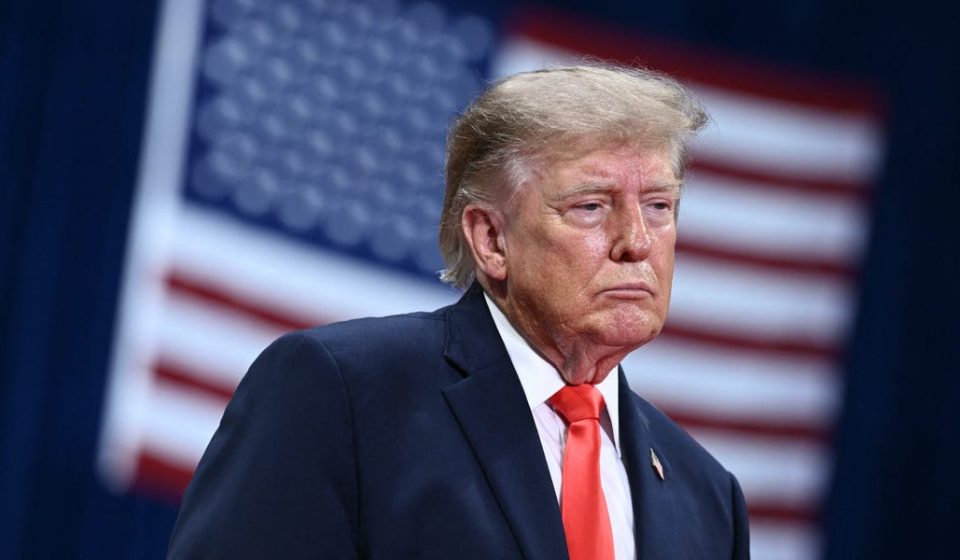

President Donald Trump said voters were unwilling to pay higher gasoline prices, which have soared because of the war in Iran, as Democrats won the midterm elections Tuesday.
“I don’t think it’s war, I think it’s the price of gas,” Trump said in a phone call with Fox News as he reflected on the results. “People are OK with what I’m doing in Iran, but they probably weren’t willing to deal with the short-term consequences of paying more for gasoline.”
“And you know, I understand that,” he continued. “I don’t agree with that, and I would say to people, you know, ‘It’s a short-term problem but for a long-term gain.’
The president congratulated Democratic congressional leaders and said he would accept the results. Democrats won majorities in the House and Senate, meaning Trump would face a Congress entirely controlled by the opposition.
“I don’t like to think of it as a loss for me, I wasn’t on the ballot,” Trump said, adding that he felt “bad for a lot of really good Republicans, a lot of really good patriots who lost tonight.”
Find out more about the 2026 Midterms:
Fuel prices have soared since February, when the United States and Israel began launching airstrikes on Iran, after which Iran began exploiting and attacking ships in the Strait of Hormuz. Disruptions to the strait, through which 20 to 25 percent of the world’s maritime oil previously passed, have limited global supplies and sent energy prices skyrocketing around the world.
U.S. regular gas prices are now about 36% higher on average, or about $1 more per gallon, than they were a year ago, according to AAA’s Nov. 3 Fuel Price Tracker.
Some states have seen much larger increases. In Michigan, where Democratic candidate Abdul El-Sayed leads Republican incumbent Sen. Mike Rogers, gas prices have jumped 52% from last year.
Diesel prices, meanwhile, have risen about 70% on average across the United States, hitting record highs this fall in all but three states.
The White House has said it expects a significant drop in oil prices once the war in the Middle East ends.
Although hostilities have largely subsided since the start of the war and both sides have repeatedly attempted to negotiate a ceasefire, fighting continues on a limited scale.
Multiple media outlets have reported that the United States has carried out an unpublicized campaign of several small-scale strikes on Qeshm, an island in the Strait of Hormuz, in recent weeks.
The Wall Street Journal was first to report on the strikes, including one on Monday.
Gn headline