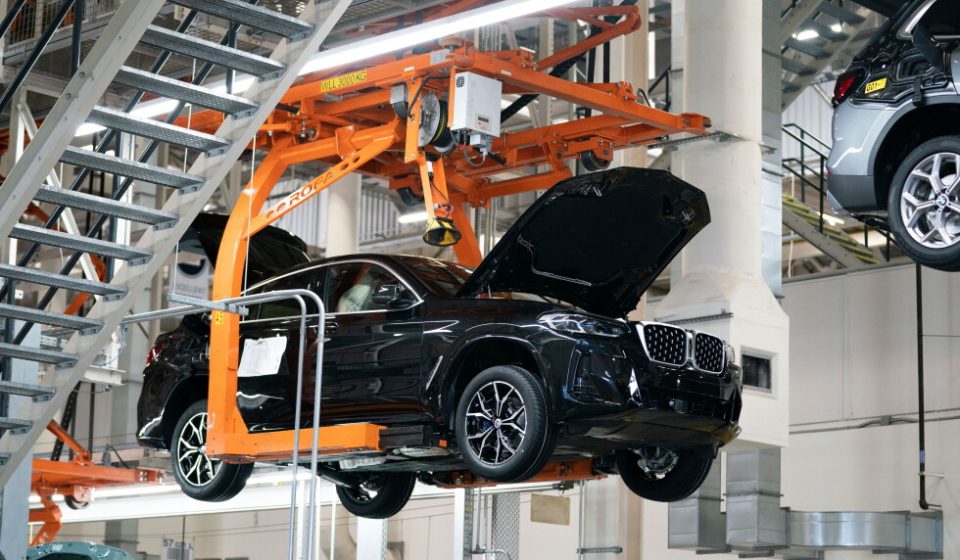
Trump says more car factories are being built in the United States than ever before. This is not correct.

DETROIT (AP) – As President Donald Trump travels the country To rally support for Republican candidates ahead of the midterm elections, he is touting his economic agenda and crediting Republican-backed tariffs for the growth of industry — including what he says are more vehicle manufacturing plants across the country.
Speaking at a Baltimore Naval Shipyard Earlier this week, he credited his administration with bring back the car manufacturers from at least five countries and painted a picture of historic factory construction after decades of none at all.
But even though Trump had some success in boosting U.S. auto manufacturing and striking deals within the industry, much of what he said was exaggerated or false.
Here’s a closer look at the facts.
What is happening with car manufacturing in the United States
TRUMP, Tuesday: “We haven’t built a car plant in 44 years in this country. Today, we’re building more car plants than we’ve ever had in history.”
THE FACTS: It is not true that no automobile plant has been built in the United States in 44 years. The United States is not currently building more auto manufacturing plants than it ever has.
More than two dozen major new vehicle assembly plants have opened in the United States over the past four decades, based on manufacturer history, public records and data from industry group Autos Drive America. Others were purchased, retooled or reused.
That said, the United States has seen significant movement in auto manufacturing under Trump’s leadership.
So far in Trump’s second term, Rivian inaugurated the construction of a second factory in Georgia, and the Hyundai Motor Group Metaplant America open there too. At the time, Trump praised Hyundai and presented the news as “a clear demonstration of the effectiveness of the tariffs.”
During his first term, Mazda and Toyota announced a gigantic joint installation of vehicles in Huntsville, Alabama and at Volvo opening of the first factory in the United States in South Carolina.
Developments under Trump are broadly consistent with what has happened over at least the past two decades, experts say.
“We’ve always made a lot of the cars that people buy here. If you buy a Honda in the United States, it’s more likely that it was made in the United States. That was true long before Trump,” said Joshua Hausman, an associate professor of economics at the University of Michigan. “Automotive factories have been built steadily over the past few decades.”
The White House provided a list of projects totaling more than $50 billion in investment from automakers, which the administration attributes to the president’s trade agenda. Among them are a $10 billion investment from Toyota is expected to involve operations across the country – the automaker has not confirmed it will add factories – and plans to Stellantis to invest $13 billion by expanding its presence in the United States. Ford Motor Co.., General engines and Mercedes-Benz are reportedly investing some $15 billion in their own projects.
“The president has successfully launched a manufacturing renaissance with billions of dollars of investment in our country,” White House spokesman Taylor Rogers said, attributing the investment to Trump’s America First trade agenda.
But not all the news under Trump was specifically about assembling all-new vehicles, and Trump’s accomplishments don’t differ much from those of President Joe Biden’s administration and others, industry experts noted.
As with Trump, the United States saw the opening of new and upgraded auto factories under Biden. Electric vehicle manufacturers Rivian has reopened a former Mitsubishi factory in Normal, Illinois. And Lucid opened a factory in Casa Grande, Arizona.
Tesla opened a brand new Gigafactory in Austin, Texas. Ford opened the Rouge Electric Vehicle Center in Dearborn, Michigan, and began construction on BlueOval City, an electric vehicle and battery complex, in Stanton, Tennessee.
General manager announced plans to invest $7 billion in electric vehicle and battery factories in Michigan and the Vietnamese automaker VinFast announced it would build an electric vehicle factory in North Carolina.
As of this year, Autos Drive America had 51 light vehicle assembly plants operating in the United States, down slightly from 52 five years earlier.
Foreign automakers have a long presence in the United States
TRUMP: “Our auto industry is coming back. They’re leaving Canada, they’re leaving Mexico, they’re leaving Japan, Germany and South Korea.”
THE FACTS: Many foreign automakers have been part of the U.S. industry for decades.
Volkswagen began assembling vehicles in the United States in the late 1970s; Honda, Nissan, Toyota and various European manufacturers followed suit in the 1980s – roughly the 44-year period Trump mentioned earlier this week. These companies now manufacture and sell millions of vehicles in the United States each year.
American jobs in automobile manufacturing and assembly began to decline at the same time that domestic automakers were losing market share to these foreign companies.
The woes of American industry came to a head during the financial crisis of 2008, under the Bush administration. U.S. companies have faltered while foreign automakers and demand for their vehicles have grown. The country has seen more imported vehicles and increased production abroad.
Under President Barack Obama’s administration, GM had to be saved from bankruptcy. In the years since 2008, U.S. manufacturing has recovered, both under and under Trump. Biden.
Biden’s policies led to a big push for investment in electric and more fuel-efficient vehicles, although many of these once-ambitious projects have since been canceled due to Trump’s policies and slow consumer demand. That is, until the war in Iran caused gas prices to skyrocket and increased interest in cleaner vehicles.
Trump takes credit for tariffs
TRUMP: “This is all due to my favorite word rates. »
THE FACTS: Experts say it’s not as simple as blaming new U.S. auto investments on tariffs.
“The current wave of tariffs has led to some offshoring of production, but it has not led to a tsunami of new assembly plants,” said Sam Fiorani, vice president of AutoForecast Solutions. “Automakers are investing for the long term, not based on the short-term decisions of a single administration.”
Building a factory takes a long time, Hausman said.
“When people think there’s a good chance that in six months tariffs will be reduced, or that in the next presidential administration tariffs will be eliminated, there’s no particular reason to think that that would cause automakers to build new factories,” he said.
Some experts say the Trump administration’s policies have hampered industrial investment. Although the tariffs have prompted some parts of the industry to boost their operations in the United States, they also play a role in driving up vehicle prices.
Trump’s tariffs not only affect vehicles from abroad, but also some of the key supplies needed to build vehicles in the United States, like steel and aluminum.
Automakers must determine whether tariffs imposed by overseas production exceed those of vehicle production in the United States, while also having to contend with the rising costs of making products here.
“The global automotive industry is very price sensitive and requires sourcing components and locating assembly facilities with a view to making the final product globally competitive,” Fiorani said. “Tariffs disrupt the equations used to obtain today’s vehicles and make them more expensive by making affordable choices too expensive to use.”
___
Alexa St. John is a climate reporter for the Associated Press. Follow her on X: @alexa_stjohn. Contact her at (email protected).
___
Find AP fact checks here: https://apnews.com/APFactCheck.
___
Associated Press climate and environmental coverage receives financial support from several private foundations. AP is solely responsible for all content. Find AP standards to work with philanthropies, a list of supporters and funded coverage areas on AP.org.
Gn bussni