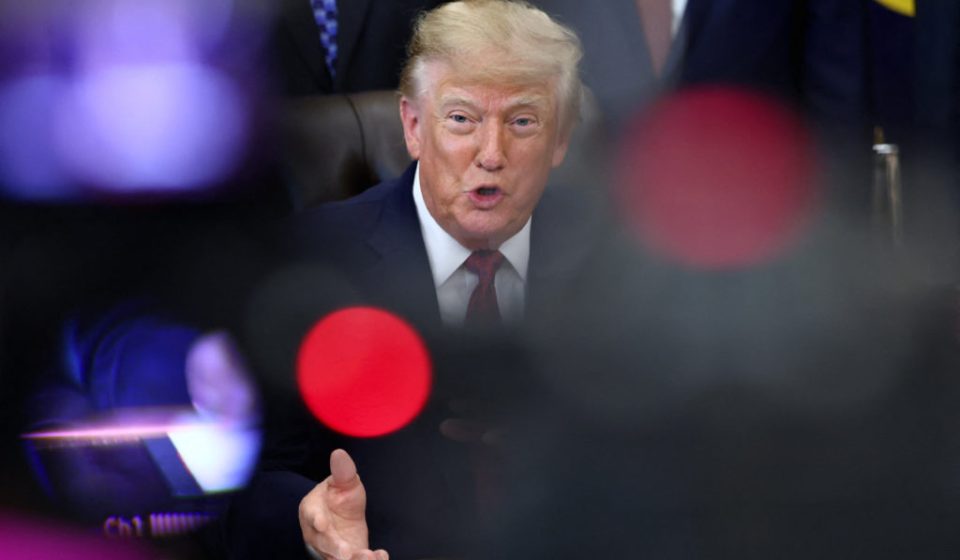
Trump to hold rally in Choctaw Nation, rare presidential visit to Indian Country

ALBUQUERQUE, N.M. (AP) — President Donald Trump is holding a campaign rally in the Choctaw Nation of Oklahoma on Thursday, placing him in the company of a handful of U.S. presidents who have visited tribal nations while in office.
The rally is part of Trump’s recent campaign drive in deep red states, where he is seeking Republican candidates and promoting his agenda ahead of the November midterm elections.
WATCH: Vance addresses GOP midterm campaign rally in Texas
The Choctaw Nation rents its venue for the gathering but does not sponsor the event, he said.
“We hope his visit will be an opportunity to learn more about what we do as a sovereign nation for our members and for all the people of southeastern Oklahoma,” Choctaw Nation Principal Chief Gary Batton said in a statement.
This is not the first time Trump has visited a tribal nation. In the home stretch of the 2020 election campaign, Trump visited the Lumbee Tribe of North Carolina and endorsed its efforts to gain federal recognition as a tribal nation, which he signed into law in 2025.
LEARN MORE: Democrats want a blue wave. New Hampshire is Exhibit A for why this might not happen
Tribal delegations have met with presidents in Washington since the beginning of the Republic, but presidential visits to reservations have been rare. The purpose and tone of these visits changed dramatically as relations between the United States and tribal nations evolved.
The first visits favored assimilation
What was likely the first visit to a reservation by a sitting U.S. president happened by chance. During a trip to Yellowstone National Park in the summer of 1883, President Chester A. Arthur met with Shoshone and Arapaho leaders on the Wind River Reservation and complimented the tribes’ “practice in industrial activities,” according to an account by Lt. Gen. Philip Sheridan at the time.
While there, Arthur’s delegation pressed Shoshone Chief Washakie and Arapaho Chief Black Coal to agree to divide the reservation they shared into private plots – a move aimed at dismantling tribal sovereignty and solving what Arthur called the “Indian problem.” The two leaders refused.
LEARN MORE: GOP hopes fade in Georgia and North Carolina as party focuses on Senate battle
Other early presidential visits to tribal lands also reflected a time when the United States was attempting to undermine tribal sovereignty and assimilate Native people into white society. Theodore Roosevelt’s 1903 trip to the Havasupai lands at the bottom of the Grand Canyon preceded the forced removal of that tribe to make way for a national park.
During his 1927 visit to the Pine Ridge Reservation in South Dakota, President Calvin Coolidge promoted assimilationist boarding schools.
Recent presidential visits have focused on tribal sovereignty
President Bill Clinton made Pine Ridge a stop on his 1999 “New Markets Tour,” billing the visit as the first by a sitting president to tribal lands since President Franklin Delano Roosevelt’s 1934 trip to the Blackfoot Nation in Montana. Clinton acknowledged that the federal government had failed to meet its obligations to hundreds of tribal nations and called for investment in Pine Ridge’s economy.
“We have tried to have more respectful and more appropriate relationships with the tribal governments in this country, to promote more authentic independence, but also to provide more authentic support,” Clinton said.
In 2014, President Barack Obama met with Dakota youth and attended a powwow on the Standing Rock Reservation in North Dakota, speaking about expanding economic and educational opportunities in Indian Country and promoting the inherent right of tribes to govern themselves. The following year, Obama spent time in the village of Kotzebue, Iñupiaq, Alaska, to highlight the impacts of climate change on Arctic communities.
President Joe Biden issued a somber apology
In 2024, President Joe Biden visited the Gila River Indian Community of Arizona to formally apologize for the federal government’s role in separating Native children from their families and forcing them to attend boarding schools run by the United States and churches. An investigation by the Biden administration found that in addition to being deprived of their language and culture, many of these children had been victims of physical, emotional and sexual abuse. At least 970 people have died, and federal officials have acknowledged the true number is likely higher.
Speaking alongside boarding school survivors and their descendants, Biden called the 150-year period “a stain on American history.”
“It’s a sin to our soul,” Biden said. “Frankly, there is no excuse why this apology took 50 years to come up with.”
The visit marked a rare acknowledgment of the assimilationist policies that shaped some of the first presidential encounters with tribal nations.
A free press is the cornerstone of a healthy democracy.
Support trusted journalism and civil dialogue.
Gn headline