Trump-Xi-Putin trilateral meeting at APEC: what to expect | Nuclear Weapons News

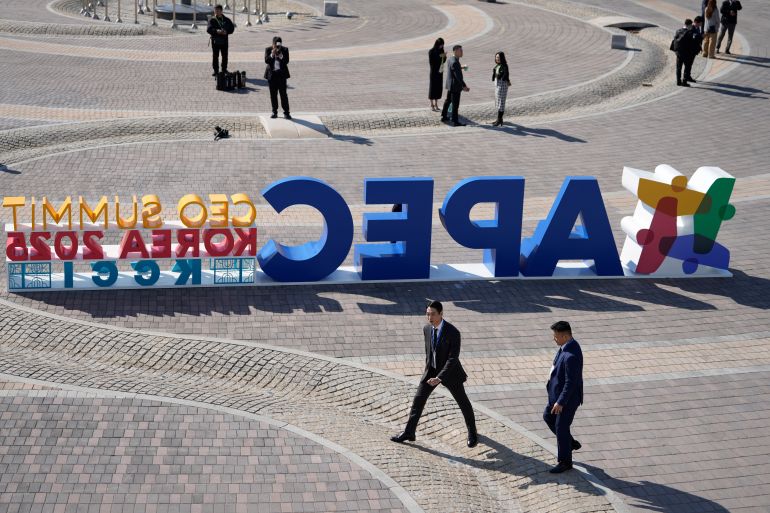
US President Donald Trump, Chinese President Xi Jinping and Russian President Vladimir Putin will hold their first trilateral meeting on the sidelines of the Asia-Pacific Economic Cooperation (APEC) summit in Shenzhen, China, the White House has confirmed.
Washington also confirmed Trump’s presence at the summit on Friday, which will take place on November 18 and 19.
Recommended Stories
list of 4 elementsend of list
The discussions will focus on nuclear proliferation, the White House said. But they come amid significant global turbulence: Russia’s war in Ukraine, the U.S.-Israeli war with Iran and ongoing trade tensions between Washington and Beijing.
“I think what we will see is some pretty impressive photo ops with a lot of really bombastic rhetoric from Trump,” Simon Mabon, professor of international politics at Lancaster University in the United Kingdom, told Al Jazeera. However, he added, the three “are not able, collectively or unilaterally, to end the conflict in Iran or Ukraine.”
So, what do both sides want and what will be the likely outcome?
Here’s what we know:

What is the program?
Every leader has their own priorities, but there are certain issues that everyone will want to discuss.
New nuclear treaty
One of the main issues for Russia and the United States is the new Strategic Arms Reduction Treaty (New START), which lapsed in February. The treaty was first signed in 2010 and limits U.S. and Russian strategic nuclear arsenals.
Russia currently has the largest number of nuclear warheads, followed by the United States, then China, which is rapidly building its own arsenal.
Trump had previously rejected Russia’s proposal to extend the treaty after its expiration, instead demanding a “new, improved and modernized agreement” that included Beijing.
China, however, seems reluctant to join an agreement in which it was not involved.
A senior Trump administration official told Reuters the topic would start the conversation, but “we don’t expect to get any agreement.”
US-Israeli war against Iran
Officials also say world leaders will discuss the war in Iran, launched by the United States and Israel on February 28. Although large-scale strikes have stopped for the moment, the conflict remains at an impasse.
After more than 100 days, the Strait of Hormuz remains closed and oil and gas prices remain volatile as ships in the strait continue to face Iranian strikes and mines. A third of China’s crude oil supply passed through the strait before the war. The conflict is also dampening demand for Chinese exports.
Russia, meanwhile, has benefited from rising energy prices and recent sanctions relief from Washington amid supply shortages – particularly diesel.
Sino-US trade rivalry
Trade wars and the race for control of electronic chips used to power artificial intelligence are straining relations between Beijing and Washington.
Trump hit China with a 145 percent tax hike last year, while Beijing retaliated by imposing 125 percent levies on U.S. imports. Tensions have further increased over China’s restrictions on exports of rare earth minerals needed to make advanced chips and other technologies.
The two countries have since reduced tariffs and reached several agreements following meetings between Trump and Xi in South Korea and Washington. However, the recent scandal at chip company Nvidia prompted the United States to claim that China was spying on CEO Jensen Huang. Beijing denies it.
Will the war in Ukraine be discussed?
It’s very unlikely. A Trump administration official told reporters that the US president would not discuss Russia’s war against Ukraine, although Kremlin officials had previously suggested the conflict could be discussed.
China, an ally of Moscow, has declared the war in Ukraine a European issue.
U.S. officials also note that Washington is continuing peace talks, with U.S. envoys Steve Witkoff and Jared Kushner visiting Ukraine and Russia this week. “China is not really part of this track, so it doesn’t seem appropriate to discuss Ukraine there,” one official told reporters.
President Trump accused Ukrainian President Volodymyr Zelenskyy of “not wanting” to end the war, while kyiv repeated allegations that the United States restricted its Starlink satellite connection that allows it to use attack drones. Trump also blamed Ukraine for soaring diesel prices due to its strikes on Russian oil facilities.
At the same time, Trump feted Putin, agreed to allow Russian diesel into global and U.S. markets, and lifted oil sanctions against Moscow.
What does each party expect from this meeting?
Russia
For President Putin, the meeting could provide an opportunity for positive photos and a platform to project his power while putting aside the Ukraine conflict, analysts say.
This will give him a “first among equals” position that he can display at home to show that he can influence the European security architecture after the war in Ukraine, Alexander Bratersky, a Moscow-based journalist and political analyst, told Al Jazeera.
China
Beijing has already pushed for a resolution to the US war with Iran, which has impacted its own energy supplies.
China will also want to avoid getting drawn into a nuclear treaty in which it did not participate.
Last month, China’s Foreign Ministry said it would be “neither fair, reasonable nor realistic to ask China to join the so-called trilateral nuclear disarmament negotiations at this stage.”
WE
Trump’s priority is to include China and Russia in a new nuclear proliferation treaty, according to administration officials. “The president has made it clear that he will discuss, among other topics, the reduction of nuclear weapons around the world. This proliferation, President Trump believes, is very dangerous,” White House spokesperson Olivia Wales told reporters.
The president could also use the meeting to demonstrate his administration’s diplomatic clout, with Iran refusing to capitulate to U.S. demands to end the war and hand Washington a victory.
Trump has also sought closer ties with Xi, Putin and North Korea’s Kim Jong Un, all considered “strongmen,” and are likely to be seen as influential in those circles, analysts say.
“I think it will be more performative – Donald Trump playing the role of a global statesman rather than a peacemaker,” Mabon said.
The crushing defeat of Trump’s Republican Party in last week’s midterm elections could weaken its influence, experts note, as a new Democratic-led Congress will likely back Ukraine more forcefully.
Is this the start of a new Yalta?
Pyotr Tolstoy, chairman of the Russian parliament’s foreign affairs committee, said this could lead to a “new Yalta”.
The 1945 conference in Yalta, then the Soviet Union, saw USSR President Joseph Stalin, American Franklin D. Roosevelt and Britain’s Winston Churchill divide Germany and establish the United Nations in what was seen as the model for a new world order.
Kremlin spokesman Dmitry Peskov called the ongoing trilateral meeting between the leaders of the United States, China and Russia “extremely important” but stressed that agreements reached at the meeting cannot be imposed on other nations.
Gn headline