
A
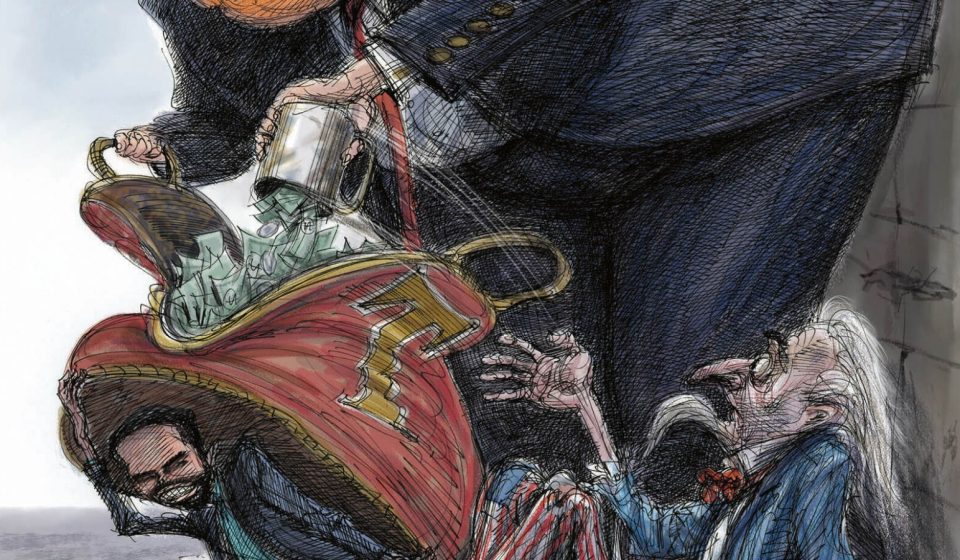
A few years ago, Democrats in Washington circulated a chart showing that the economy always does better when they are in charge and worse when Republicans occupy the White House. This is statistically true – at least in recent decades – but hardly relevant. And that’s because business cycles and presidencies are a bit like shifting tectonic plates: They overlap, but almost never align perfectly. Presidents don’t actually create the economies that are attached to their names. They only react to them, competently or not.
There are several reasons for this. The first is that economic dislocations typically happen long before people feel them, and it takes years for the data to catch up. In 1992, when George HW Bush was running for re-election, the economy was estimated to have grown quarter-by-quarter between 1.4 and 2.7 percent – evidence of the recession that helped Bill Clinton win. Years later, however, revised figures showed that growth rates, while stable, were actually significantly above 4% and that recovery was already underway. (At the end of Clinton’s first year, the economy was growing 5.6 percent.) You could do the same exercise for other presidents, and the basic lesson would be the same: Presidencies are always shaped by the underlying trends they inherit, even if they aren’t visible at the time.
The second reason is that economies are subject to external shocks that have nothing to do with the president’s domestic policies. The Iranian revolution of 1979 greatly aggravated an energy crisis that predated the Carter administration. The 2001 terrorist attacks crippled George W. Bush’s economy, and the onset of the Covid pandemic in 2020 did the same to Donald Trump’s first term. All of these presidents faced painful recessions, but they had about as much control over the events that triggered those recessions as they might have over an asteroid hurtling toward Earth.
At least that’s how it was before Trump’s second term, which in this way – as in many other ways it has become almost a cliché to say – marks a departure from everything we’ve seen before. Unlike any president since Woodrow Wilson at least a century ago, Trump has actually created his own economic hellscape, embarking on a series of radical measures that no one asked for and that only the stupidest ideologues would have advised. Trump is the only president in our lifetime to be placed at the helm of a basically seaworthy economy and immediately set a course for the nearest field of icebergs.
Remember, by the time Trump took over the White House in 2024, the economy was finally rebounding from its pandemic lows, with growth and employment numbers steadily rising. The fear heard most often among Democrats was that Trump was about to reap all the benefits of Biden’s recovery and make it look like his own. “He had a good economy,” Rob Shapiro, an economist who worked in the Clinton administration, told me recently. “All he had to do was not screw it up. » Turns out no one should have worried.
Trump has effectively created his own economic hellscape, embarking on a series of radical measures that no one asked for and that only the stupidest ideologues would have advised.
The very first thing Trump did was start a trade war – not just with China this time, but with the entire world. His sweeping tariff regime might have been an interesting experiment were it not for the fact that inflation – driven primarily by supply chain disruptions and exacerbated by massive government spending – was already persistently high. Trump knew this, having talked about it constantly during his campaign, but apparently no one could make him understand that tariffs would certainly make a temporary problem more permanent, by increasing the cost of imports and manufacturing. (By the way, I’m not trying to sound like some sort of Nobel laureate – it’s so basic that anyone who has played Monopoly should be able to understand it. Even the Star Wars version.)
As the endless trade wars intensified, Trump decided to start a real war with Iran, because the ayatollahs were brutally suppressing their people, or maybe because they were about to build a nuclear bomb, or maybe because Israel was starting a war and Trump had nasty FOMO – all of these explanations have been offered at different times, so who knows? What we do know is that Trump’s chosen war, while militarily ineffective, proved an economic disaster, choking off the flow of oil to Asia and Europe and causing energy prices to skyrocket at home. Like Jimmy Carter, Trump now sees his economy held hostage by Iranian hard-liners. Unlike Carter, Trump actually plunged into the crisis, as if the electorate was crying out for him.
Either of these two political decisions alone would probably have been enough to jeopardize a still fragile recovery. But also consider that job growth, which had been rapid in the final year of Biden’s term, has slowed to a near standstill in 2025 — largely because of Trump’s draconian immigration crackdown, which has made it harder for small businesses to find labor, both skilled and unskilled. And then there’s the federal debt, which was a pressing problem long before Trump came along, but becomes even more urgent when interest rates rise again. Interest payments on the government debt are at a record high (about 18% of national revenue, up from about 11% before the pandemic), and Trump’s erratic foreign policy increases the risk that foreign investors will not want to continue appropriating U.S. debt.
For decades, a small group of fiscal alarmists in Washington have warned of a doomsday scenario in which rising debt and interest rates would lead to a dark period of forced austerity and prolonged recession. Leave it to Trump to make it look like the world will end next week.
FEW PRESIDENTS qualify as deep economic thinkers, but usually they come to power with some sort of broad, coherent idea of what they believe – supply-side or pro-growth, monetarist or Keynesian. Trump, the business mogul president, manages to be everywhere. He is as fiercely opposed to taxes and regulation as any arch-conservative, as protectionist as any pro-labor leftist, as enthusiastic about controlling industries – insisting that the government take a stake in private companies – as any Soviet collectivist. The only throughline of Trump’s economic policy, as for the rest of his presidency, is cultural retribution. Career bureaucrats, immigrants, academics, progressive governments, multinational coalitions: all are enemies in Trump’s world, and putting a boot on their neck is his only real national agenda. He claims it’s good for the economy, and any data to the contrary is dismissed as just another lie from the educated elite.
In fact, economists will tell you that the underlying “fundamentals” – they love that word – remain quite strong in Trump’s second year back in office; we are still growing at a decent rate. But its erratic mismanagement has made two existing problems worse. The first is that more and more Americans feel like they are drowning, even though the economy itself is not; With slowing wage growth, rising prices and more expensive debt, the financial equation that makes life possible for most families is not working as it should. (This while Trump and his family have made billions from the presidency, largely thanks to foreign investors in Trump’s burgeoning crypto empire.) And the other is that the economy is far more vulnerable to the calamity we don’t see coming. When inflation is already a problem and paying down your debt takes up a larger share of revenue, the government can’t really spend much more money in the event of a sudden, dramatic downturn – like, say, another pandemic.
The economy can be repaired, even if it costs money. Trump’s presidency, probably not.
Conservative economist Douglas Holtz-Eakin told me he views Trump’s economy as a “yes but” economy. As in: “Yes, we’re doing great, but the tariffs. Yes, things are good, but now he wants a war with Iran. He can’t get out of his own way.” This seems too kind to me, however, because it makes Trump’s missteps seem clumsy and accidental, when in reality they are willful and reckless. Trump is not getting in his own way; he does precisely what he intends to do, consequences be damned. What we are experiencing is the “economy of self”. The more Trump tries to dominate his opponents, the more damage he does to all of us – and to his legacy.
The economy can be repaired, even if it costs money. Trump’s presidency, probably not. As I write this, voters have yet to deliver their verdict in the midterm elections; it’s possible, even unlikely, that Trump will defy most of our expectations and limit his losses, as Biden did in 2022. (And if he doesn’t, it’s a safe bet he’ll try to overturn the results anyway.) Either way, though, voters made their feelings about Trump’s economic judgment clear. In a New York Times According to a poll released in mid-September, 14 percent of voters — and just 29 percent of Republicans — said the economy was better today than it was a year ago. The competition among Republicans to succeed Trump begins now, and you can expect to see more Republican lawmakers and governors posing like monster movie extras in the face of Trump’s tariffs and war in the coming months, out of fear of what will happen to the party in 2028 if they don’t. We got a taste of that in September, when Utah Sen. John Curtis, a solid Republican, called for an investigation into Donald Trump Jr.’s ties to the Russian oligarch who paid for his wedding reception on a private island in the Bahamas.
This will of course enrage Trump, but this time, when he goes looking for enemies, he really should find a mirror. Unlike every other president in the modern era, he got exactly the economy – and the failed presidency – that he deserves.
Gn bussni