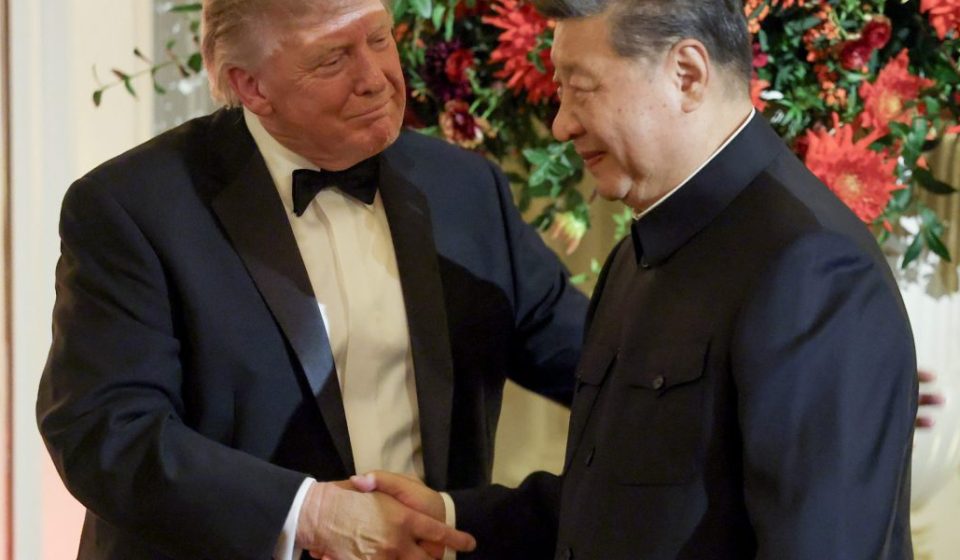
Trump’s offer to sell weapons to China is an admission that he does not take threats to its security seriously.

President Donald Trump offered to sell weapons to China during President Xi Jinping’s recent summit in Washington, a move that foreign policy experts say makes a mockery of U.S. warnings about China’s looming military threat.
In an interview with Fox News on Sunday, David Purdue, the US ambassador to China, suggested that US weapons were open to a multitude of countries, including China.
“President Trump keeps saying, ‘Hey, we’re selling guns to other people around the world,'” he said. “He actually asked President Xi if he would like to purchase some at some point.”
The White House has said the US government has no plans to sell weapons to China. The State Department did not immediately respond to Fortunerequest for comment.
The comment disconcerted foreign policy experts, who said the suggestion of selling weapons to Beijing would contradict the series of sanctions and trade restrictions the Trump administration has imposed on the country, and would also reject China’s role in providing munitions and military intelligence to Iran. The remark also comes after China obtained sensitive parts for the F-35 fighter jet that could be used to neutralize US stealth technology.
“You wouldn’t want to help China modernize its military and turn against yourself,” said Zhiqun Zhu, a professor of political science and international relations at Bucknell University. Fortune. “Especially with the current intense competition between the two powers. I mean, it doesn’t make sense.”
While Trump has called China a strategic competitor and referenced it in rejecting calls to slow AI development, the president has also expressed affinity for dictators like Xi, Russia’s Vladimir Putin and North Korea’s Kim Jong Un.
As a result, Trump has often appeared to prioritize his personal ties to the leaders of America’s adversaries over America’s allies.
“If there was any ambiguity about whether President Trump views China as a security threat, this revelation from @USAmbChina Perdue puts the question to rest,” Ryan Hass, director of the Brookings Institution’s China Center and senior fellow at the Center for Asia Policy Studies, wrote in a social media post on Sunday. “Trump’s proposal to sell weapons to China will be destabilizing for America’s partners who are at the tip of the Chinese spear.”
“A very good bargaining chip”
America’s pre-existing commitments to supply arms to Taiwan, an independent island that China continues to claim, further complicate Trump’s suggestion of an arms sale to China. The White House is withholding a $14 billion arms package and violating the Taiwan Relations Act of 1979, which was passed after the United States established diplomatic relations with China and which requires the United States to provide weapons needed to defend Taiwan.
In May, senators signed a bipartisan letter to finalize the sale. Before Xi arrived at the White House last week, a group of Republican leaders led by Kentucky Sen. Mitch McConnell presented another letter to the State Department and Defense Department reiterating the need to finalize the deal.
Trump previously called the ongoing arms sale to Taiwan a “very good bargaining chip” with China. For Zhu, Trump’s tactics reveal what he is willing to give up or defy in order to maintain good relations with China.
“He still views arms sales as leverage, at least as a bargaining chip,” Zhu said. “If China comes up with something truly effective, it is not inconceivable that it could further delay, or even temporarily cancel, further arms sales to Taiwan.”
The art of the transaction
Simultaneously withholding weapons from Taiwan while proposing a deal with China is a textbook example of Trump’s interest in making trade deals his primary diplomatic method. In this case, Zhu explained, Trump has little interest in actually engaging with China as a diplomatic partner, but is more concerned with striking a deal that would bring more money to the United States.
“He really saw this as part of the commercial diplomacy that he conducts,” Zhu said. “He views all of these things as transactional. From America’s perspective, this is obviously a very important geopolitical and geoeconomic issue. But from Trump’s perspective, it’s transactional. It has almost nothing to do with China.”
Trump has already facilitated trade deals with China, creating an exception to the US ban on sales of Nvidia and AMD chips to China. Despite the fierce race for AI, he allowed companies to sell certain chips under a revenue-sharing model in which the United States receives a cut of up to 25%.
Trump has a history of mixing trade and diplomacy elsewhere. Last year, the Trump administration negotiated a peace deal between Armenia and Azerbaijan that gave the United States the exclusive right to build a transit corridor, dubbed the “Trump Route for International Peace and Prosperity,” that would connect the two countries.
While presidents have used the strategy of “transactional diplomacy” for decades, few have prioritized financial gain over long-term national security benefits. Zhu believes that in this specific case, these two objectives are diametrically opposed.
“If this is a strategic issue, he obviously won’t offer arms sales to China to help modernize its military,” he said.
Gn headline