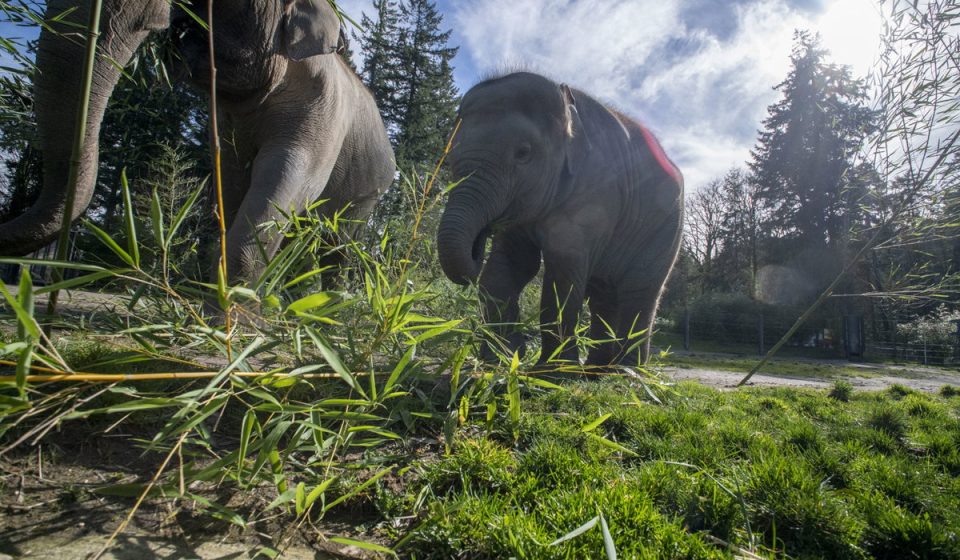
Bend, Ore. (KTVZ) — Veterinary experts at the Oregon Zoo have launched a comprehensive treatment plan for Tula-Tu, an Asian elephant calf battling elephant endotheliotropic herpesvirus, or EEHV. Caregivers alerted veterinarians on October 24 after noticing subtle changes in the calf’s behavior and energy levels.
Testing at the Oregon Veterinary Diagnostic Laboratory at Oregon State University confirmed an elevated EEHV viral load the next day. The diagnostic results prompted veterinary staff to initiate plasma transfusions alongside antiviral treatments to help combat the virus.
Dr. Carlos Sanchez, director of animal health at the Oregon Zoo, stressed that rapid intervention is essential to respond to potential infections. “Early detection is key,” Sanchez said. “We do routine blood monitoring in-house, with veterinary technicians trained to recognize specific elephant blood cells. Right away, they could see that Tula’s white blood cell count was low, so we put him on antiviral medication while awaiting advanced molecular testing to confirm or rule out EEHV.”
Sanchez reported that Tula-Tu remained stable throughout treatment. “The combination of a stable viral load, normal platelet count and improved white blood cell count suggests a favorable trajectory,” Sanchez said. “She’s not out of the woods yet, but these results give reason for cautious optimism. Diagnosis and treatment of this disease have advanced significantly in recent years. Every hour of stability brings her closer to recovery.”
Earlier this year, Tula-Tu became the first West Coast elephant to receive an mRNA vaccine designed to protect against EEHV-1A, the most common strain of the virus. Its active infection is caused by EEHV-1B, a related strain. Although EEHV-1B accounts for fewer reported fatalities, both variants can cause serious illness in young Asian elephants. “We don’t know if the EEHV-1A vaccine protects against the -1B variant,” Sanchez said. “It’s possible, but we don’t know to what extent.”
Sanchez is chair of the research committee of the North American EEHV Advisory Group. He explained that EEHV is a latent virus found in almost all Asian elephants. While adult elephants generally develop natural immunity, calves become vulnerable between 1 and 8 years of age as maternal antibodies wane. Active infections can become life-threatening within days, as happened in 2018 when another calf, Lily, died from VEEH shortly before her sixth birthday.
For nearly 25 years, the Oregon Zoo has supported international research into EEHV vaccines and treatments. Blood samples collected at Tula-Tu will contribute to ongoing joint research with Oregon State University and Baylor College of Medicine to analyze vaccine responses. Scientists have documented approximately 200 deaths from EEHV among wild Asian elephants. “The work we are doing now could play an important role in protecting future baby elephants from disease, including those in range countries,” Sanchez said. “It is very difficult to study the virus in wild elephants, but zoos can closely monitor elephants in their care and obtain samples of blood and other fluids.”
The zoo has also contributed to international diagnostic efforts. In 2023, Oregon Zoo veterinary staff partnered with Malaysian wildlife officials to establish Sabah’s first hematology laboratory to track EEHV in wild and captive elephants, providing clinical training for health practitioners across Southeast Asia.
Gn Health