U.S. government investigating Iranian ties to up to 50 hijacked commercial ships: NPR


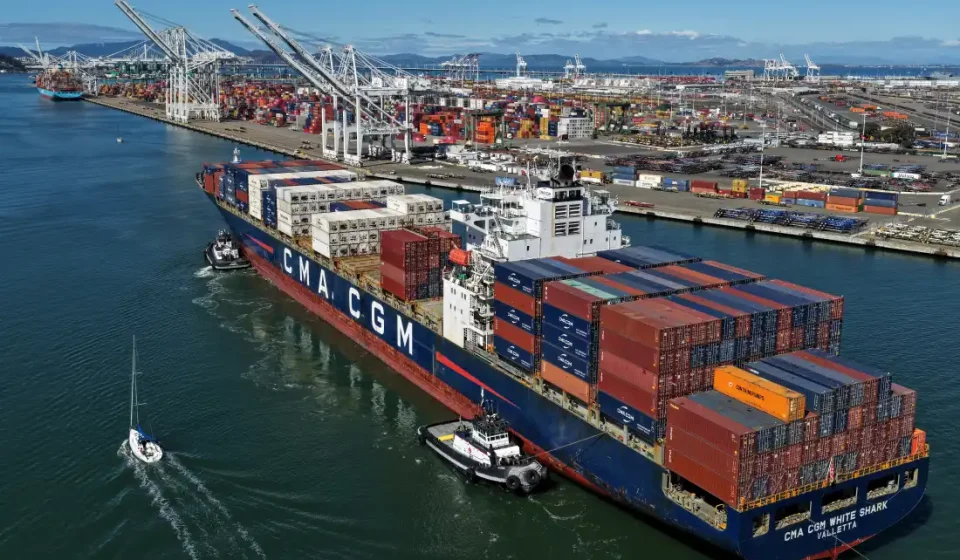
In an aerial view, a container ship arrives at the Port of Oakland on October 10, 2025 in Oakland, California.
Justin Sullivan/Getty Images
hide caption
Justin Sullivan/Getty Images
The U.S. government has intelligence suggesting that up to 50 commercial shipping vessels were recently compromised by cyberattacks, an activity that federal authorities are investigating and is potentially linked to Iran.
That’s according to a U.S. official familiar with the matter who was not authorized to speak on the record, a former military cyber operator and an industry executive briefed on the attacks. The series of violations was first reported by the THE The Wall Street Journal.
The attacks on the maritime sector, if officials’ suspicions are correct, could be the latest example of Iranian cyberattacks on global critical infrastructure during the ongoing war with the United States.

NPR reported that cybersecurity experts and U.S. officials believe Iranian hackers were responsible for a series of digital attacks on U.S. water treatment systems across the country in August, as well as a series of attacks targeting refrigeration systems that led to spoiled food at grocery stores on U.S. military bases and across Europe, as recently as early November.
The Coast Guard and the FBI first teamed up in August to send a “highly specialized team” to board two different foreign commercial vessels “in the Gulf of America” bound for U.S. ports, according to a statement provided by the FBI and the Coast Guard. “The captain, crew and shore-based company personnel have been critical partners in ensuring threats are mitigated,” according to the release.
The FBI and Coast Guard press offices also told NPR that there are currently no “reports of operational disruptions, vessel instability, physical danger to crews, or environmental impacts.”
However, there are dozens of other vessels in international waters that the U.S. government believes have been compromised by hackers and many more that could be vulnerable to similar attacks.

According to the US official close to the investigation, malicious actors took advantage of known vulnerabilities in Fortinet FortiGate devices, frequently used in the maritime industry. The Coast Guard and FBI issued a cyber bulletin in September warning the industry that malicious actors were breaking into these devices, which help manage firewalls and virtual private networks. “Threat actors routinely look for specific, unpatched vulnerabilities to gain a foothold,” the bulletin said.
According to the U.S. official, in some cases, employees aboard the ships suspected something nefarious was happening when they noticed email interruptions or failure to log into their accounts, or, in at least one case, a prolonged communications outage. The U.S. official declined to comment on how the U.S. government knows the extent of violations in the sector.
However, according to the US official, the hackers managed to break in using the Fortinet vulnerability and then move from the ships’ computer systems to their network of devices controlling the physical processes on board the ships, so-called operational technology.

The U.S. official said bad actors “could have impacted onboard systems that control propulsion, steering, navigation and cargo management,” although they did not share any examples of this type of activity. In at least one case, one of the vessels involved was an LNG carrier designed to transport liquefied natural gas. It is important to keep systems at a certain temperature to avoid dangerous accidents if a ship’s cargo contains explosive materials, ranging from chemicals to fuel.
As commercial vessels become accustomed to physical security reviews entering the United States following the 9/11 terrorist attacks, digital threats become even more important to track as adversaries can break in and wreak havoc remotely. “It’s a completely new paradigm for these tankers to be networked in this way,” the U.S. official said.
Despite this, national security officials have feared for years that such a thing would happen. A former Navy official who requested anonymity to discuss internal operations told NPR that “we’ve been watching for a long time the possibility of exploiting and taking control of (operational technology) systems on Navy ships and (Navy) merchant ships, and now it’s coming to fruition.”
While the U.S. government is wary of publicity about Iranian hacking efforts during the war, officials also want to raise awareness of the vulnerability of Internet-connected devices, particularly those related to technology that controls critical processes. “These are not sophisticated attacks,” the official said. “This is a known vulnerability that could be mitigated with fairly basic cyber hygiene.”

“Modern ships are highly integrated systems. A cyber attack presents significant risks, including the possibility of a collision, grounding, oil spill, or even explosion. The Coast Guard regularly issues bulletins on cyber vulnerabilities and steps ship owners and operators can take to secure their networks,” according to a Coast Guard release.
As winter approaches and a busy holiday season for commercial shipping, authorities are preparing to investigate any ships entering U.S. ports that may be compromised.
“People never think about what a modern blessing is until it’s cut off. People take the shipping system for granted until there’s a problem and their stuff doesn’t arrive at its destination before Christmas,” the U.S. official said. “I wish more Americans knew how complex this system is.”
Gn headline