
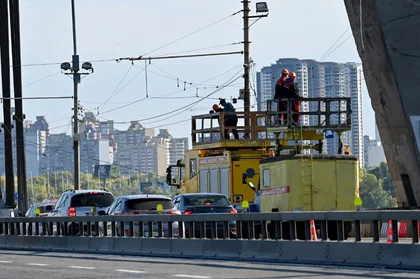

Ukraine launched a massive overnight drone attack on Moscow and the surrounding area, with one of the apparent targets being a major oil depot that supplies fuel to three of the Russian capital’s airports.
Moscow Mayor Sergei Sobyanin said 650 drones were launched toward Moscow between the evening of October 5 and the morning of October 6. Russian air defenses claimed to have destroyed most of them before they reached the city, including 105 drones on the approaches to Moscow.
JOIN US ON TELEGRAM
Follow our coverage of the war at @Kyivpost_official.
Moscow Oblast Governor Andrei Vorobyov said 185 drones were intercepted overnight. More than ten private houses were damaged in Istra, in the village of Lobanovo and in the locality of Radumlya, he said.
“Six people were injured. Unfortunately, there is one dead,” Vorobyov said.
One of the apparent targets was the Volodarskaya Line Production and Dispatch Station (LPDS), described by Russian investigative newspaper Astra as the largest oil depot in the Moscow region.
The facility is operated by Transnefteprodukt, part of Russia’s state-owned oil pipeline company Transneft. It can process up to 3 million tonnes of petroleum products per year, including gasoline, aviation fuel and diesel.
Fuel from the facility is supplied to Moscow’s three main airports – Vnukovo, Domodedovo and Sheremetyevo.
The reported strike came just days after Ukraine attacked another major Transneft facility in Russia.

Other topics of interest
Debris from Russian drones falls on Kyiv, setting cars on fire
Two cars were destroyed and a third damaged by falling drone debris in Pecherskyi, while another incident was reported in Solomianskyi.
On October 2, Ukrainian forces struck the Samara LPDS in Samara Oblast, Russia’s largest oil center, according to Russian media. A fire broke out at the establishment following the attack.
The Samara facility has 71 storage tanks with a combined capacity of more than 1.6 million cubic meters and serves as a junction for four major oil pipelines.
Russian Deputy Prime Minister Alexander Novak also said Ukrainian forces attacked four Russian oil refineries on the night of October 2, although he did not identify the facilities.
Novak said Russian authorities and oil companies had increased security around refineries and were considering additional support measures for the oil processing sector, including extending deadlines for planned modernization projects.
The attacks come as Ukraine increasingly targets Russian oil infrastructure, a key source of revenue for Moscow and a vital part of the country’s fuel supply system.
On Monday, October 5, US President Donald Trump once again blamed the rise in gasoline prices on Ukrainian strikes against Russian oil refineries, arguing that disruptions linked to the war with Iran were no longer the main factor.
“What’s driving up the gas is no longer the Strait of Hormuz,” Trump wrote on Truth Social, saying record volumes of oil were now flowing through the waterway. Instead, he pointed to Russian refineries “being destroyed by Ukraine” as the driving force behind the price rise.
Trump also blamed refinery shutdowns in Democratic-led states. His comments come on the eve of next month’s US midterm elections, as Republicans fight to retain control of Congress.
Gn world