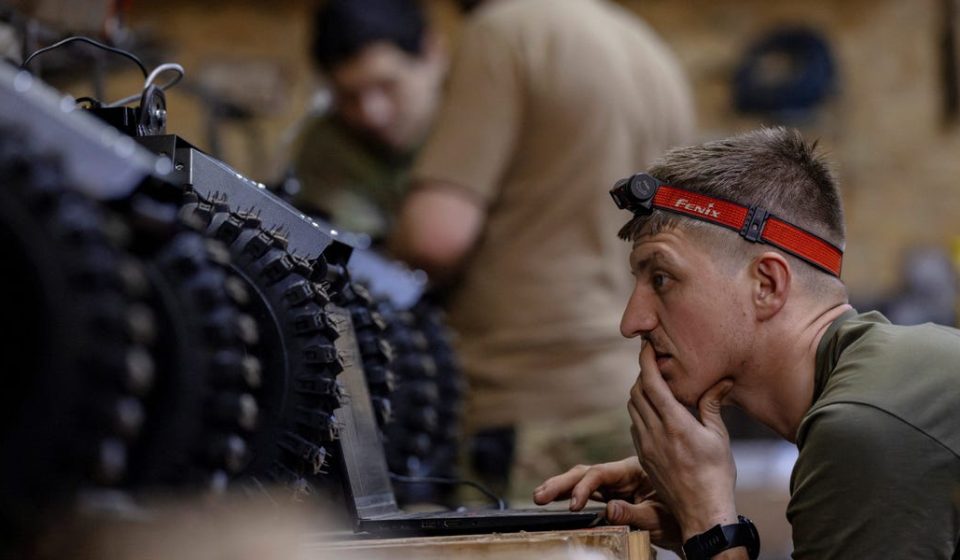

In northern Donetsk, Ukraine’s Third Army Corps uses a network of aerial and ground drones to deploy and clear minefields while attacking Russian lines.
These missions are part of its recent large-scale offensive, Operation Vivaldi, which has so far reportedly seized about 50 square miles around the town of Lyman.
The corps said ground drones, capable of carrying heavy payloads and operating in more dangerous areas, significantly reduced the time to lay mines. A single drone can deploy a minefield more than 1,300 feet deep in two days, whereas a human crew would have taken two weeks.
A commander of the 96th Corps Support Battalion, Maj. Serhii Tischenko, explained to Business Insider how the operation is run, including how troops prefer to split sapper and attack operations depending on the time of day.
“It is definitely better to operate at night, because the enemy cannot see our UGVs,” said Tischenko, whose battalion supports the 125th Separate Heavy Mechanized Brigade and the 60th Mechanized Brigade.
Ground drones, or unmanned ground vehicles, are most often tracked or wheeled platforms, designed to carry up to 400 kg, or about 880 pounds.
They are silent on the battlefield, Tischenko explained, and so it is common for the Third Corps to clear mines at night and then launch assaults during the day.
“It is more convenient to conduct assault operations during the day because the enemy uses a lot of FPV drones, and during the day we can detect them more easily,” he added.
Ground drones play a vital role here, Tischenko said, because an assault trooper seeing one ahead gives him clarity and reassurance that the coast is clear.
“They can continue to advance without constant fear of being seriously injured by a mine. This is extremely important during an assault,” Tischenko said.
The 96th also uses drones for mining operations, he said, which mainly helps slow the Russian advance and give the Ukrainians time to react.
Besides ground-based drones, Tischenko said his unit also deployed heavy aerial bombers – typically hexacopters that can carry up to 40kg – to lay dozens of mines at a time.
“A single heavy bomber can drop up to 40 antipersonnel mines on a specific area,” Tischenko explained.
On a typical night, a heavy bomber crew can be seen flying five sorties at ranges of up to 10 km, or just over six miles, the commander added. On average, a mining team in his battalion could conduct about 130 sorties per month, he said.
Smaller aerial drones can also drop explosive charges to clear Russian minefields, Tischenko said.
“And it produced significant results. We disorganized and demoralized the enemy and its assault groups,” said Tischenko, who added that his unit carried out mining missions along about 18 miles of the front lines during Operation Vivaldi.
Ukraine has spent a year and a half heavily promoting the use of unmanned ground vehicles, which its officials often call “robots,” as a way to minimize human exposure to the most dangerous front-line missions.
Unlike soldiers, ground drones do not tire or lose focus, making them perfect for meticulous undermining work, Tischenko added.
More importantly, they can be repaired when damaged or destroyed, he added.
“A human life, once lost, cannot be restored. We would rather spend money on UGVs than risk the lives of our soldiers,” the commander said.
Gn world